Lila Myth Meaning & Symbolism
A king, granted a vision of an alternate life by the goddess Saraswati, awakens to question the nature of his own reality and the dreamer behind it all.
The Tale of Lila
Listen, and let the veil between worlds grow thin. In a time when kings were philosophers and gods walked just beyond the edge of sight, there ruled a sovereign named Padma. His kingdom was prosperous, his rule just, his life a tapestry of duty and pleasure woven with golden thread. Yet, in the quiet hours, a whisper haunted him—a question that gnawed at the foundations of his certainty. "Is this all there is? Is this reality, or merely a convincing dream?"
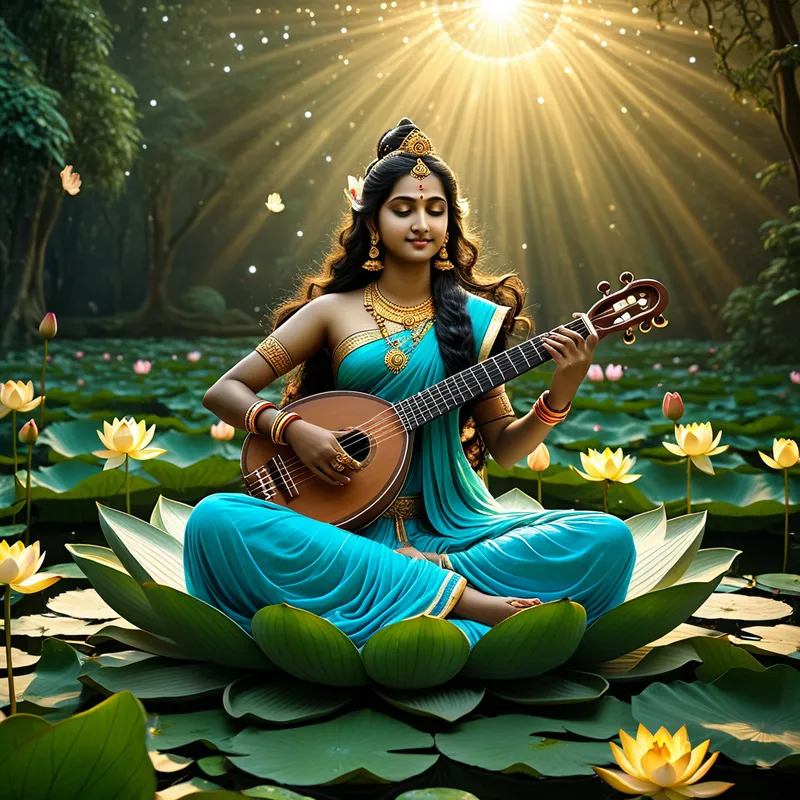
One evening, as the scent of night-blooming jasmine filled the palace gardens, Padma poured out his soul in prayer to Saraswati, she who holds the keys to all understanding. Moved by the sincerity of his existential thirst, the goddess appeared, not with thunder, but with the soft luminescence of a pearl. "You seek to know the nature of reality, King," she said, her voice like the murmur of a sacred river. "Then you shall have a vision. A Lila. You will live another life, in its full and painful detail, and see what you learn."
With a touch of her hand upon his brow, King Padma fell into a deep slumber. And in that sleep, he dreamed. But this was no ordinary dream. It was a world of solid stone and aching bone. He was no longer a king, but a humble Kumbhakara, a potter named Madhu. He felt the coarse clay beneath his nails, the ache in his back from the wheel, the sharp tang of poverty. He married, loved a woman, knew the joy of children and the searing grief of their loss. He lived an entire human span—decades of struggle, small triumphs, profound sorrows, and fleeting joys—all within the space of a single palace night.
As the potter Madhu lay on his deathbed, an old, tired man surrounded by weeping family, the vision dissolved. Padma awoke with a gasp, back in his royal bed, the morning sun painting his chambers gold. But the king was gone. In his place was a soul shattered by the weight of two lives. The memory of the potter’s calloused hands was as real as the silk sheets he clutched. The love for his dream-wife and dream-children burned in his heart with undiminished ferocity. Which life was the dream? Which was real? He stumbled through his palace, a ghost in his own kingdom, seeing the faces of courtiers as fleeting masks, touching marble pillars that felt like insubstantial mist.
In his torment, he cried out again to Saraswati. The goddess manifested once more, a serene island in his sea of confusion. "Great King," she asked, "for whom do you grieve? For the potter Madhu, or for yourself?"
Padma, his voice broken, replied, "O Goddess, I am utterly confounded. I grieve for Madhu, his life, his loves, his death. That life was as real as this one. Which of these is true? Which is the dream?"
Saraswati smiled, a smile that held the patience of eternity. "Consider this, wise one. If the dream-life of the potter felt utterly real to the dreaming king, then what of this king's life? To whom does this seem real? Who is the dreamer here, Padma? And who is the dream?"
With those words, a silent explosion of understanding bloomed within him. The boundary between the two lives, between dream and wakefulness, dissolved not into nothingness, but into a vaster, more mysterious ground of being. He saw not two falsehoods, but two expressions of a single, ineffable consciousness at play. His grief did not vanish, but was transmuted into awe. He bowed his head, not in answer, but in radiant, silent wonder at the question itself.

Cultural Origins & Context
The story of King Padma’s Lila is not found in the grand, epic Itihasas, but resides in the profound philosophical strata of the Yogavasishtha, also known as the Maharamayana. This vast text, a dialogue between the sage Vasishtha and a young Prince Rama, is a compendium of stories designed to illustrate the nature of reality, consciousness, and liberation.
The myth of Lila served a specific societal and pedagogical function. In a culture with a highly structured social order (varna) and prescribed life stages (ashramas), this story acted as a philosophical solvent. It was told not to encourage neglect of worldly duty, but to provide a transcendent perspective from which to perform it. It was a tool for the spiritual elite and the sincerely seeking to cultivate vairagya—not a cold indifference, but a freedom from being psychologically enslaved by one’s own life-drama. It transformed daily experience from a fatalistic sentence into a participatory art form.
Symbolic Architecture
At its core, the myth dismantles the tyranny of a single, monolithic "reality." King Padma represents the individual ego-consciousness, which believes itself to be the sole author and experiencer of a fixed, objective life. The potter Madhu is the "other," the seemingly separate reality, the path not taken, the shadow life. Saraswati is the activating principle of wisdom (prajna) that orchestrates the experience, not to confuse, but to enlighten.
The most potent illusion is not the dream, but the unshakable conviction that the waking state is not one.
The entire narrative is a map of Maya. Maya is not mere "illusion" as falsehood, but the divine creative power that manifests the phenomenal world. Padma’s journey is the process of moving from being a captive within the projection to recognizing oneself as a facet of the projector. The two lives are not hierarchical; the king’s life is not "more real" than the potter’s. They are parallel expressions, equally valid and equally transient dramas within the cosmic consciousness.
Psychologically, this represents the ego’s confrontation with its own constructed nature. We all live a "life story" we believe to be fundamentally true. The Lila challenges this, asking: what if your deepest sorrows, your defining triumphs, your very identity, are but a compelling role in a play? The ensuing disorientation—Padma’s crisis—is the essential death of naive realism, a prerequisite for psychological and spiritual growth.

The Dreamer's Resonance
In the modern dreamscape, the myth of Lila manifests not as a literal dream of being a king or a potter, but through specific, haunting patterns. To dream of living an entire, detailed alternate life—falling in love, building a career, growing old—and then waking with its emotional residue clinging to you, is a direct somatic echo of Padma’s experience. More commonly, it appears as dreams of déjà vu so intense it feels like memory, or of meeting a stranger who feels more familiar than your own family.
These dreams signal a psychological process of de-identification. The psyche is attempting to loosen the ego’s absolute identification with a single narrative of self. The somatic feeling is often one of profound disorientation upon waking, a literal "loss of footing" in one’s own life. This is not a pathology, but a potential initiation. The dreamer is experiencing the fluidity of consciousness itself, brushing against the truth that the "I" they take to be solid is more akin to a character being dreamed into being by a deeper, wider awareness.

Alchemical Translation
The alchemical work modeled by the Lila is the transmutation of literal suffering into meaningful awe. For the modern individual, the "kingdom" is the curated identity—our job titles, relationships, personal history, and self-concept. The "potter’s life" is all we have repressed, denied, or deemed "not me": the forgotten dreams, the unlived potentials, the shadow aspects, even the traumas that seem to define us.
Individuation is not about becoming a better king or a better potter, but awakening to the consciousness that dreams them both into existence.
The process begins with the "Saraswati moment"—a piercing insight or crisis that questions the solidity of our reality. This is the call to adventure. The ensuing "dream"—the exploration of therapy, shadow work, active imagination, or profound introspection—is the descent into the alternate life, the Madhu within. This is the nigredo, the dark night where the old ego-kingdom collapses under the weight of new, contradictory truths.
The resolution is not a choice between lives, but the conjunctio oppositorum—the sacred marriage of opposites. It is the realization Padma reaches: a state of witness-consciousness that can hold both the king and the potter, both the success and the failure, both the joy and the grief, without being exclusively identified with any of them. The grief is not erased; it is alchemized from a personal wound into a universal note in the symphony of existence. The individual ceases to merely live their life and begins, consciously, to dream it, participating in their own Lila with a newfound sense of creative responsibility and sacred wonder. The goal is liberation not from the world, but within it, as a lucid dreamer in the divine play.
Associated Symbols
Explore related symbols from the CaleaDream lexicon: