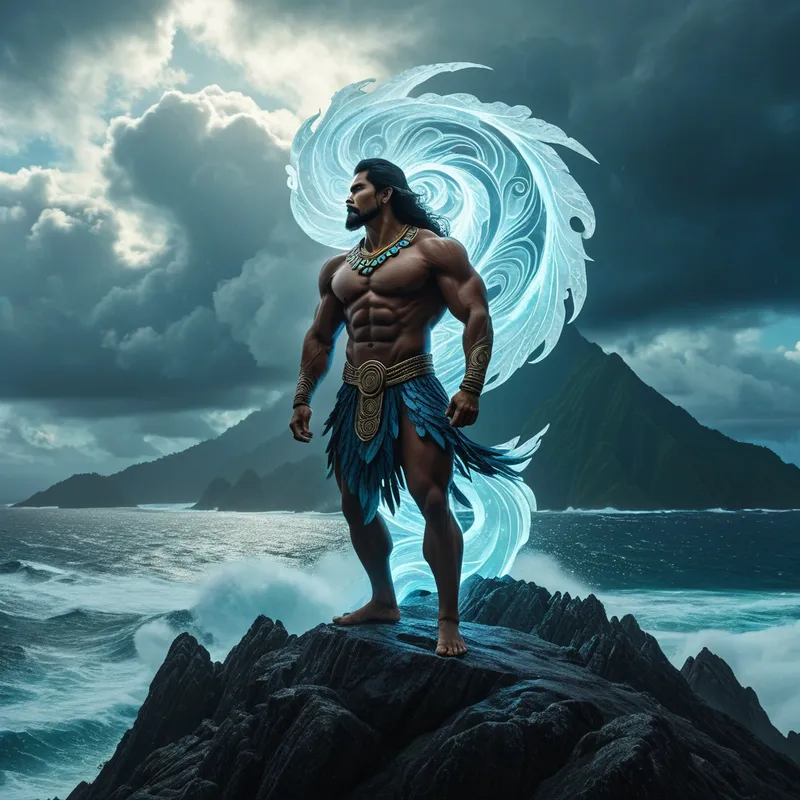
Lihangin Myth Meaning & Symbolism
A myth of the wind god Lihangin and the sea goddess Lidagat, whose union and separation births the world and the human condition.
The Tale of Lihangin
Listen, and hear the story whispered on the breeze that sighs across the waves. In the time before time, when the world was a vast, silent canvas of deep blue, there existed only the great, empty Kaluwalhatian and the boundless, restless Dagat. From the breath of the sky was born Lihangin, a being of restless spirit and invisible strength. His body was the gentle caress of the zephyr and the roaring might of the typhoon. From the womb of the sea arose Lidagat, a being of profound depth and fluid grace. Her form was the shimmer of sunlight on calm water and the dark, crushing pressure of the abyss.
Their realms touched at a horizon that was not a boundary, but a threshold of yearning. Lihangin, from his high vault, would send down playful gusts to ripple Lidagat’s surface. In return, she would send up vapors, gifts of her essence, to dance with him in the high air. This courtship was a symphony of elements—a sigh answered by a spray, a roar met by a surge. Their love grew so immense, so fundamental, that it could not be contained in separation. Lihangin descended. He wrapped his airy form around her liquid one on that primordial shore where sky met sea. In their union, the world found its first rhythm: the tide of her breath, the pulse of his heart.
From this sacred mingling were born four children: three sons of fierce power—Likabutan, Libulan, and Adlaw—and one daughter, Lisawa, who carried the sweetness of rain. For a time, the cosmos was a family, whole and complete. But the nature of their origins held a tragic seed. Lihangin was of the sky, Lidagat of the sea. Their essence was a marriage of opposites, not a fusion into one. The very act of creation, of giving life to their children, demanded a terrible price: the dissolution of their own union.
A great stillness fell. Lihangin, his spirit spent and bound by the laws of the primordial world, could no longer maintain his form entwined with his beloved. He was drawn upward, pulled back to the expanse of Kaluwalhatian. Lidagat, her waters heavy with the memory of his touch, receded into the depths of Dagat. They were parted, forever divided by the very horizon that had once been their meeting place. Their children were left in the middle world, the world their love had made tangible—the earth, the sky, the celestial bodies. They became the rulers of this new domain, but their origin was a wound: they were born of a union that could not last, children of a separation that defined existence itself. And so, the wind forever seeks the sea, and the sea forever reaches for the wind, in a longing that shapes every storm and every calm.

Cultural Origins & Context
This myth originates from the Visayan peoples of the Philippine archipelago, a civilization deeply shaped by the sea. It was not written in codices but carried on the breath of the babaylan and the chants of the community. Passed down through generations, it served as a foundational cosmogony—a story explaining not just how the physical world came to be, but the very texture of the human soul. In a world of voyaging, fishing, and storms, the relationship between wind (hangin) and water (tubig) was not mere meteorology; it was the fundamental dialogue of life, danger, sustenance, and travel.
The myth functioned as a philosophical anchor. It explained the inherent duality and longing in life: the joy of connection and the inevitability of loss, the creative power of union and the painful growth born of separation. It established a cosmic genealogy where humans, living on the land born from this drama, inherit this condition of being "in-between," children of both celestial aspiration and earthly, emotional depths.
Symbolic Architecture
At its core, the myth of Lihangin is an archetypal map of consciousness itself. Lihangin represents the spirit, the intellect, the realm of ideas, air, and freedom. Lidagat symbolizes the soul, the emotions, the unconscious, the watery depths of feeling and memory. Their passionate union is the miraculous, creative moment when spirit descends into soul, when conscious awareness engages deeply with the unconscious—the moment of inspiration, profound love, or spiritual epiphany.
The greatest creation is often born from the temporary, sacred marriage of opposites, a union that by its very nature cannot be made permanent in its initial, ecstatic form.
Their forced separation is not a punishment, but a necessity of cosmic and psychic evolution. The spirit cannot remain submerged indefinitely without losing itself; the unconscious cannot be permanently illuminated without losing its mysterious, generative power. Their parting creates the "middle world"—the realm of the ego, the conscious self (represented by their children). We, as individuals, are the products of that fleeting, divine union, tasked with ruling the domain of our own lives, yet forever feeling the pull of our two origins: the call to transcendence (the sky) and the call to immersion (the sea).
The Dreamer's Resonance
When this myth stirs in the modern panaginip, it often manifests as dreams of powerful, elemental unions followed by wrenching separations. One might dream of embracing a lover made of water or mist, only to have them dissolve. One might be a figure of wind, trying desperately to hold the shape of a sandcastle against the tide. The somatic experience is one of tearing, of a fundamental force pulling the dreamer apart in two directions.
Psychologically, this signals a profound process at work: the aftermath of a deep psychological union. This could be the end of a transformative relationship, the integration of a major insight that now requires living in its new reality, or the necessary distancing from a complex or identity that once defined you. The dream is the psyche processing the grief and disorientation of that separation, which is not an end, but the birth pangs of a new level of being—the "children" or new psychic structures that must now be governed.
Alchemical Translation
The individuation journey modeled here is not one of final, static unity, but of learning to hold the tension of the opposites. The goal is not to force Lihangin and Lidagat back into a single form, but to become the world that their love created—the conscious self that contains both their natures.
The initial descent of spirit into soul (the love affair) is the nigredo, the darkening, the immersive engagement with the unconscious that is both blissful and chaotic. The separation is the albedo, the whitening, the necessary distillation and clarification. The children—Likabutan (conscious order), Libulan (reflective intuition), Adlaw (guiding ideals), and Lisawa (empathetic feeling)—are the new, differentiated psychic functions born from the process.
The mature soul does not seek to permanently reside in the ecstatic union, but to become the fertile land that exists because of it, watered by memory and illuminated by aspiration.
For the modern individual, this means honoring the creative, unifying moments of profound connection or insight, while also accepting that they initiate a cycle. We must allow the "wind" of our spirit to rise again to gain perspective, and allow the "sea" of our soul to return to its depths to integrate. Our wholeness lies in acknowledging we are the living bridge, the horizon itself, where this eternal dialogue continues to generate the weather of our inner lives.
Associated Symbols
Explore related symbols from the CaleaDream lexicon:
- Sky — Represents the realm of Lihangin, the spirit, transcendence, freedom, and the father principle of distant authority.
- Ocean — Represents the realm of Lidagat, the soul, the unconscious, emotional depth, and the mother principle of generative mystery.
- Separation — The core dynamic of the myth, representing the necessary distance that allows for individual consciousness and the birth of the tangible world from intangible love.
- Union — The primordial, creative act between wind and sea that establishes the pattern of all creation arising from the coming together of opposites.
- Wind — The essence and body of Lihangin, symbolizing invisible force, breath, spirit, communication, and restless movement.
- Water — The essence and body of Lidagat, symbolizing emotion, fluidity, the unconscious, life, and adaptive change.
- Horizon — The liminal space where sky and sea meet and yearn for each other, representing the human condition of existing between spirit and soul, aspiration and immersion.
- Children — The offspring of the union, symbolizing the new psychic structures, conscious realities, and responsibilities born from a profound inner marriage that then separates.
- Longing — The eternal emotional state that drives the cosmos in this myth, representing the soul's inherent desire for reconnection with its lost wholeness.
- Storm — The manifestation of the passionate interaction between Lihangin and Lidagat, symbolizing creative turmoil, emotional upheaval, and transformative power.