
Lethe Myth Meaning & Symbolism
The myth of Lethe, the river of forgetfulness in the Greek underworld, explores the soul's need to forget before rebirth.
The Tale of Lethe
Listen, and let the mists of Hades gather around you. Beyond the final gate, past the mournful fields where the insubstantial shades wander, flows a river not of water, but of silence. This is Lethe, the Stream of Oblivion. Its currents are not cold, but cool as a forgotten thought; its surface does not ripple, but holds a perfect, milky calm.
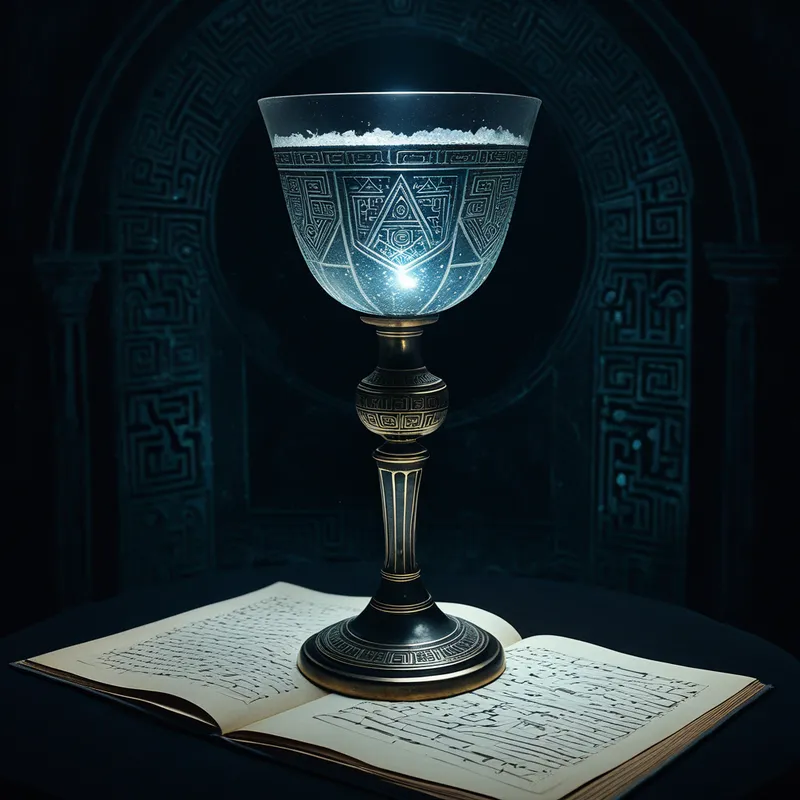
Here, in this hushed realm, the newly dead arrive, still clinging to the echoes of their lives—the sting of a betrayal, the warmth of a last embrace, the weight of a name. They are led, not by the stern Charon, but by quiet attendants, to this placid bank. A simple cup is offered, fashioned from the clay of the underworld itself. To drink is not a command, but an inevitability, the final act of a finished story.
One shade, still shimmering with the ghost of its earthly passion, resists. It clutches at the memory of a face, a voice. “If I drink,” it whispers to the silent air, “do I cease to be?” The river offers no answer, only its profound, inviting stillness. The shade’s fingers tremble. To remember is agony, a chain tethering it to a world it can no longer touch. The weight of a lifetime—its joys now hollow, its griefs now sharp as broken glass—becomes unbearable. With a sigh that is the last echo of its former self, it accepts the cup. The liquid is tasteless, weightless. As it passes the lips, a gentle dissolution begins. The cherished face blurs, the beloved name slips away into a soft, white noise. The knot of identity, so fiercely held, loosens thread by thread. The shade’s eyes, once bright with memory, grow calm and empty. It turns from the river, its step lighter now, and drifts toward the plain of Asphodel, where it will wait, a blank page, for the whisper of a new beginning. Lethe has done its work. The soul is unburdened, cleansed, and ready for the wheel of fate to turn once more.

Cultural Origins & Context
The myth of Lethe is woven into the deepest fabric of Greek eschatology—the doctrine of the soul's final things. It finds its most detailed exposition in Plato’s Republic, in the Myth of Er, and is a fixture in poetic descriptions of the underworld by writers like Virgil in his Aeneid. Unlike the more dramatic rivers Styx or Phlegethon, Lethe represented a quieter, more profound necessity.
Its function was societal and philosophical. For a culture deeply concerned with kleos (glory) and memory among the living, Lethe presented the ultimate paradox: in death, all glory is erased. This served as a humbling, equalizing force. More importantly, within the Orphic and Eleusinian Mysteries, Lethe was not an end, but a crucial part of a cycle. Souls were believed to reincarnate. To be born anew, they had to forget their previous lives, their sufferings, and even their accumulated wisdom. Drinking from Lethe was a necessary purification, a psychic reset mandated by the cosmos itself. It was a myth that answered the human fear of eternal, unbearable memory and offered a form of mercy within the austerity of the afterlife.
Symbolic Architecture
Lethe is far more than a geographical feature of hell; it is a primordial symbol of the mind’s own necessary function of dissolution. It represents the via negativa of consciousness—the path of un-knowing, of release.
To become new, the old self must first become nothing. Forgetting is the womb of potential.
Psychologically, Lethe symbolizes the unconscious itself—not as a storehouse of repressed trauma (though it holds that too), but as a vast, neutralizing medium. It is the psychic process that allows acute pain to dull into ache, and then into a faint scar. It is what enables us to sleep, to let go of the day’s burdens. Lethe is the necessary shadow to Mnemosyne (Memory). Without the capacity to forget, memory would be a torturous, unending present. Identity would become a rigid, unbearable monument. Lethe offers the mercy of fluidity, the grace of release from the tyranny of a fixed narrative.
The act of drinking is the ultimate surrender, a voluntary relinquishment of the ego’s most prized possession: its story. It symbolizes the profound truth that holding on can be a greater hell than letting go.
The Dreamer's Resonance
When the waters of Lethe flood the modern dreamscape, they rarely appear as a classical river. Instead, the dreamer encounters the experience of Lethe. They may dream of losing their name, of looking in a mirror and seeing a stranger’s face, or of being in their childhood home that feels familiar yet utterly alien. They may find themselves trying to read a crucial letter or book, but the words blur and dissolve as they touch the page. These are dreams of ontological dissolution.
Somatically, this can feel like a terrifying free-fall, a loss of grounding. Psychologically, it signals a deep process underway: the deconstruction of an outworn identity. The psyche is initiating a necessary forgetting. Perhaps a long-held self-concept (“I am a victim,” “I am this profession,” “I am defined by that relationship”) has become a prison. The Lethe-dream announces that the old contract is being voided. The ego is being asked, or forced, to release its grip on a defining narrative. It is a frightening but sacred process, indicating the soul’s preparation for a rebirth that the conscious mind cannot yet conceive.

Alchemical Translation
In the alchemy of individuation—the process of becoming one’s whole, unique self—the journey to Lethe is the essential stage of solutio (dissolution) and mortificatio (putrefaction). It is the dark night of the soul where all former structures, achievements, and even cherished identities are broken down into their prima materia.
The ego must taste the waters of oblivion to discover it is not the water, but the vessel that changes shape.
The modern individual does this not by literal death, but through profound crises: the end of a career, the collapse of a worldview, a devastating loss, or a deep depression. These experiences are psychological encounters with Lethe. They strip away the accrued layers of who we thought we were. In this space, we are forced to surrender our story. This is not a failure, but the core of the mythic pattern. The soul, in its wisdom, knows that the persona must be dismantled for the Self to emerge.
The alchemical goal is not to remain in Lethe’ blankness, but to pass through it to the other side. In Plato’s myth, souls drink from Lethe before choosing their next life. Thus, the modern translation is this: after the necessary forgetting—after the dissolution of the old “I”—comes a moment of pristine, unburdened choice. From the cleared ground of the Self, freed from the compulsions of past traumas and identities, one can then drink from the Mnemosyne, not to reclaim the old life, but to remember one’s essential, archetypal nature and choose anew. Lethe, therefore, models the ultimate act of psychic courage: to consent to oblivion, trusting that on the far side of forgetting lies not annihilation, but the possibility of a more authentic becoming.
Associated Symbols
Explore related symbols from the CaleaDream lexicon:
- Bubbling Brook
- Cushion
- Streaming Service
- Melted Ice Cream
- Chilled Lemonade
- Smithsonite Gem
- Howlite Driftstone
- Smithsonite Stone
- Forgotten Reptile
- Glistening Iceberg
- Nostalgic Photograph
- Chalkboard Eraser
- Plush Throw Pillows
- Velvet Cushion
- Fabric Recliner
- Eraser Fantasy
- Celestial Eraser
- White-Out
- Lingering Scent
- Drowning Sorrows
- Fuzzy Memory
- Fleeting Memory
- Cascading Waterfalls
- Glimmering Stream
- Cave Waterfall
- Water Source
- Ganges River
- Tepid Water
- Dripping Water
- Memory Leak
- Dissociation Wave
- Laminar Flow
- Lapse
- Lymph
- Numbness
- Anesthesia
- Sliding
- Dampness
- Apathy
- Cerebrospinal
- Synovial
- Forgetting
- Amnesia
- Bland
- Mellow
- Cooling
- Pickled
- Musty
- Stale
- Molasses
- Chlorine