Legba Myth Meaning & Symbolism
The story of the divine linguist who stands at the crossroads, holding the keys to communication, destiny, and the space between all worlds.
The Tale of Legba
In the time before time, when the world was still wet with creation, the gods lived close to the earth. The sky was a blanket held taut by the mountains, and the language of the spirits was the wind in the leaves. But a great silence threatened this vibrant world. For while the mighty Bondye had forged all things, and the radiant Lwa each governed their domains—the oceans, the forests, the forge, the love in the heart—they could not speak to one another. Their tongues were as different as fire is from water. The world was a chorus of beautiful, isolated songs, and harmony was impossible.
This silence bred confusion. The rains fell when the earth needed sun. The seeds slept when the soil called for growth. Humanity stumbled, receiving blessings meant for the wild and warnings meant for the depths. The cosmos was a palace of locked rooms, and the keys had been scattered at the dawn.
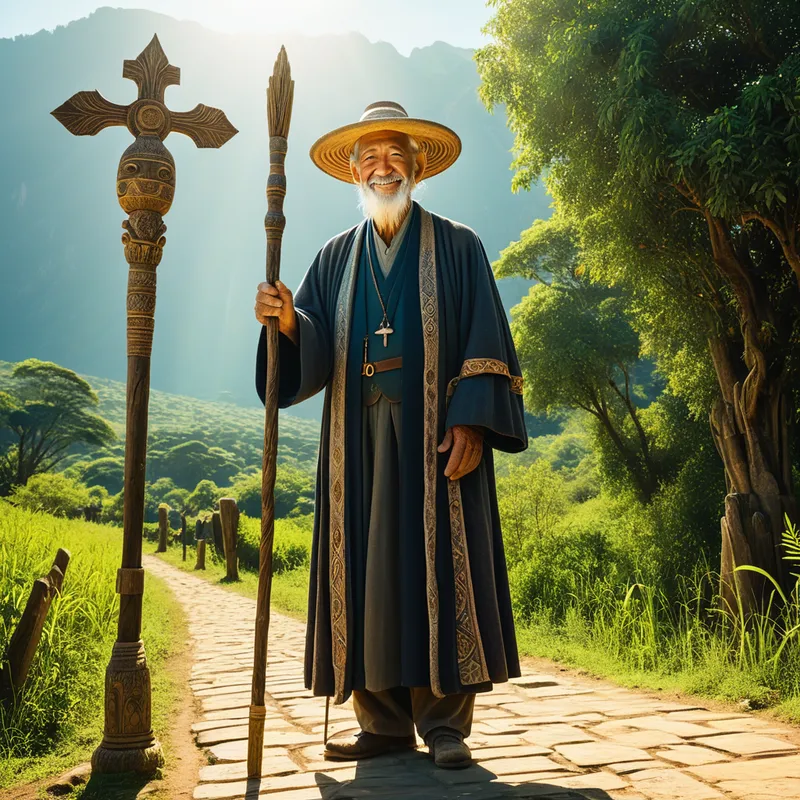
In a humble village that existed in all villages, there lived an old man. He was not the strongest, nor the most regal. He walked with a staff, his back bent as if carrying a great weight, and his clothes were a tapestry of patches, each a story from a different realm. He was known as Legba. While others sought power in a single domain, Legba wandered. He sat at the fire with hunters, learning the language of the arrow's flight. He knelt in the marshes, understanding the gossip of the reeds. He listened to the blacksmith's hammer until he heard the iron's secret name, and he watched lovers until he decoded the silent grammar of their glances.
He became the repository of tongues. He knew how to ask the river for passage in the river's own voice. He could argue with a storm in the crackling dialect of lightning. But his true place was not in the village center, nor in any single god's court. His place was between. He took his staff and walked to where three paths met—the road from the village, the path into the wild forest, and the thin track that led to the unseen world. This crossroads was neither here nor there, a place of pure potential.
There, he planted his staff and waited. When Ogou sought to declare war on the sea, his fiery proclamations hit an invisible wall at the crossroads. Legba stepped forward. He did not command Ogou to stop; instead, he took the god's searing words and cooled them, shaped them, translated their heat into a language the ocean spirit, Lasirèn, could understand—a language of deep currents and echoing caves. Conflict dissolved into a negotiation of boundaries.
When the people's prayers to Bondye rose up like smoke, they fragmented, lost in the vastness. Legba, at his crossroads, caught these fragments. He gathered the scent of their offerings, the rhythm of their drums, the color of their hope, and wove them into a single, coherent plea in the silent language of divine attention. And when the blessings from above descended, vast and incomprehensible, it was Legba who broke them into a thousand smaller, understandable miracles—a timely rain, a child's laughter, a successful hunt.
He asked for no throne. His power was the key, not the kingdom. The gods, realizing the harmony he facilitated, granted him the first offering, the first prayer, the first step in any ceremony. For without the Opener of the Way, nothing could begin, and nothing could move between worlds. The silence was broken, not by a single loud voice, but by the humble, essential whisper of translation at the crossroads.
Cultural Origins & Context
The figure of Legba originates in the spiritual systems of West Africa, particularly among the Fon and Ewe peoples, where he is known as Elegba or Eshu. With the catastrophic displacement of the Transatlantic Slave Trade, this deity did not fade; he transformed and endured. Enslaved Africans, stripped of their physical homeland, carried their spiritual geography within them. In the crucible of the Caribbean and the Americas—in Haiti (Vodou), Cuba (Santería, where he is syncretized with Saint Anthony or the Holy Child of Atocha), Brazil (Candomblé), and beyond—Legba became a crucial figure of cultural survival.
He was the mythic embodiment of adaptation, the master of the new linguistic and social "crossroads" forced upon a diasporic people. His myth was not merely told; it was performed in ritual, invoked in song, and embodied in dance. Societally, Legba fulfilled a profound function: he modeled how to navigate an oppressive, foreign world. He represented the necessary cunning, linguistic dexterity, and spiritual agency required to communicate, to negotiate between the world of the enslaved and the world of the spirits (and often, by metaphor, the world of the enslavers). He was the guardian of the community's connection to its ancestral roots and its divine sources of power, ensuring that even in a land designed to silence them, their prayers could be heard and their identity maintained.
Symbolic Architecture
At its core, the myth of Legba is an ode to the principle of connection. He is not the content of the message, but the medium; not the destination, but the necessary passage.
The true power lies not in possessing the secret, but in understanding the lock.
He symbolizes the threshold itself. The crossroads is the ultimate symbol of choice, potential, and crisis—a place where one direction must be chosen, forsaking others. Legba’s presence sanctifies this moment of decision, insisting it is not mere chance but a sacred interface. Psychologically, he represents the ego's function as a mediator between the vast, often chaotic unconscious (the world of the Lwa, the ancestors) and the demands of external reality. He is the faculty that translates raw instinct, intuition, and deep psychic impulse into actionable thought, speech, and behavior.
His trickster nature is essential. He is not a stern, judgmental gatekeeper but a playful, sometimes mischievous tester. He places obstacles in the path not to deny passage, but to ensure the traveler is attentive, respectful, and truly ready for what lies beyond. His deceit exposes self-deception. In this, he embodies the psychological truth that growth often comes disguised as disruption, and that the path to the Self is rarely a straight line.
The Dreamer's Resonance
When the archetype of Legba stirs in the modern dreamscape, it often manifests around moments of decisive impasse or necessary communication. To dream of a crossroads, a locked gate, a lost key, or a misunderstood message can be a somatic signal of this archetype's activity.
The psychological process at work is one of integration and translation. The dreamer may be at a life threshold—a career change, the end of a relationship, a creative beginning—feeling "stuck" because different parts of their psyche are speaking incompatible languages. The ambitious drive shouts one thing, the need for security whispers another, and the soul's longing sings in a third tongue. The Legba dream is a call from the unconscious to take up the mediating staff. It asks the dreamer to become the translator of their own internal conflicts, to find the words (or actions) that can honor all sides and facilitate a movement forward. The anxiety of the crossroads is reframed as a sacred duty: to listen deeply to one's own inner plurality and to consciously choose the path, thereby transforming paralyzing confusion into directed potential.

Alchemical Translation
The individuation journey, the process of becoming psychologically whole, is an endless series of crossings. Legba provides the model for this alchemical work. His myth teaches that the goal is not to become the all-powerful god in the celestial court, but to become the essential function that allows the court to operate—to become the conscious mediator of one's own psyche.
The Self is not found by fleeing the crossroads, but by building an altar there.
The first offering must always be to this principle of awareness. In practical terms, this means before charging into action (Ogou's fire) or retreating into emotion (Lasirèn's depths), we must pause at the internal crossroads. This is the practice of mindfulness, of holding space for contradictory thoughts and feelings without immediately identifying with one. It is the act of "translating" a gut feeling into conscious insight, or a traumatic memory into a coherent narrative.
Legba’s alchemy is the transmutation of chaos into communication, of static conflict into dynamic dialogue. His humble, patchwork exterior signifies that this mediating function is built from all the disparate experiences of a life—the joys, the wounds, the skills, the failures. They are not discarded in the pursuit of some purified, singular identity; they become the very fabric of the translator's cloak. To integrate the Legba archetype is to realize that one's wholeness depends not on eliminating life's paradoxes, but on developing the profound skill to stand at their center, staff in hand, and speak all their names. In doing so, you do not control destiny; you become the willing, conscious participant in its unfolding, opening the way for your own becoming.
Associated Symbols
Explore related symbols from the CaleaDream lexicon: