Laozi Myth Meaning & Symbolism
The enigmatic sage Laozi, on the verge of departing the known world, is compelled to write his timeless wisdom, the Tao Te Ching, before vanishing into the West.
The Tale of Laozi
The world of the Zhou dynasty grew heavy, its rituals brittle, its wars incessant. In the dusty archives of the court, where the records of a fading order were kept, there labored an old man named Laozi. His eyes held the depth of still water, having seen the rise and fall of a hundred ambitions. He was a keeper of secrets so profound they had worn away all desire to speak them.
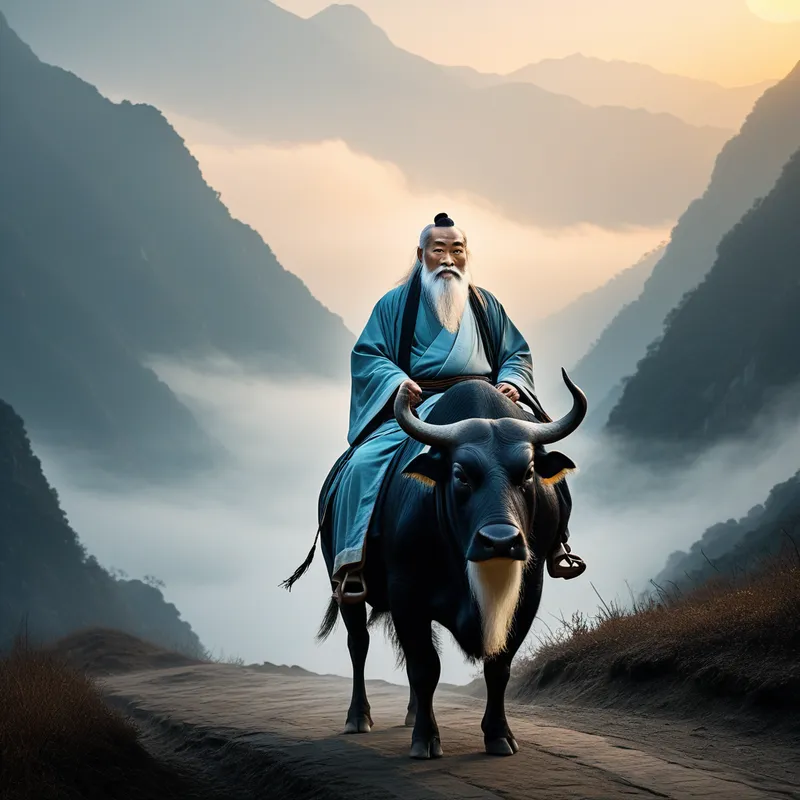
A deep weariness settled in his bones, a knowing that the time for keeping had passed. The Way, the Tao, could no longer be contained within walls of ceremony or the brittle shell of a crumbling kingdom. A pull arose in his spirit, westward, toward the unknown passes and the silent mountains. He requested leave from his post, saddled a black water buffalo—a beast of patient strength and earthy darkness—and turned his back on the world of men.
His journey was a slow unraveling. He moved not as a traveler with a destination, but as a leaf upon a stream, following the current of an inner necessity. The road led him to the Hangu Pass. Here, at the edge of the known world, where the ordered realm met the formless wilderness, stood the gatekeeper, Yin Xi. He was a man of duty, yet his spirit was attuned. He did not see just an old man on an ox; he perceived a radiance, a gathering aura of immense, departing power.
Yin Xi barred the way, not with force, but with a profound request that was also a command of fate. “Master,” he said, his voice cutting through the mountain silence, “you wish to withdraw and hide yourself. But I implore you, for the sake of those to come, leave us a record of your teaching.”
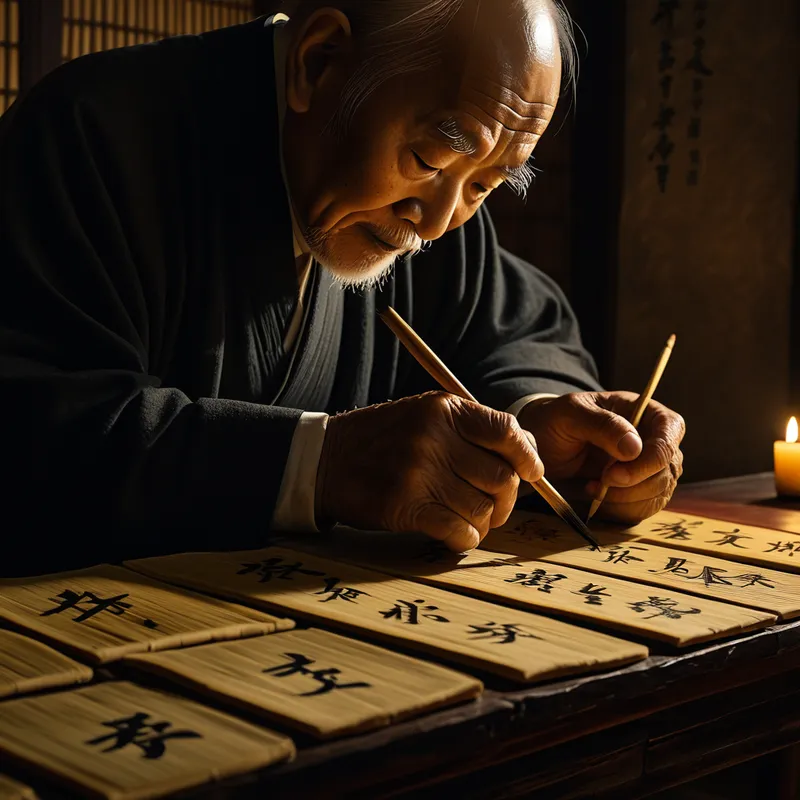
There, in the shadow of the gatehouse, with the wind sighing of distant deserts, Laozi paused. The moment hung between manifestation and dissolution. To speak was to contradict the very Wu Wei he embodied; to remain silent was to let the wisdom vanish like mist. In that tension, the timeless yielded to the temporal. He dismounted, took brush and bamboo slips, and for three days, the scratch of the brush was the only sound. Five thousand characters flowed forth—not a systematic treatise, but a series of paradoxical whispers, a map of the unmappable. He wrote of the Way that cannot be named, of the virtue that comes from emptiness, of governing by not governing.
When the last character was set, the ink still holding the memory of his thought, he handed the slips to Yin Xi. No farewell was spoken. He mounted his buffalo once more, passed through the gate, and faded into the western mists. He was never seen again in the world of forms, leaving behind only the echo of his wisdom and the enduring mystery of his departure.
Cultural Origins & Context
The figure of Laozi emerges from the ferment of the Hundred Schools of Thought, a time of great social upheaval and intellectual fervor. Unlike the meticulously documented histories of Confucius, Laozi’s story is shrouded in myth from its inception. The primary source, the <abbr title=""Records of the Grand Historian" by Sima Qian">Shiji, presents him not as a clear historical figure but as a legendary archetype, perhaps synthesizing the stories of several reclusive sages.
The myth served a crucial societal function for the philosophical tradition that would become Daoism. It provided a sublime origin story for the Daodejing, attributing it not to scholarly compilation, but to a moment of divine compulsion at the threshold of existence. The tale was passed down by Daoist masters and practitioners, for whom Laozi was not merely a philosopher but a manifestation of the Dao itself. His departure symbolized the ultimate Daoist ideal: transcending the political and social fray to merge with the natural, eternal flow of the cosmos.
Symbolic Architecture
The myth is a perfect symbolic vessel for profound psychological truths. Laozi himself represents the integrated Self, the consciousness that has reconciled all opposites and now operates from a center of profound stillness. His role as a Keeper of the Archives is key: he is the custodian of collective cultural knowledge (the conscious ego and persona) who finds it ultimately insufficient.
The sage does not accumulate. The more he does for others, the more he possesses. The more he gives to others, the more he has.
The Hangu Pass is the ultimate limen, the psychological threshold between the conscious world (the ordered state) and the unconscious (the formless west). The black water buffalo is the instinctual, embodied energy that carries consciousness on its final journey toward dissolution into the source.
The pivotal encounter with Yin Xi symbolizes the necessary confrontation with the “gatekeeper” of the psyche—perhaps the inner critic, the societal demand for legacy, or the final aspect of the ego that insists on leaving a trace. The writing of the Daodejing is the ultimate act of Wu Wei: a creation born not from willful striving, but from a surrendered response to a cosmic demand. It is the distillation of a lifetime of wisdom into its essential, paradoxical form, left as a guide for those still navigating the world of duality.
The Dreamer's Resonance
To dream of Laozi’s journey is to dream of a profound psychic transition. One may dream of packing lightly, leaving a job or identity (the archives), or riding a strange, patient animal. The central motif is the compelled pause at the threshold. The dreamer arrives at a border—a literal gate, a shoreline, a door—and is stopped by a figure who demands something of them before they can pass.
This reflects a somatic and psychological process of necessary embodiment before transcendence. The unconscious is signaling that a total withdrawal or escape (vanishing into the west) is not yet possible or authentic. Some part of the life’s essence, its hard-won wisdom, must be consciously articulated and left behind in the world of form. It is the psyche’s insistence that individuation is not a selfish escape, but a process that must ultimately offer something back to the collective, even if that offering is enigmatic and paradoxical.
Alchemical Translation
The myth models the final stages of the individuation process, the alchemical Rubedo or the creation of the lapis philosophorum. The “archives” of the personal history and achievements are reviewed and found to be heavy. The conscious mind (Laozi) feels a powerful pull to return to the unconscious source (the West).
The journey of a thousand miles begins with a single step, but the journey of the soul begins with the cessation of all striving.
The alchemical work happens at the pass. Here, the ego (Yin Xi), instead of being defeated or discarded, is transformed into the essential collaborator. It demands the opus, the great work, in tangible form. The psychic transmutation is this: the raw experience of a lifetime (the prima materia) must be subjected to the fire of existential confrontation and distilled into its quintessence—the concise, potent scripture of one’s own truth.
The final disappearance is not annihilation, but integration. The sage does not die; he “returns to the Tao.” For the modern individual, this translates to achieving a state of being where one’s actions are spontaneously in harmony with the deep currents of life, where the constructed self has become so transparent it allows the impersonal, guiding intelligence of the Self to flow through unimpeded. One vanishes as a separate, striving entity, not into nothingness, but into the fullness of the authentic, effortless life.
Associated Symbols
Explore related symbols from the CaleaDream lexicon: