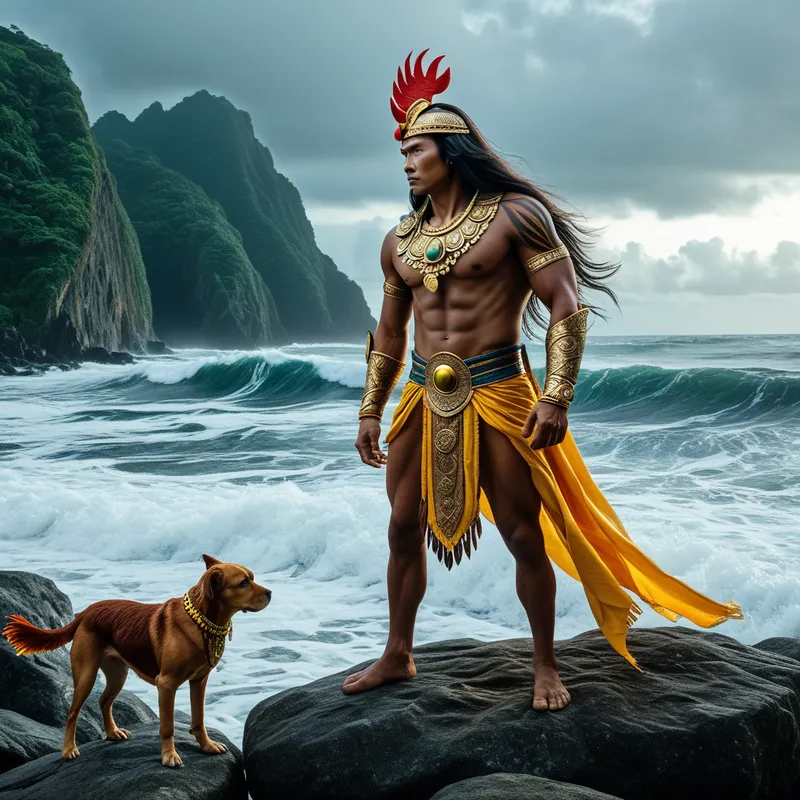
Lam-ang Myth Meaning & Symbolism
A miraculous hero speaks at birth, avenges his father, courts his love with impossible feats, dies, and is resurrected by his animal allies.
The Tale of Lam-ang
Hear now the story that the wind carries from the mountains of the north, from the lands kissed by the South China Sea. It is a tale not of a man, but of a force of nature given human form.
In the village of Nalbuan, a child was born unlike any other. From the womb of his mother, Namongan, he did not cry. He spoke. “Mother,” said the infant, “give me a name. I am Lam-ang. And now, tell me of my father, Don Juan.” He learned that Don Juan had journeyed to the mountains of the Igorot to punish a band of headhunters and had not returned. At nine months old, Lam-ang stood, not a babe but a youth in full strength. He demanded his father’s weapons. His mother wept, but the destiny in his eyes was immutable.
He traveled to the Igorot village, his steps shaking the earth. There, he found not his father, but the truth: Don Juan had been slain, his head taken. A cold fire ignited in Lam-ang. Alone, he faced the entire village of warriors. He fought with the fury of a typhoon, his body anointed with the oil of the basi jar, making him invulnerable. He vanquished them all, leaving not a single enemy standing. From the piled spoils, he retrieved his father’s bleached skull, and a great lamentation rose from him, a sound that made the eagles flee the sky.
His destiny then turned to love. He set his heart upon Ines Kannoyan of Kalanutian, a woman of famed beauty with suitors lining the road to her house. Lam-ang arrived not with quiet humility, but with cosmic announcement. His rooster crowed, and the earth trembled, causing the houses of Kalanutian to lean. His dog barked, and the leaning houses straightened. Ines’s parents were awestruck. Lam-ang’s courtship was a spectacle of impossible prowess: he dived into the deepest, most treacherous part of the Cagayan River to retrieve a precious pearl from the berkakan, and he scaled a impossibly high cliff to gather beeswax from savage hornets. He won her hand.
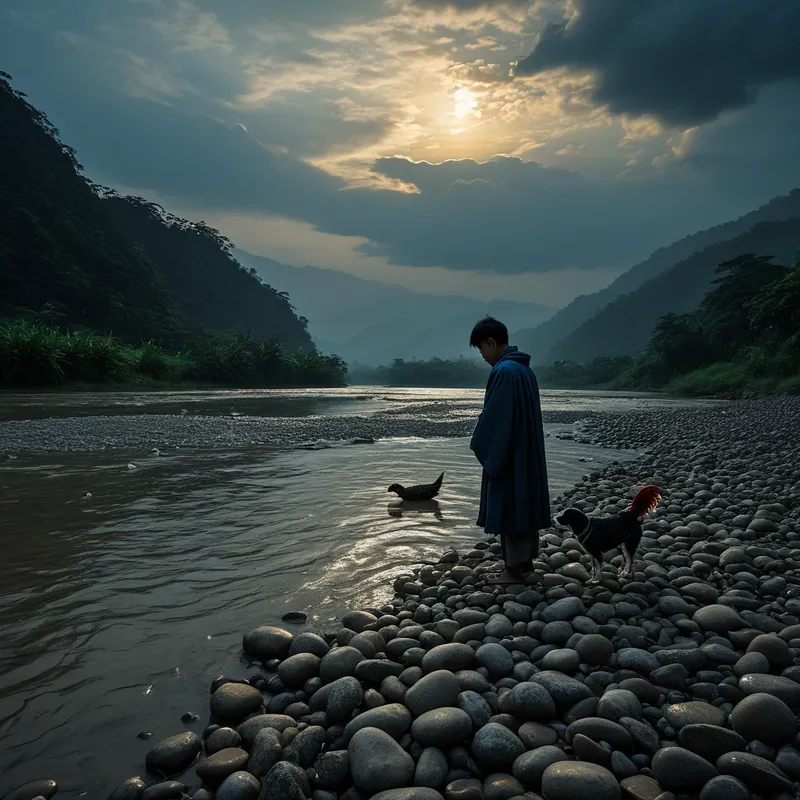
But fate’s wheel turns. To complete a marriage ritual, Lam-ang must cleanse himself in the very river where he triumphed. He entered the waters, but this time, the river’s spirit turned against him. The monstrous berkakan, perhaps an embodiment of all the unavenged dead, surged from the depths. It seized Lam-ang, and before the eyes of his horrified beloved and animal companions, it devoured him whole, leaving not a shred of flesh.
All seemed lost. The world grew dim. But his loyal rooster and dog journeyed back to Nalbuan. They gathered his bones from the riverbed, every last fragment. With the guidance of Lam-ang’s grieving mother, they laid the bones on a mat. The rooster crowed over them. The dog barked over them. And from nothingness, from scattered ruin, flesh knitted itself over bone, breath filled new lungs, and Lam-ang sat up, blinking in the sun, reborn, more vital than before. He returned to Ines, and their union was celebrated for seven days and seven nights, a testament that not even death could sever a destiny so fiercely woven.
Cultural Origins & Context
This epic, known as Biag ni Lam-ang, is the premier epic of the Ilocano people of northern Luzon. Unlike the written epics of other cultures, it lived for centuries in the oral tradition, chanted by village bards or lakan during gatherings, harvest festivals, and rites of passage. It was a living narrative, flexing and adapting with each telling, until it was first transcribed by the Spanish priest and folklorist Isabelo de los Reyes in the late 19th century, and later popularized in a canonical verse form by poet Pedro Bucaneg.
Its societal function was multifaceted. It was a repository of Ilocano ideals: bravery (gaget), loyalty, familial duty, and the pursuit of honor (dayaw). It encoded cultural practices, from courtship rituals to concepts of justice and vengeance. But more profoundly, it served as a cosmological anchor. In a world of spirits, headhunters, and capricious nature, Lam-ang’s story asserted that human will, when aligned with a pre-ordained destiny and supported by loyal allies (both human and animal), could overcome any chaos, even the final chaos of death itself. It was a mythic blueprint for resilience.
Symbolic Architecture
Lam-ang is not merely a strong man; he is the archetypal Hero consciousness erupting into the world. His speaking at birth signifies a psyche born whole, with its purpose and identity already intact. He is a paradox—a divine child in a superhuman body.
The hero’s journey is not outward, but inward; his battles are against the fragmented aspects of the paternal and maternal lineages he carries within.
His vengeance quest represents the necessary, often violent, confrontation with the personal and collective Shadow—the unprocessed trauma (his father’s murder) that haunts the family soul. His courtship of Ines is the pursuit of the Anima, but not through gentle romance. He wins her by mastering the chaotic elements (the treacherous river, the fierce hornets), symbolizing the need to order one’s inner world and prove one’s worth to the soul itself.
His death by the berkakan is the critical moment. The very domain of his previous triumph (the river) becomes his tomb. This represents the inevitable defeat of the heroic ego. No strength, no pre-ordained destiny, can forever stave off the devouring maw of the unconscious, of fate, or of life’s inherent tragedy.
Resurrection is not a reward for the ego, but a gift bestowed by the loyal, instinctual forces of the psyche that the ego once commanded.
The rooster (dawn, announcement, spirit) and the dog (loyalty, instinct, earth) are the salvific agents. They are the neglected, humble parts of the Self that perform the true miracle. The rebirth is not a return to the old, invulnerable Lam-ang, but the creation of a new, integrated being who has tasted dissolution and been remade by forces greater than his own will.
The Dreamer's Resonance
When this mythic pattern stirs in the modern dreamer, it signals a profound somatic and psychological process of death and renewal. To dream of a miraculous, speaking child may point to the emergence of a new, authentic identity breaking through the womb of conventional life. Dreams of a vengeful quest often coincide with a necessary, angry confrontation with a legacy of parental failure or familial trauma that has been silently shaping one’s life.
The central dream image—being devoured by a creature from deep water—is a classic encounter with the Great Mother in her terrifying aspect. It feels like being consumed by depression, anxiety, or a life crisis that strips away all one’s accomplishments and identity, reducing the psyche to its bare bones. The somatic sensation is one of utter dissolution, weightlessness, and despair.
The subsequent dream phase—the gathering of bones by animal helpers—is the slow, often unconscious, work of reconstruction. It is the body’s wisdom and the deep instincts (the dog) beginning the labor of healing, alongside a new conscious perspective (the rooster) that “crows” a new reality into being. The dreamer may awaken from such a cycle not with a sense of victory, but with a quiet, grounded solidity—the feeling of having been utterly unmade and somehow, impossibly, reassembled.

Alchemical Translation
The alchemy of Lam-ang is the opus contra naturam—the work against nature—that becomes a work with nature. It models the process of Individuation in its most dramatic form.
Stage 1 (Calcinatio): The hero’s birth and vengeful fire. This is the burning away of naive identification with the family and tribal complex. The ego is forged in the fire of conflict, becoming distinct and empowered. Lam-ang avenges his father, but in doing so, he differentiates from him.
Stage 2 (Solutio): The courtship and the river dive. The empowered ego must now learn to navigate the fluid, relational world of the soul (the Anima, symbolized by Ines and the river). This is a dissolution of rigid ego-boundaries in service of connection and relatedness.
Stage 3 (Mortificatio): The devouring. This is the essential, humbling crisis. The ego’s project is utterly destroyed. All that remains are the bare, essential structures of the Self—the bones. This is the dark night of the soul, the feeling of psychic annihilation that is a prerequisite for transformation.
Stage 4 (Coagulatio): The resurrection. Here, the work is done not by the heroic will, but by the symbiotic relationship between the instinctual (dog) and spiritual (rooster) allies—the previously servant parts of the psyche. The bones are reconstituted into a new body. This is the emergence of the Self, an entity that encompasses both the ego and the unconscious, mortal yet touched by the eternal.
The ultimate transmutation is not from mortal to immortal, but from a hero who conquers death to a human who incorporates death into his life story, thereby becoming truly whole.
For the modern individual, the myth instructs: you may be born with a destiny, you may achieve great deeds and win your heart’s desire, but you will be devoured by life. Your triumph lies not in avoiding this fate, but in cultivating the loyal, instinctual, and spiritual parts of yourself that will patiently gather your scattered pieces and sing you back into a more complete existence.
Associated Symbols
Explore related symbols from the CaleaDream lexicon:
- Hero — The conscious will and striving ego, destined for greatness but destined, too, for a humbling fall that leads to true integration.
- Death — The essential dissolution of the ego’s identity, a terrifying yet necessary stage of psychic transformation, making way for rebirth.
- Rebirth — The miracle of integration, where the scattered elements of the self are reconstituted by deeper, loyal forces into a new, more whole being.
- River — The flowing, often treacherous, realm of the soul, the unconscious, and emotion; a place of both triumph (retrieving the pearl) and annihilation.
- Bone — The essential, indestructible core structure of the Self that remains after all else has been stripped away; the blueprint for renewal.
- Dog — The archetype of instinctual loyalty, earthiness, and the somatic wisdom that faithfully serves the process of healing and reassembly.
- Journey — The epic, non-linear path of the soul from differentiation (avenging the father) to relation (courting the beloved) to dissolution and ultimate return.
- Destiny — The pre-ordained pattern or calling that guides the individual, which is not a guarantee of easy success but a map for a necessary ordeal.
- Honor — The driving force of the heroic ego, the code that demands action and vengeance, which must ultimately be transcended for deeper love to emerge.
- Mother — The source of life and, through grief and ritual knowledge, a guiding force in the miraculous process of psychic resurrection.