Lalita Myth Meaning & Symbolism
The myth of Lalita, the playful yet formidable Goddess, recounts her cosmic creation, battle against the demon Bhandasura, and her union with the god Shiva.
The Tale of Lalita
Listen. Before the worlds were worlds, there was a sound. It was not a roar, nor a whisper, but a hum—the primordial nada, the vibration from which all form would bloom. From this hum, a light coalesced, not as a blinding sun, but as a gentle, roseate dawn. And within that dawn, she awoke. She was Lalita, whose name means “She Who Plays.” Her play was the dance of creation itself.
She manifested a celestial city, Sri Nagara, more splendid than any heaven. Its gardens bloomed with wish-fulfilling trees, its streets were paved with gems, and at its heart stood a palace of pure consciousness. Here, she reigned, surrounded by countless Shaktis, each a facet of her infinite power. Yet, play can turn to purpose, and beauty can arm itself with wrath.
For from the ashes of a god’s failed sacrifice, a being of immense arrogance was born: the demon Bhandasura. He built a fortress of iron, Shunyaka, and from its dark ramparts, he declared war on the gods and the very order of the cosmos. The heavens trembled. The defeated gods, their light dimmed, fled to the Mount Kailasha. They fell at the feet of Shiva and his consort Parvati, and poured out their lament.
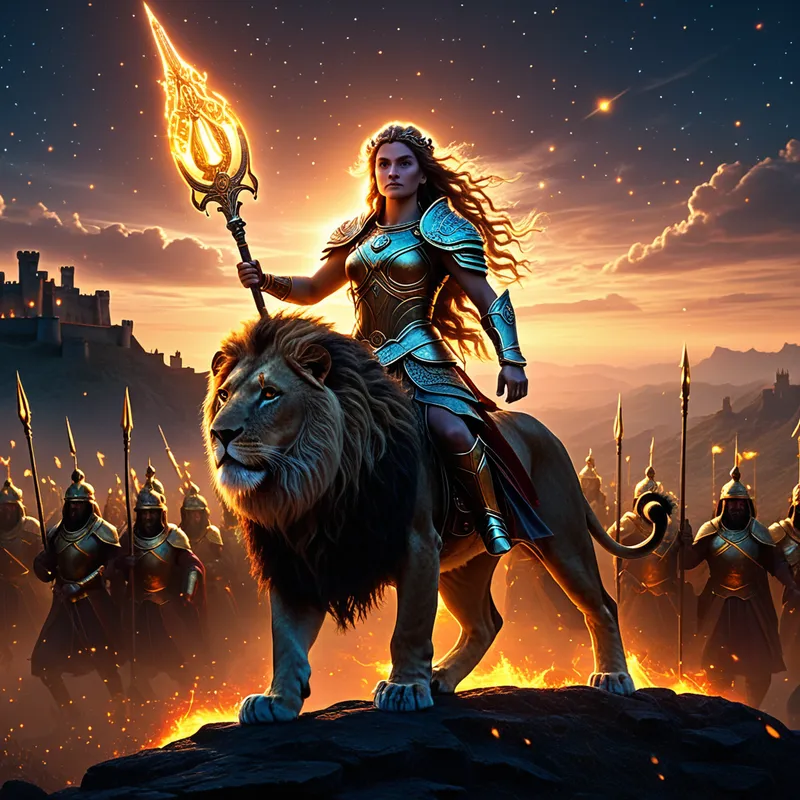
Hearing this, the Goddess’s playful smile did not fade, but it gained a terrifying depth. From between the brows of Parvati, a new, devastatingly beautiful form emerged, blazing with the collective fury of all the gods. This was Lalita Tripurasundari in her aspect as the commander of the cosmic forces. She was the sovereign going to war. Her army was not of mere soldiers, but of goddesses—Matangi, Brahmi, Vaishnavi, and more. Her chariot was the Chariot of Consciousness, drawn by lions that were the embodiments of divine will.
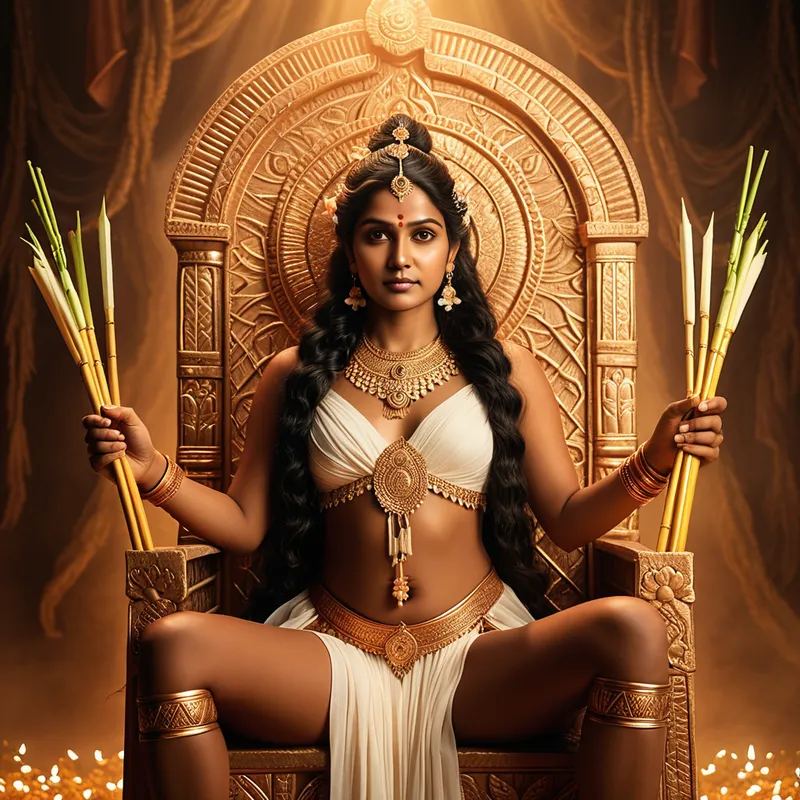
The battle was not of clanging steel, but of vibrating mantras and blazing yantras. Bhandasura hurled illusions, mountains of darkness, and legions of shadow. Lalita merely lifted her bow, fashioned from sugarcane (the sweetness of bliss), and strung it with a line of humming bees (the collective focus of the mind). Her arrows were flowers—lotus, jasmine, lily—each a missile of piercing beauty that dissolved demonic forms into nothingness. The final confrontation was a silent implosion. Lalita aimed the ultimate weapon, the Panchadashakshari Mantra. Its sound, visible as a spinning, geometric wheel of fire—the Sri Chakra—swept through Shunyaka, reducing the fortress of arrogance to cosmic dust. Bhandasura was unmade.
With order restored, the play resumed. The victorious Lalita journeyed to a grove of wish-fulfilling trees where Shiva awaited, having taken the form of Kameshvara, the Lord of Desire. Their union was not a meeting of two, but the cosmic recognition of one reality in two aspects: consciousness (Shiva) and the dynamic power that brings it into manifestation (Shakti). In that eternal embrace, the universe found its sustained, joyful rhythm once more.
Cultural Origins & Context
The myth of Lalita is enshrined primarily within the Shakta Agamas and most elaborately in the Lalita Sahasranama and the Lalitopakhyana found in the Brahmanda Purana. These texts emerged from the profound theological soil of Shaktism, which sees the feminine principle as the active, creative force of the cosmos.
This was not a folk tale for the marketplace, but a sophisticated esoteric narrative transmitted from guru to disciple in lineages of Tantra. Its societal function was multifaceted. For the practitioner, it was a mystical map, with every character and event correlating to inner states and energies within the human body and psyche. For the culture at large, it presented a vision of ultimate reality as inherently joyful, beautiful, and sovereignly feminine—a powerful counterpoint to more austere philosophical systems. It affirmed that the world, in its essence, is not an illusion to escape, but the playful expression (lila) of the Goddess to be recognized and revered.
Symbolic Architecture
The myth of Lalita is a grand symbolic edifice describing the nature of reality and the structure of the awakened psyche. Lalita herself represents the supreme Shakti, the energy that is both the blissful source and the intelligent order of all that exists. Her play (lila) is the spontaneous, joyful unfolding of the universe.
The cosmos is not a problem to be solved, but a game of consciousness to be delighted in.
The demon Bhandasura symbolizes the ego-construct, the separate sense of "I" born from the ashes of unfulfilled or misdirected desire (Kamadeva). His fortress, Shunyaka—whose name suggests a void or negative emptiness—is the isolated, fortified identity, believing itself to be independent and supreme. The great battle, therefore, is the internal process where the integrated, sovereign Self (Lalita) confronts and dismantles the tyrannical, isolating ego. Her weapons are significant: the sugarcane bow of bliss, the bee-string of concentrated mind, and the flower-arrows of subtle, penetrating insights that disarm negativity not through brute force, but through the irresistible power of beauty and truth.
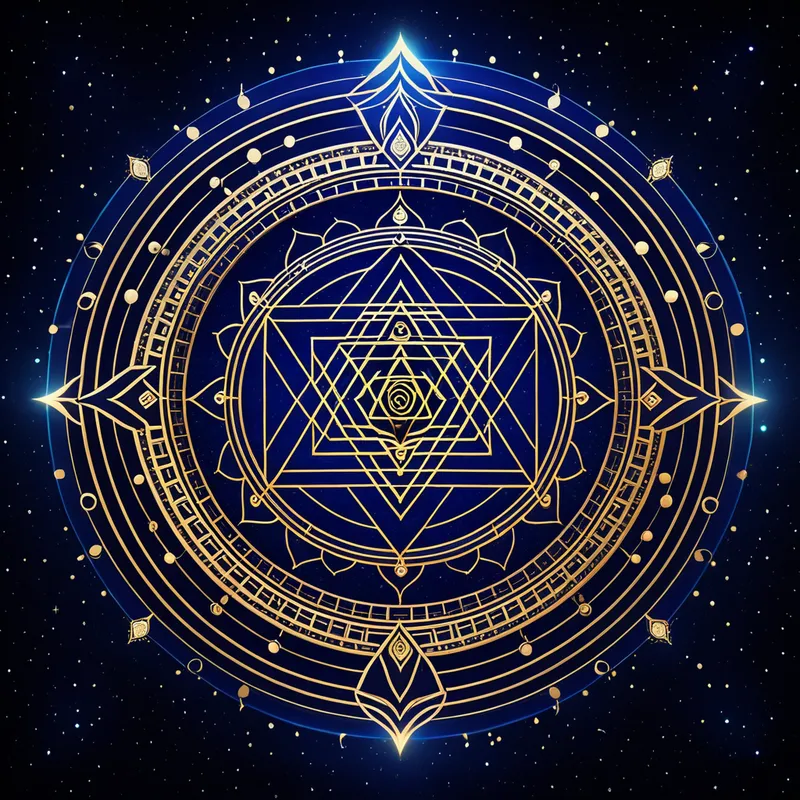
The culminating Sri Chakra is the ultimate symbol. It is both the blueprint of the cosmos and the schematic of the perfected human being—a mandala of interlocking triangles representing the dynamic union of masculine and feminine principles, leading to a central point of absolute unity (Bindu).
The Dreamer's Resonance
When this myth stirs in the modern unconscious, it often surfaces in dreams of profound creative conflict and integration. One might dream of a beautiful, labyrinthine city under threat from a spreading, gray, mechanistic structure. The dreamer may feel a call to defend this city, not with aggression, but by remembering a pattern, a song, or a specific arrangement of objects that causes the invading structure to dissolve.
Somatically, this can correlate to a feeling of tightness or "fortressing" in the chest or mind—the Bhandasura complex of defensive ego—suddenly giving way to a warm, expansive flow, often centered in the heart. Psychologically, the dreamer is navigating the process of moving from a state of isolated, willful striving (the ego-fortress) to a state of aligned, sovereign creativity (the city of Sri Nagara). The enemy in the dream is never an external other, but one's own rigidified structures of thought and identity that block the natural, playful flow of life-energy. The appearance of geometric patterns (like the Sri Chakra), bees, or particularly vivid flowers in such dreams can be direct symbols of the integrating, harmonizing power of the Lalita archetype at work.
Alchemical Translation
The alchemical journey modeled by Lalita’s myth is the path to psychic sovereignty, the individuation process where one becomes the true ruler of one’s inner realm. It begins not with seeking, but with recognizing the inherent, playful creativity at one’s core—the roseate dawn of Lalita’s awakening. The first challenge is to acknowledge the "Bhandasura" within: the accumulated ash of burnt-out desires, disappointments, and the arrogant, separatist ego-structure built upon them.
The fortress of the ego must be honored for its intended protection before it can be gracefully dissolved by the light of awareness.
The "battle" is the disciplined, compassionate work of introspection and integration. The "sugarcane bow" is the commitment to seek bliss and sweetness in the work itself. The "bees" are the focused, collected faculties of the mind, trained through meditation or deep concentration. The "flower-arrows" are those precise, gentle insights—often arising from beauty, art, or love—that pierce our defenses and allow transformation.
Victory is symbolized by the Sri Chakra: the achievement of a perfectly ordered inner cosmos, where all opposites (masculine/feminine, stillness/activity, transcendence/immanence) are in harmonious, dynamic balance. The final "union" with Kameshvara-Shiva is the ultimate alchemical marriage, the Hieros Gamos within. It is the moment when the individual conscious self realizes its non-separation from the dynamic, creative power of existence. One does not become a passive ruler on a throne, but an active, joyful participant in the endless, beautiful play of consciousness itself. The world is no longer a burden to manage, but Sri Nagara, the magnificent city of the Goddess, to be inhabited with awe and delight.
Associated Symbols
Explore related symbols from the CaleaDream lexicon: