Lakshmi Myth Meaning & Symbolism
The story of Lakshmi's emergence from the primordial ocean, her choice of Vishnu, and her role as the embodiment of spiritual and material prosperity.
The Tale of Lakshmi
Listen. Before the worlds were as they are, there was only the boundless, silent ocean. Not of water, but of potential—the Kshirasagara. Upon its dark, placid surface slept Vishnu, coiled in the endless dream of existence. But a tension grew in the cosmic order. The Devas, gods of light, had grown weak. The Asuras, beings of potent power, had grown arrogant. The universe itself was listless, thirsting for the nectar of immortality, Amrita, lost in the ocean’s depths.
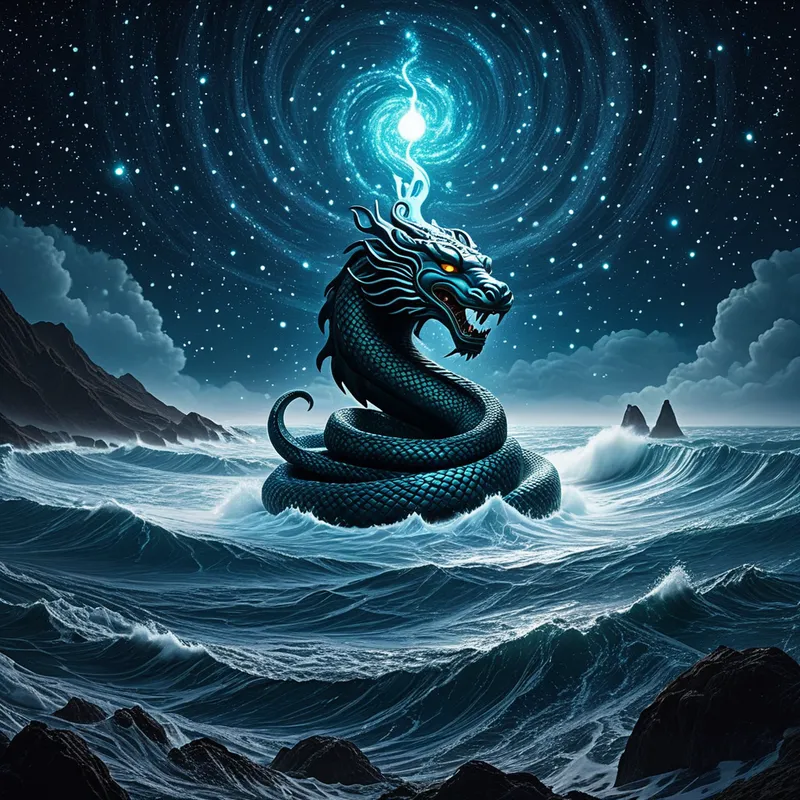
A great pact was forged, a desperate collaboration. They would churn the ocean itself. Using the mountain Mandara as a rod and the great serpent-king Vasuki as the rope, the Devas and Asuras took their places. The Asuras, believing themselves stronger, grasped the serpent’s head. The Devas, advised by wisdom, took its tail. They began to pull. Back and forth. The mountain spun. The ocean roared and frothed, heaving with the agony and ecstasy of creation.
First came poison, a dark, seething horror that threatened to consume all. Shiva drank it to save creation, his throat burning blue. Then, wonders began to rise. The wish-fulfilling cow, Kamadhenu. The celestial tree, Kalpavriksha. The white elephant, Airavata. Treasures and terrors alike bubbled forth from the abyss. The churning was an act of cosmic violence, a birth pang of reality.
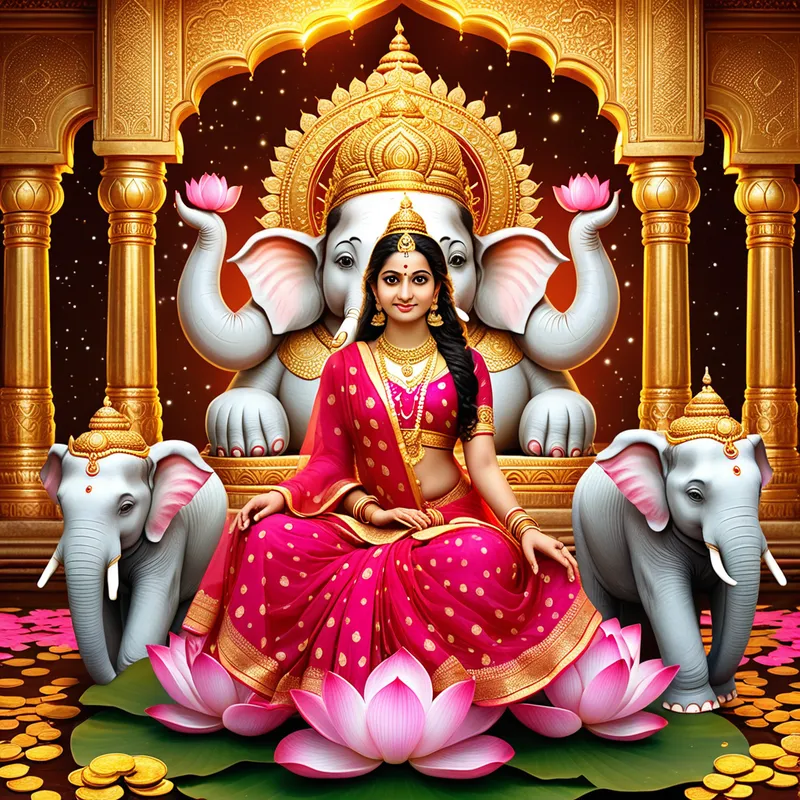
And then… a softening of the light. A fragrance, unlike any other—sweet, clear, and utterly calming. From the heart of the foaming chaos, a lotus bloomed, radiant and perfect. And upon that lotus stood Her. She was not born; she emerged, fully formed, the ocean’s own answer to the universe’s yearning. Her eyes held the compassion of all mothers. Her form was grace itself, adorned not by jewels, but radiating a light that was wealth, that was sovereignty, that *was> beauty. She was Sri Lakshmi.
All beings gazed, breathless. The Asuras reached, the Devas bowed. But her gaze swept over the assembly, over the strife and the struggle, and found rest upon the one who had not grasped, who had not strained for her, but from whose navel the mountain had sprung, who sustained the very act of churning. She looked at Vishnu, the preserver, resting upon the serpent Shesha in the midst of the tumult. A smile touched her lips. She glided across the waters and took her place at his side. In that choice, fortune found its foundation. In that union, chaos gained a center. The churning could continue, for prosperity now had a home.
Cultural Origins & Context
The myth of Lakshmi’s emergence is primarily narrated in the Vedas, and with elaborate detail in the Puranas, such as the Vishnu Purana and the Bhagavata Purana. It is a story told not in quiet temples alone, but during the vibrant festival of Diwali, where her return is celebrated with lamps, rangoli, and the hopeful opening of account books.
Its societal function is profound and multifaceted. It is a cosmological map, explaining the origin of both boons and banes in the world. It is a social allegory, teaching that great rewards (like Amrita and Lakshmi herself) require cooperation between opposing forces (Devas and Asuras), even if that alliance is temporary and fraught. Most importantly, it establishes a core dharmic principle: that true prosperity (Sri) is not neutral. It is inherently aligned with preservation, order, and righteousness (Vishnu), not with brute force or unbridled ambition.
Symbolic Architecture
Lakshmi is not merely a goddess of money. She is the archetype of sovereign abundance in its fullest sense. Her birth from the churning ocean is the central symbol.
True wealth does not come from superficial scratching at the surface of life, but from the profound, often turbulent, churning of one’s own depths.
The Kshirasagara represents the unconscious, the boundless potential of the psyche. The churning is the necessary inner work—the confrontation with shadows (the Asuras), the application of discipline (the Devas), and the endurance of painful truths (the poison). Lakshmi, emerging on the lotus, symbolizes the radiant consciousness and holistic well-being that is the reward for this difficult, integrative labor. Her four arms often represent the four goals of human life: Dharma (righteousness), Artha (means), Kama (desire), and Moksha (liberation). She holds them all in balance.
Her choice of Vishnu is equally critical. It signifies that enduring abundance must be rooted in a stable, preserving consciousness. Without a "Vishnu principle"—a center that can hold, a values-based structure—prosperity is fleeting, chaotic, and ultimately destructive. The lotus seat (Padma) signifies spiritual purity and beauty rising unstained from the muddy waters of material existence.
The Dreamer's Resonance
When the archetype of Lakshmi stirs in the modern dreamer, it often manifests not as a literal goddess, but as motifs of emergence and election. Dreaming of finding coins in mud, of a lotus blooming in an urban gutter, or of being unexpectedly chosen for a honor speaks to this energy. Somatic sensations might include a feeling of warmth in the chest or a deep, calming sigh of relief.
Psychologically, these dreams signal a process where the dreamer is integrating disparate parts of themselves—churning their inner ocean. The appearance of Lakshmi-like symbols marks the moment when this labor begins to yield its fruit: a nascent sense of self-worth, the recognition of inner resources, or the feeling that one’s efforts are aligning with a deeper, sustaining purpose. It is the psyche’s announcement that a period of scarcity (of love, opportunity, or self-regard) is giving way to a recognition of inherent abundance.

Alchemical Translation
The individuation process modeled by the Lakshmi myth is the alchemy of turning base striving into sovereign being. We all engage in the churning—pulling at the serpent of our desires and fears, grappling with our inner gods and demons in the pursuit of security, success, and meaning. The initial yields are often toxic: envy, anxiety, burnout (Shiva’s poison).
The alchemical work is to continue the churning with conscious intent, not to seize the treasures (the external validations) but to create the conditions for the emergence. This requires building our inner Vishnu—a core of witnessing presence, ethical integrity, and the capacity to sustain effort without being consumed by it.
Individuation is not about acquiring Lakshmi; it is about becoming the kind of consciousness (Vishnu) to which Lakshmi, the fullness of being, naturally adheres.
The "wealth" that then arises is psychic wholeness. The lotus of the Self blooms from the mud of experience. The coins flowing from her hand become the currency of authentic action and relationship. For the modern individual, this translates to a prosperity that is not measured solely in bank statements, but in resilience, creative flow, nourishing connections, and the unshakable sense that one is, and has, enough. The myth teaches that fortune is not found; it is earned through the profound labor of integration, and it is sealed by the conscious choice to anchor it in a stable, compassionate center.
Associated Symbols
Explore related symbols from the CaleaDream lexicon: