Kōyō Myth Meaning & Symbolism
A myth of a mountain spirit whose radiant beauty brings autumn's fire, embodying the poignant union of transcendent glory and inevitable surrender.
The Tale of Kōyō
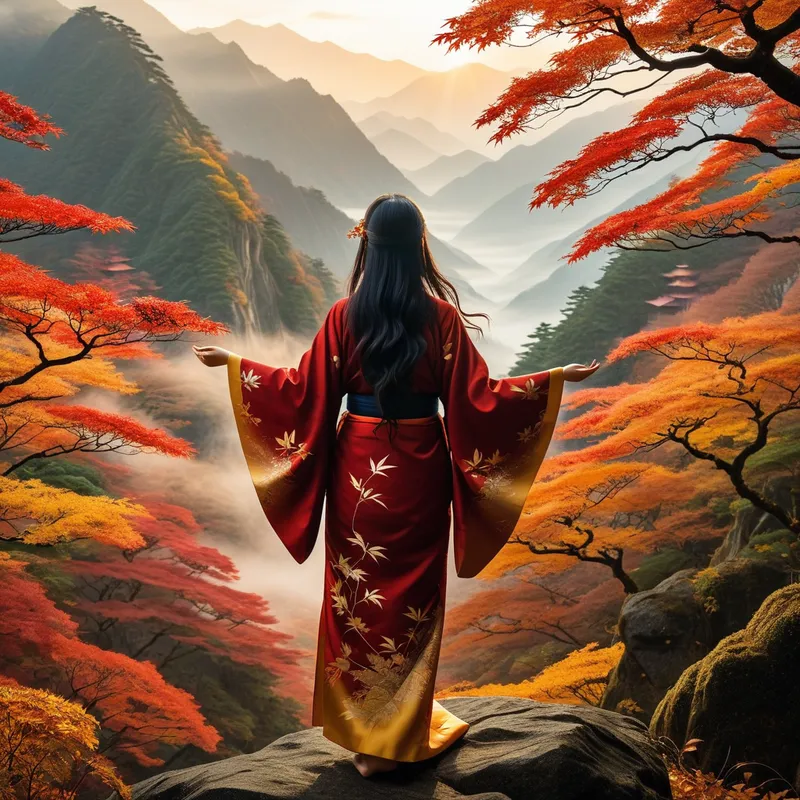
Listen, and let the mountain wind carry you back. Before the cities, before the rice fields were tamed, the mountains were the realm of the kami—spirits of deep, untamed power. Among the highest peaks, where the air thins and the clouds cling like ghosts, there lived a spirit of such particular grace that the very rocks softened in her presence. Her name was Kōyō.
She was not a spirit of stone or torrent, but of the living cloak of the mountain itself. For most of the year, she slept within the deep green heart of the ancient maples, a quiet pulse beneath the canopy. But as the sun’s gaze weakened and the nights grew teeth, a restlessness would stir her. It began as a whisper in the sap, a cooling in the roots. Then, one evening, as the balance of the world tipped, she would awaken.
Her emergence was not with sound, but with color. Where her spirit-foot touched a branch, green would shiver and retreat, replaced by a blush of gold. A sigh from her lips would set a cluster of leaves trembling into brilliant orange. Her dance—a slow, swirling motion as if weaving the very twilight—would paint the slopes in torrents of scarlet and vermilion. She was the artist of decay, the muse of fleeting glory. The mountain would catch fire, not with heat, but with a cold, dazzling beauty that stole the breath from any mortal who glimpsed it. This was her sacred duty and her solitary joy: to dress the world in a final, spectacular raiment before the sleep of winter.
Yet, one autumn, a young woodcutter, driven by need higher into the peaks than any before, witnessed her. He had become lost, the path swallowed by mist. As he pushed through a final thicket, he stumbled into her grove. And there she was, in the heart of a maple older than empires, her form woven from light and leaf. He did not see a monster, but a vision of such heartbreaking beauty that he dropped his axe, its thud a profanity in the silent sanctum.
Kōyō paused. Mortal eyes were upon her—a violation. But in his gaze, she saw not fear, but awe so pure it was a kind of offering. For a moment, the wind stilled. A single leaf, a perfect, luminous crimson, detached from her sleeve and spiraled down. It landed in his open, calloused palm. In that touch was the entire myth: the sublime beauty of the moment, the sharp pain of its passing, and a profound, wordless understanding. The spell broke. The mist surged, the grove faded, and when it cleared, he stood alone, holding only a perfect, but ordinary, red leaf. The mountain around him blazed with color, but the heart of the fire was gone, retreated deep into the spirit-world, leaving only its magnificent, dying echo for the world to see.
Cultural Origins & Context
The tale of Kōyō is not found in the canonical texts of Kojiki or Nihon Shoki, which chronicle the deeds of the celestial kami. She belongs to a different, yet equally vital, stratum of belief: the world of Yōkai and local mountain deities, the spirits of specific places and phenomena. Her story is a product of Shintō sensibility fused with the poetic observation of the natural world, passed down through setsuwa (oral anecdotal tales) and regional folklore, particularly in areas famed for their autumn vistas like the mountains of Hokuriku or Kiso.
Told by villagers, woodcutters, and travelers around evening fires, the myth served multiple functions. On one level, it was an etiological story, explaining the magnificent, sudden transformation of the autumn mountains—a natural event so dramatic it demanded a supernatural agent. On another, it reinforced sacred geography. The most breathtaking groves were not just scenic; they were kiyome no chi, the dwelling of a spirit, commanding respect and caution. The woodcutter’s intrusion and the spirit’s retreat codified a boundary: the most profound beauty is often fragile and requires reverence, not possession. It taught that some wonders are meant to be witnessed in humility, not owned or understood.
Symbolic Architecture
At its core, Kōyō is the archetypal embodiment of mono no aware, the poignant, gentle sadness at the transience of things. She is not the decaying leaf, but the glorious, conscious act of dying brilliantly. Her symbolism is a profound paradox:
She is the spirit of death painted in the colors of life’s most vibrant fire.
Psychologically, Kōyō represents the aspect of the Self that must engage in a beautiful, necessary surrender. She symbolizes the conscious acceptance of an ending—the closing of a chapter, the release of an identity, the culmination of a life phase. This is not a defeatist withering, but an active, artistic transformation. The “crimson leaf” is the ego-complex at its peak of development, radiant with the richness of experience, just before it must be released to make way for the introspective “winter” of the psyche.
The woodcutter represents the conscious mind, the ego, stumbling into the realm of this deep, autonomous psychic process. His awe is the ego’s proper response to encountering the Self in a moment of profound transformation. His axe—the tool of cutting, of utility, of shaping the world to his will—becomes useless. The gift of the leaf is the Self leaving a token in the realm of consciousness: a memory, an insight, a symbol of the transformation that has been witnessed but not controlled.

The Dreamer's Resonance
When the pattern of Kōyō stirs in the modern dreamer, it often manifests in dreams of breathtaking, melancholic beauty. One might dream of a forest suddenly turning to gold and crimson in a single moment, of holding a perfectly preserved but glowing autumn leaf, or of witnessing a beautiful figure who disappears into a swirl of falling leaves. The somatic feeling is one of awe mixed with a deep, resonant ache in the chest—the physical signature of mono no aware.
Psychologically, this dream motif signals that a major cycle within the psyche is reaching its natural, glorious conclusion. The dreamer is being shown that something—a relationship, a career, a long-held self-concept—has reached its fullest, most beautiful expression and is now preparing to fall away. The conflict is not against an external force, but against the ego’s desire to hold on, to make the eternal summer of this beautiful state. The dream presents the beauty of the release itself, inviting the dreamer to find the sacredness in letting go, to see the dignity and artistry in the surrender. It is the unconscious affirming that an ending can be the most profound part of the story.

Alchemical Translation
The alchemical process mirrored in Kōyō’s myth is nigredo—but a nigredo cloaked in the splendid robes of rubedo. In the journey of individuation, we must not only confront the shadow in the dark (the classic nigredo), but also learn to consciously and beautifully dissolve the forms we have outgrown. Kōyō models this advanced stage of psychic transmutation.
The work is to become both the spirit who paints the world in fire and the mortal who receives the single, falling leaf.
The first step is to recognize the “autumn” within oneself—the signs of culmination, the richness that hints at a coming end. The alchemical operation is to engage with this process not as a passive victim of time, but as the artist-spirit. This means actively honoring what is ending, giving it its final, magnificent due—writing the farewell letter, having the closing conversation, creating the ritual that marks the passage. This is Kōyō’s dance.
The second step is the woodcutter’s humility. The conscious ego must learn to stand in awe, to drop its tools of control (the axe), and to simply receive the gift of the moment. The single leaf is the lapis, the philosopher’s stone, in this context. It is not a trophy of conquest, but a token of connection to the deeper, cyclical Self. It is the insight, the core truth, or the enduring feeling that remains after the form has passed. To integrate Kōyō is to understand that our deepest transformations are both our most beautiful creations and our most sacred surrenders, a cycle where loss and glory are revealed as one and the same.
Associated Symbols
Explore related symbols from the CaleaDream lexicon: