Kvasir Myth Meaning & Symbolism
A being of pure wisdom, born from the truce of gods, is murdered by dwarves. His blood, brewed into the mead of poetry, becomes the source of all inspiration.
The Tale of Kvasir
Hear now, a tale spun from silence, born from the end of war. The great war between the Aesir and the Vanir had ground to a weary halt. No side could claim victory, only exhaustion. To seal their fragile peace, the gods gathered at the sacred truce-ground. From each deity, from the mightiest Odin to the gentlest Freyja, they spat into a great vessel—a cauldron of mingled breath and essence. This was no mere gesture. It was the pooling of divine potential, the raw substance of truce.
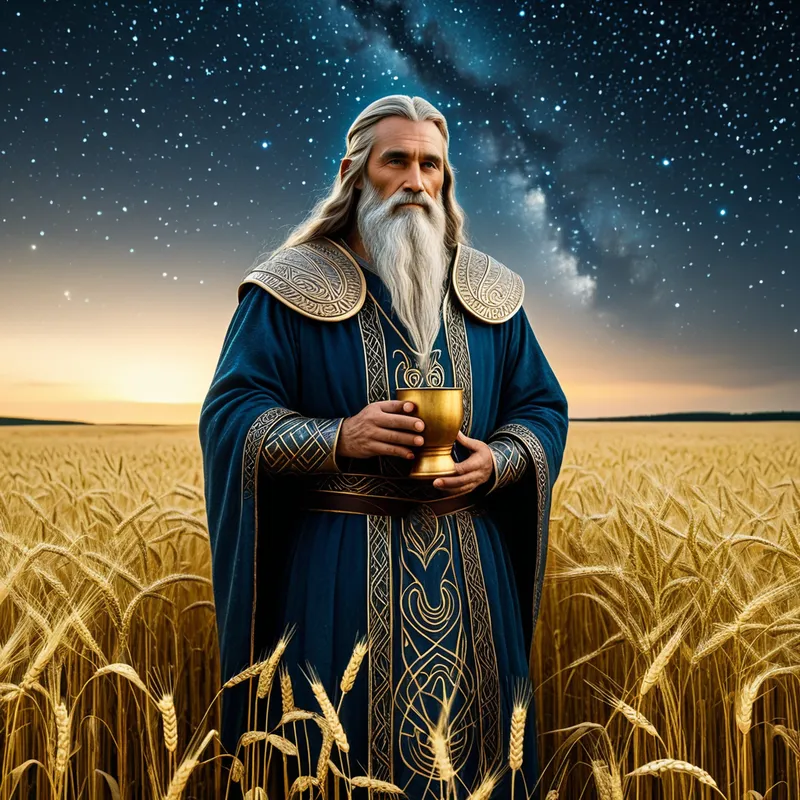
From that vessel of collective promise, a being arose. He was Kvasir. He was not born of thunder or earth, but of consensus. His form was that of a wise man, and his eyes held the light of all things knowable. He walked the nine worlds of the Yggdrasil, and no question posed to him went unanswered. His wisdom was a clear, deep well from which all could drink. He became a living bridge between the realms, a testament to what could be forged from conflict’s end.
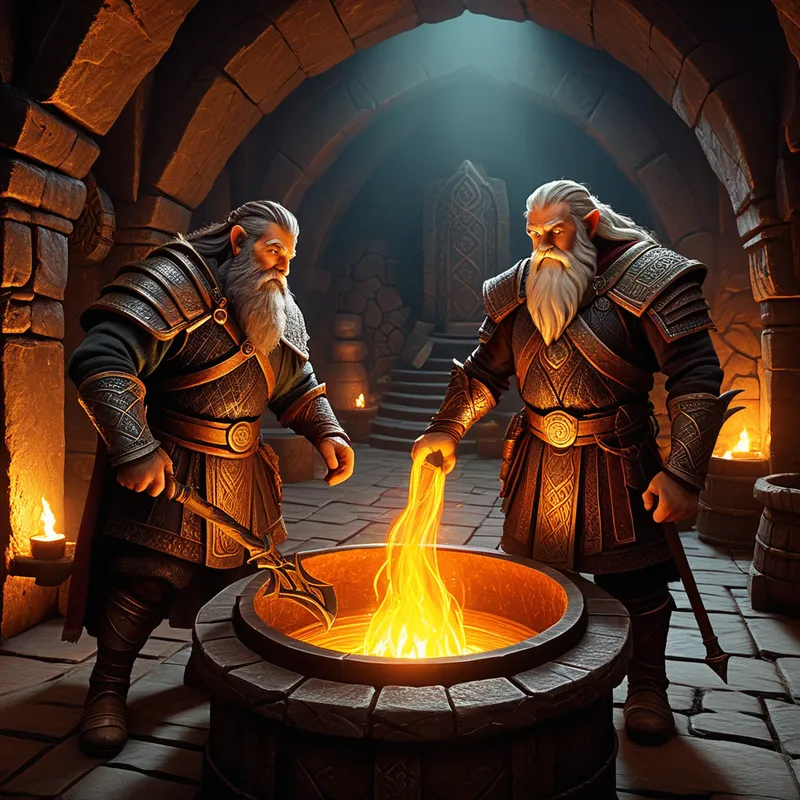
His wanderings led him to the threshold of a dwarven hall, home to the brothers Fjalar and Gjalar. These were masters of craft and deep, covetous cunning. They welcomed the sage, their smiles sharp as forged iron. “Share your wisdom with us, great Kvasir,” they said, their voices honeyed. And he, in his boundless generosity, did. But their desire was not for shared knowledge, but for its possession. In the dark of their hall, where the forge’s heart had cooled to embers, they struck him down. The wisest of beings fell not to a giant’s wrath, but to the small, envious greed of lesser minds.
They did not merely hide their crime. They performed a dark alchemy. They drained Kvasir’s vital blood into two wondrous vessels: the cauldron Odrerir and the vats Son and Bodn. They mixed the blood with honey, and through their secret arts, they brewed a mead of such potency that whoever drank of it would become a skald or a scholar, blessed with the gift of poetry and profound speech. They had transmuted living wisdom into a potion of power, and they guarded it in the deep, stone veins of the earth.
But poison, once created, seeks to spread. The dwarves, in their arrogance, used the mead to settle a debt with a giant, Suttungr, after killing his parents. Suttungr, recognizing the prize, hid it in the center of a mountain, Hnitbjorg, and set his daughter Gunnlod to watch over it. There it sat, the distilled essence of a murdered god, locked away from the world. Until the whisper of it reached the one ear that forever strained for such knowledge: the ear of Odin. The All-Father’s quest to reclaim this stolen wisdom—through deception, sacrifice, and transformation—is another saga. But its source, its sacred, tragic origin, remains the being born from peace, murdered for his gift, and transformed into the very wellspring of inspiration itself.
Cultural Origins & Context
The myth of Kvasir is preserved primarily in the Prose Edda of Snorri Sturluson, written in the 13th century but drawing from far older oral traditions. In the Viking Age, the skald (poet) held a position of immense social and spiritual power. Poetry was not mere entertainment; it was a magical act, a way to preserve history, curse enemies, praise kings, and interface with the divine. The myth of Kvasir served as the foundational etiological story for this power. It answered the profound question: where does inspiration come from?
The tale functioned on multiple levels. For the society, it sanctified the poet’s role, linking their skill to a divine, if tragic, origin. It framed wisdom and poetic inspiration as substances of immense value, worthy of divine conflict and cosmic theft. The narrative also reflects a deeply Norse understanding of a paradoxical world: the greatest gifts (wisdom, poetry, peace) are often born from violent or ignoble acts (war, murder, betrayal). Knowledge is not pure; it is alchemized from experience, both glorious and grim. The myth was likely told in halls by skalds themselves, a reminder of the sacred and costly nature of the words they wielded, a lineage of inspiration that stretched back to the gods’ own spittle.
Symbolic Architecture
Kvasir is the archetype of the unintegrated wisdom principle. He represents pure, uncontained knowledge—consciousness itself, born from the resolution of opposites (Aesir vs. Vanir). He is not a god of thunder or fertility, but of meaning-making.
He is the living word before it is spoken, the understanding before it is claimed by ego.
His murder by the dwarves symbolizes the inevitable “killing” of pure insight by the lesser, grasping aspects of the psyche—the dwarves representing the cunning, crafty, and possessive complexes within us that seek to own and hoard wisdom rather than live it. The transformation of his blood into the Mead of Poetry is the central alchemical image. The essence of conscious wisdom (blood = life, spirit) is mixed with the sweetness of human experience (honey) and fermented through the dark, transformative process of the unconscious (the dwarven forge). What emerges is not raw knowledge, but inspiration—a potent, intoxicating force that can elevate or deceive.
The myth maps the journey of any profound insight: it arises from a reconciliation within (the truce), exists for a moment in pure form (Kvasir), is inevitably seized and distorted by our shadowy, possessive tendencies (the murder), and must be laboriously reclaimed and integrated through a heroic effort of the greater Self (Odin’s quest).

The Dreamer's Resonance
When this myth stirs in the modern unconscious, it often manifests in dreams of profound but fragile discovery. You may dream of finding a crystal-clear spring or a brilliant, illuminating book, only to have it dissolve, be stolen, or turn to blood in your hands. You may encounter a benevolent, wise figure who offers a crucial answer, but the dream environment—a narrowing tunnel, a closing door, deceitful companions—prevents you from retaining it.
Somatically, this can feel like the frustration of a word on the tip of your tongue, or a sudden, bodily understanding that evaporates upon waking. Psychologically, you are in the space between the birth of an insight and its integration. The “dwarves” are at work: your own envy of others’ wisdom, your intellectual greed that wants to possess understanding as a trophy, or a cynical inner voice that murders nascent creativity before it can breathe. The dream is signaling that a valuable piece of your own inner wisdom has been “killed” and brewed into an intoxicant—perhaps manifesting as obsessive rumination, clever but empty words, or inspiration that you feel is locked away (the mountain), guarded by a powerful, isolating complex (Gunnlod).

Alchemical Translation
The individuation process modeled here is the transmutation of information into wisdom, and finally into authentic voice. We all begin with our own “spittle of the gods”—raw experiences, conflicts, and reconciliations that form our basic consciousness (Kvasir’s birth). But to live in the world, this pure consciousness is sacrificed. Our innate knowing is “murdered” by socialization, trauma, and the need to craft a persona (the dwarven act).
The goal is not to resurrect the innocent Kvasir, but to undertake the odyssey to reclaim the mead.
The dwarven brew represents the latent potential within our wounds and losses. Our life’s blood—our vital experiences, especially the painful ones—mixed with the honey of memory and feeling, ferments in the vat of the unconscious. For a long time, this mead is in the possession of our “dwarves” (neuroses, complexes) or locked in the mountain of our defenses.
The heroic, Odinic phase of the work is to consciously engage with these depths. It requires cunning (self-awareness), sacrifice (surrender of old identities), and the willingness to be transformed by what we retrieve. To drink responsibly from this inner mead is not to become intoxicated with self-importance, but to gain the gift of true expression—to speak and live from a place where personal experience has been alchemized into something that can connect, heal, and inspire. Your poetry, your authentic creative voice, is the redeemed blood of your own inner Kvasir. It is proof that wisdom, though born of peace, killed by shadow, and hidden in darkness, can be won back to become the intoxicating elixir of a life fully, eloquently lived.
Associated Symbols
Explore related symbols from the CaleaDream lexicon: