Kupe Discovers Aotearoa Myth Meaning & Symbolism
A legendary Polynesian navigator pursues a monstrous octopus across the vast Pacific, leading to the discovery of a new homeland.
The Tale of Kupe Discovers Aotearoa
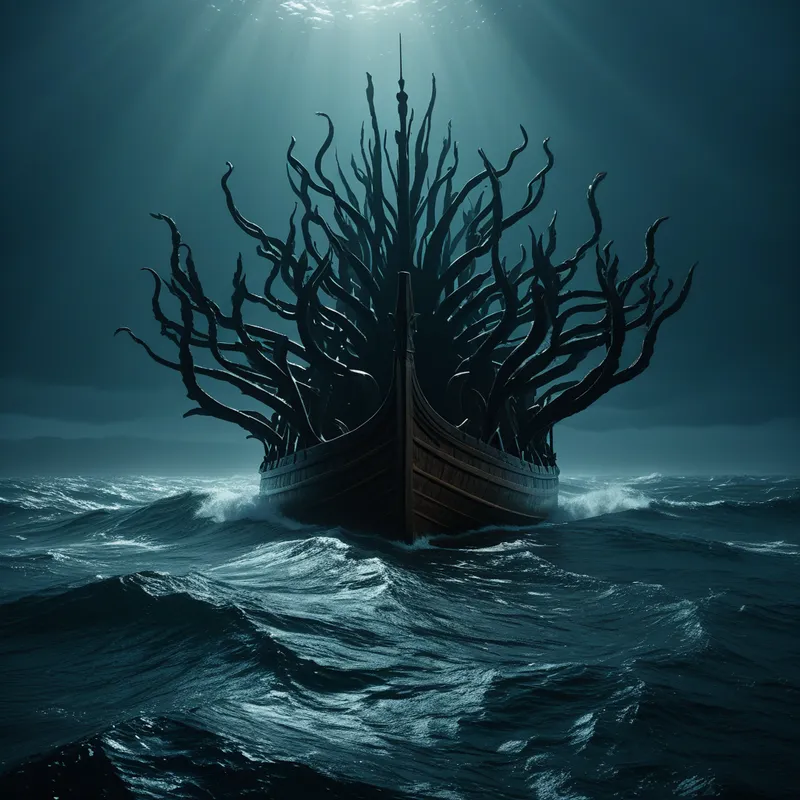
Listen, and let the salt spray sting your face. Let the vast, empty belly of Te Moana-nui-a-Kiwa stretch before you, a realm of blue mystery and whispered dangers. In the ancestral homeland of Hawaiki, a shadow fell upon the people. Their fishing grounds grew barren, their nets came up torn and empty. The culprit was no ordinary thief, but a creature of legend: Te Wheke-a-Muturangi, a colossal octopus of such size and malice it was said to be the familiar of the powerful tohunga, Muturangi. This beast, with arms like great forest vines, haunted the deep, plundering the bounty of the sea.
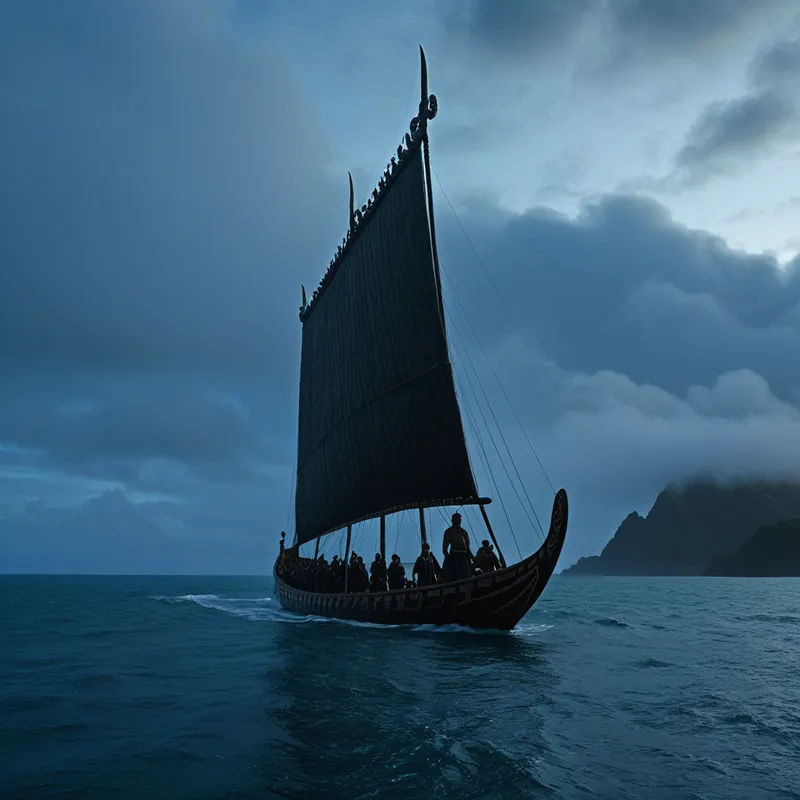
Into this conflict stepped Kupe, a rangatira of immense courage and skill. His spirit, like his finely carved waka, was built for the open ocean. He could read the language of the stars, the whispers of the currents, the flight paths of the koekoeā. The desecration of the sea was a challenge he could not ignore. With his companion, Ngahue (or in some traditions, his wife, Kuramārōtini, who uttered the fateful cry of sighting land), Kupe prepared his great canoe, Te Matahorua. They loaded it with provisions, with sacred knowledge, and with a burning purpose: to hunt the wheke to the ends of the earth.
The pursuit was an epic of endurance. For weeks, then months, they chased the beast across the trackless ocean. They followed the slick, oily trail it left in the water, a sinister path under the blazing sun and the cold, watchful stars. The wheke was cunning, diving into the black abyss, leading them over waves that rose like mountains and into calms that were a mirror of despair. Kupe navigated by the sun by day and the constellations—Matariki and Tautoru—by night. His world was the creak of the hull, the sigh of the wind in the sail, the endless horizon.
Then, a miracle. In the grey light before dawn, Kuramārōtini peered into the distance. Was it a bank of cloud? A trick of the weary eye? No. It was solid, it was enduring. “He ao! He ao! He Aotea! He Aotearoa!” she is said to have cried. “A cloud! A cloud! A white cloud! A long white cloud!” Land. Before them rose the mist-shrouded peaks of a new world, a land of towering forests and birdsong unknown. In a final, furious confrontation in the strait that now bears his name, Kupe battled the great wheke, striking off its head and arms, staining the waters with its ink-dark blood. The quest was complete. The predator was vanquished. The explorer had found not just an end to a chase, but a beginning for his people. He explored the coastlines, named the islands and landmarks, and then, ensuring the way was known, returned to Hawaiki to bring the news of the land he called Aotearoa.
Cultural Origins & Context
The traditions of Kupe are part of the whakapapa and pūrākau carried by the various iwi (tribes) of Aotearoa, particularly those of the North Island. These stories are not mere fables but are foundational history, carried in the oral tradition by tohunga and skilled orators. They serve as the title deed to the land, explaining the origins of place names, validating ancestral authority, and encoding vital navigational and ecological knowledge. The story of Kupe functions as a cosmological map, linking the Maori people directly to their Polynesian homeland of Hawaiki and charting the perilous, intentional journey of discovery. It is a narrative of origin that underscores the incredible feats of celestial navigation and deep-sea voyaging that populated the Pacific, making Kupe the archetypal ancestor-explorer whose courage made the present homeland possible.
Symbolic Architecture
At its heart, the myth of Kupe is a profound allegory of consciousness confronting the unconscious. Hawaiki represents the known world, the familiar psyche. Te Wheke-a-Muturangi is the shadowy, disruptive complex that depletes one’s resources—a consuming obsession, a hidden fear, a paralyzing grief that empties the waters of life’s vitality. It cannot be ignored; it must be pursued.
The journey into the unknown is never a flight from the self, but a pursuit of the very thing that devours the self from within.
The vast Pacific is the boundless, undifferentiated realm of the unconscious. Kupe’s waka is the vessel of the ego, the disciplined consciousness equipped with the tools of tradition (star lore, ancestral knowledge) to navigate these depths. The discovery of Aotearoa is not an accident but the direct result of this heroic pursuit. It symbolizes the emergence of new psychic territory—a previously unknown aspect of the self, a new level of integration, or a creative destiny that only reveals itself when one has the courage to follow the disruptive shadow to its source. The slaying of the wheke is not mere violence, but the necessary act of differentiation, of cutting through the tangled, grasping arms of a chaotic complex to establish order and life in a new land.
The Dreamer's Resonance
When this myth stirs in the modern dreamer, it often manifests as a profound sense of being called into a vast, unknown emotional or psychological space. One might dream of pursuing a elusive, shadowy creature through strange waters, or of being adrift on an endless ocean, guided only by distant stars. The somatic feeling is one of both profound solitude and exhilarating potential—the tightness in the chest of deep anxiety coupled with the keen alertness of the explorer.
This dream pattern signifies the psyche initiating a voyage of necessity. The dreamer is being compelled to leave the “Hawaiki” of a current life structure, belief system, or comfortable identity that is being subtly drained by an unrecognized “wheke.” The journey feels perilous because it is; it is a move into uncharted internal waters. The appearance of a distant “long white cloud”—a hint of land, a new idea, a glimpse of a future self—in the dream is the first promise of the psychic reward for this courage. The dream is the unconscious charting the course for a necessary and transformative discovery.
Alchemical Translation
The alchemical process mirrored in Kupe’s voyage is the separatio followed by a sublime coniunctio. First, the conscious self (Kupe) must separate from the merged, troubled state of the known world (Hawaiki plagued by the wheke). This is the nigredo, the dark journey across the sea of the unconscious, filled with doubt and struggle.
The pursuit and confrontation represent a fierce engagement with the material of one’s own shadow—the inky, grasping, elusive aspects of the psyche that consume energy. To engage it is to begin its transformation.
The new land is not found by running away, but by following the very thread of one’s deepest disturbance.
The final act—the discovery and naming of Aotearoa—is the albedo and rubedo. The white cloud signifies the dawning of a new conscious attitude, the “land” is the solidification of a new psychic reality. By courageously navigating by his own inner stars (intuition, values, inherited wisdom) and confronting the shadow, the individual does not simply return home. They become the founder of a new inner homeland. They transmute the chaotic pursuit into a purposeful discovery, claiming and naming the previously unconscious potentials as now-integrated parts of their sovereign self. Kupe’s return to Hawaiki to share the news completes the cycle, symbolizing how this deeply personal individuation journey ultimately serves to enrich the collective, showing others the pathway to their own Aotearoa.
Associated Symbols
Explore related symbols from the CaleaDream lexicon:
- Ocean — The vast, primal unconscious and the realm of the unknown that must be traversed to move from a depleted state to a fertile new beginning.
- Journey — The essential process of pursuit and discovery, representing the life-altering voyage from a known problem to an unknown solution.
- Bird — Specifically the koekoeā, representing celestial guidance, intuition, and the signs from nature that lead the wayfarer toward their destiny.
- Shadow — Embodied by Te Wheke-a-Muturangi, the devouring complex or repressed content that paradoxically holds the key to new life when confronted.
- Star — The fixed points of ancestral knowledge, tradition, and inner truth that provide orientation in the trackless dark of the psyche.
- Mountain — The newly discovered land of Aotearoa, symbolizing the solid, enduring psychic structure that emerges after the oceanic journey.
- Hero — Kupe as the archetypal figure who answers the call, faces the monster, and secures a new homeland for the future of the self.
- Fish — The bounty of the psyche that is lost to the shadow, representing depleted creativity, vitality, or nourishment that the journey seeks to restore.
- Canoe — The vessel of the conscious ego, crafted and provisioned with skill and tradition, capable of surviving the voyage into the deep unconscious.
- Cloud — The first glimpse of the promised land, a symbol of hope, revelation, and the tangible yet elusive goal of the transformative quest.
- Blood — The ink of the wheke and the result of its defeat, representing the vital cost and the profound, staining change wrought by the confrontation.
- Destiny — The hidden land waiting to be found, the pre-ordained but unknown endpoint of a courageous and faithful pursuit.