Kupala Night Myth Meaning & Symbolism
A midsummer myth of sacred fire, purifying water, and a quest for a magical fern flower, symbolizing the union of opposites and the search for wholeness.
The Tale of Kupala Night
Listen, and let the smoke of the sacred fire carry you back. The world holds its breath on the shortest night, the night when the sun, Dazhbog, hesitates at the threshold of his descent. This is Kupala Night, when the veil between the worlds of the seen and the unseen grows thin as a moth’s wing.
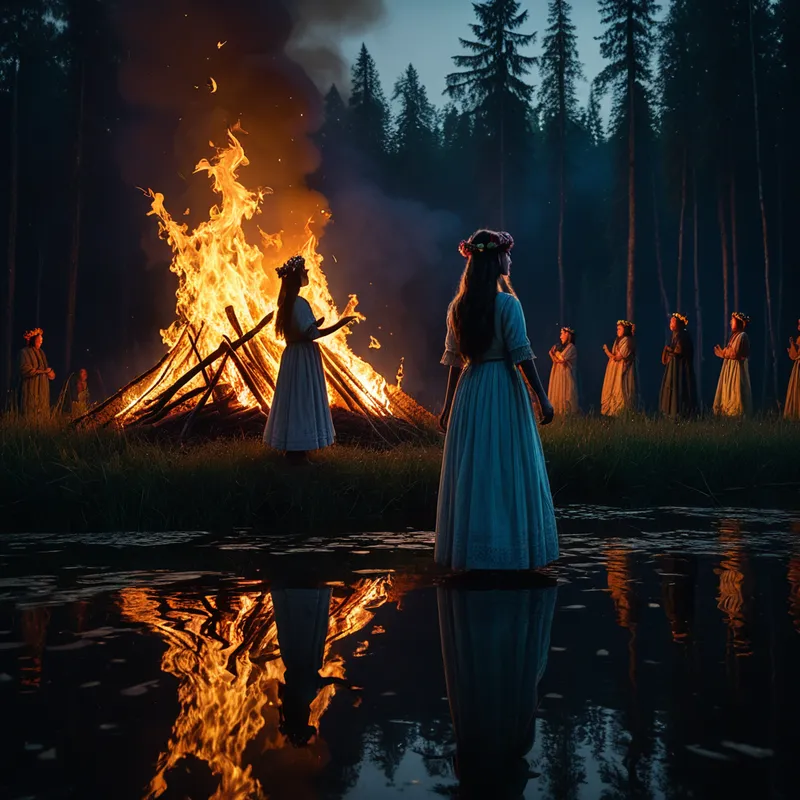
In the deep, primeval forests, where the moss drinks the twilight, the people gather. They come not as farmers or herders, but as souls remembering an older pulse. They build a great wheel of wood and straw, a sun captured from the sky, and with a torch lit from the last embers of the hearth, they set it ablaze. The Kupala fire roars to life, its heat a tangible force pushing back the gathering dark. This is no ordinary flame. It is the fire of Yarilo, the fierce, fertile spirit of summer, and it demands participation.
Young men leap over the flames, their shouts echoing through the pines. To leap high and clear is to be blessed, purified, made strong for the year to come. To falter is to carry misfortune. The fire tests courage; it burns away the old, the stagnant, the fearful.
But the night holds another power, its opposite and its twin. Beyond the circle of light lies the river, dark and swift, a ribbon of Vodanoi’s domain. As the fire’s heat fades on the skin, the maidens approach the water’s edge. They weave wreaths of flowers and herbs—chamomile, fern, and rue—and set them afloat upon the current, each a tiny, blooming boat carrying a silent wish for love and destiny. A wreath that floats far and true promises a fortunate path. One that sinks whispers of challenges to come. One caught by a young man downstream… that is a sign written by the night itself.
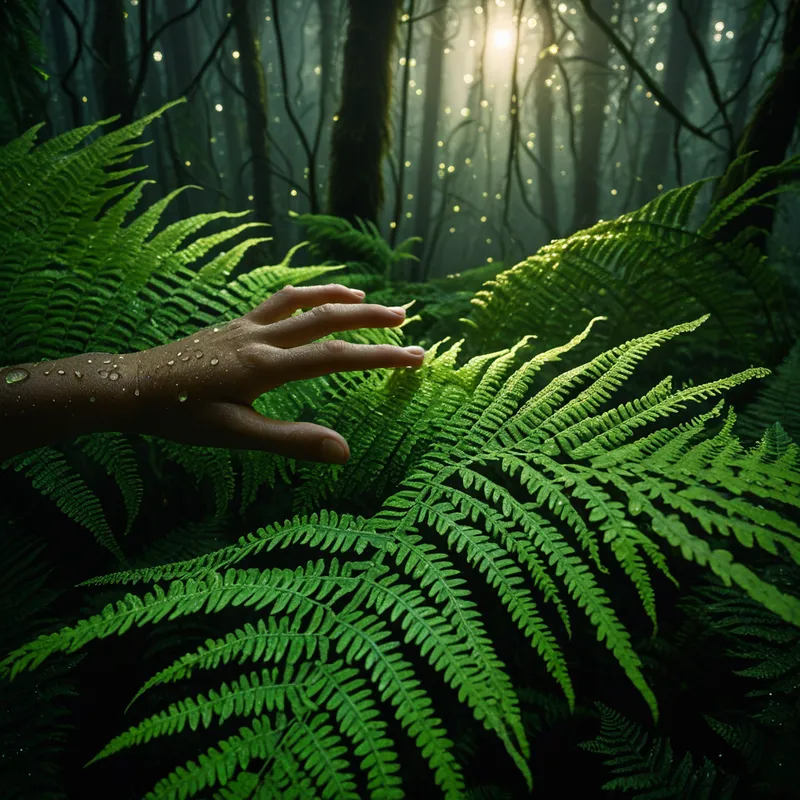
And then, the deepest mystery. As midnight approaches, the bravest souls, pairs of young men and women, venture into the heart of the forest. They seek the impossible: the Fern Flower. It is said that for one fleeting moment, at the precise turning of the world, the humble fern, which bears no blossom, erupts in a radiant, golden flower. Its light reveals truths, opens locks, and shows the way to hidden treasures. But the forest is watchful. Spirits of the wood, the Leshy, and unseen forces guard this secret. The seekers must move without fear, hand in hand, supporting one another through the deceptive shadows and whispering leaves.
They search, hearts pounding a rhythm older than memory. Few ever see it. But on this night, to seek is to be transformed. Whether the golden light is found or not, those who enter the dark woods together are bound by the shared courage of the quest. As the first hint of dawn pales the eastern sky, the people, weary and changed, return to their homes. The great fire is now embers, the river has carried its offerings away, and the forest holds its secret once more. The sun, Dazhbog, rises, and the longest day begins, infused with the magic of the shortest night.
Cultural Origins & Context
Kupala Night, celebrated on the summer solstice (June 23-24), is a pre-Christian Slavic and Baltic festival whose roots sink deep into the animistic soil of agrarian life. It was not a single myth recited by a bard, but a living, communal ritual—a myth enacted by an entire village. The name Kupala is etymologically linked to words for bathing (kupat) and togetherness (kup), pointing to its core elements of purification and community.
The rituals were passed down not through sacred texts, but through the embodied knowledge of generations. Grandmothers taught the weaving of wreaths, fathers built the bonfire pyre, and the young learned the songs and dances by participating. Its societal function was multifaceted: it was a rite of passage for the youth, a fertility ritual for the land and the people, a purification ceremony to ensure health, and a powerful mechanism of social bonding. By leaping the fire and floating wreaths, individuals were integrated into the cyclical, cosmic order of their world. The Christianization of the region saw the festival syncretized with the Feast of St. John the Baptist (hence Ivan Kupala), but its core pagan symbols—fire, water, ferns, and fertility—proved indelible, persisting in folk customs across Eastern Europe to this day.
Symbolic Architecture
At its heart, Kupala Night is a profound drama of opposites seeking union. It is a ritualized map of the psyche, charting the necessary confrontation and integration of dualities to achieve wholeness.
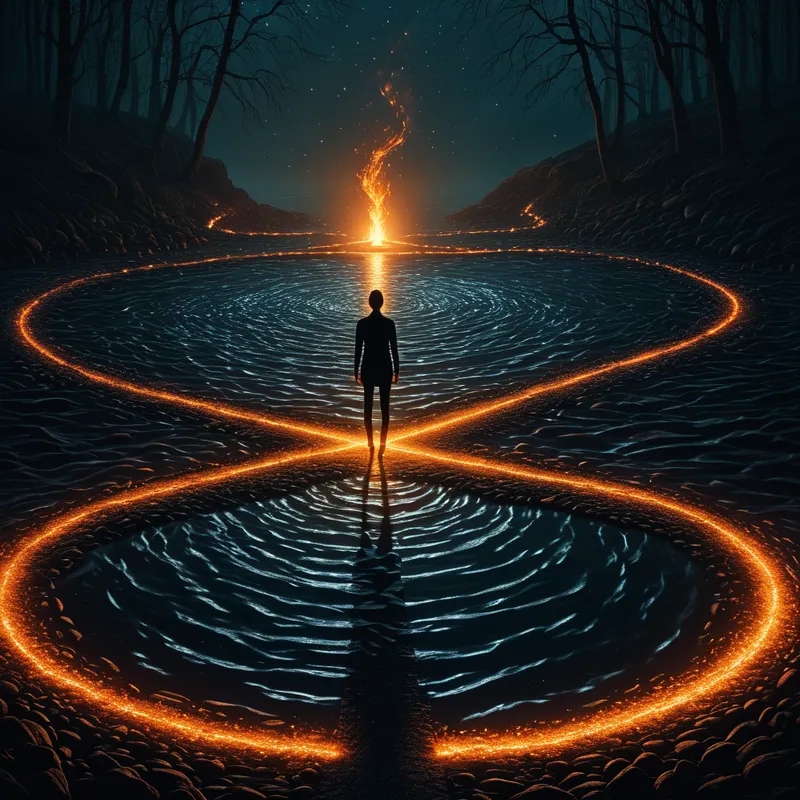
The fire does not destroy the water, nor does the water quench the fire; on this night, they converse, and in their dialogue, the soul is forged.
The Kupala fire represents the active, masculine, solar principle: consciousness, will, purification, and the burning away of the past. The river embodies the receptive, feminine, lunar principle: the unconscious, emotion, intuition, and the flow of destiny. The ritual demands engagement with both. To only leap the fire is to be all spirit, ungrounded. To only float a wreath is to be swept away by emotion without direction. The seeker must be tempered by both.
The quest for the Fern Flower is the search for the hidden Self, the treasure of psychic integration that blooms only in the darkest, most unconscious part of the forest (the psyche). That it is sought by a pair signifies that this integration often involves reconciling our inner masculine and feminine aspects, our logic and our intuition. The flower itself—a light in the darkness, beauty from the barren—is a symbol of the transcendent function, the new psychic reality that emerges from the tension of opposites.
The Dreamer's Resonance
When the imagery of Kupala Night arises in modern dreams, it signals a powerful initiation process within the psyche. The dreamer is at a solstice point in their life—a peak or a turning.
Dreaming of leaping over a great fire may coincide with a somatic feeling of adrenaline and risk. Psychologically, it indicates a need for a courageous act of purification: to leave a situation, burn away an old identity, or take a definitive leap of faith. The body feels the call to action.
Dreams of floating on dark water, or watching a wreath drift away, often bring a somatic sense of surrender and release. This reflects a psychological process of letting go, trusting the flow of life, or connecting with deep, intuitive feelings that have been ignored. There may be anxiety, but also a profound relief.
To dream of searching through a dense, dark forest for a source of light is the quintessential image of the individuation journey. The dreamer is in the midst of confusion or depression (the forest), seeking meaning, insight, or a new direction (the flower). The presence or absence of a companion in this dream-quest reveals the dreamer’s relationship to their own inner other—are they integrating their contrary aspects, or feeling isolated in their search?
Alchemical Translation
The alchemical process mirrored in Kupala Night is the Coniunctio Oppositorum—the sacred marriage. For the modern individual, this is not about finding an external partner, but about achieving inner marriage.
The goal is not to find the flower, but to become the clearing where fire and water can meet without annihilating each other.
The first stage, Nigredo, is represented by the deep night itself and the dark forest. It is the necessary descent into confusion, shadow, and the unknown. One must acknowledge what is hidden. The fire leap is the Calcinatio—the burning off of ego attachments and outdated personas. The water ritual is the Solutio—the dissolving of rigid structures in the fluidity of feeling and the unconscious.
The quest through the forest is the arduous work of Separatio and Coagulatio: distinguishing one’s inner components (what is fear? what is true desire?) and beginning to reassemble them with new understanding. The moment of potentially finding the fern flower is the Albedo, the dawning of a new, illuminating consciousness.
Ultimately, the full ritual—engaging with fire, water, and the forest quest—models the final stage of Rubedo, the reddening. This is the achieved wholeness, where the opposites are not just balanced but creatively united, producing a vibrant, resilient self. The individual who has undergone this psychic Kupala Night carries within them both the purifying strength of the flame and the adaptive depth of the water. They have visited the dark forest of the soul and returned, not necessarily with a tangible treasure, but with the earned wisdom that the search itself is the transformation. They become, in a sense, a living embodiment of the solstice—a point of perfect tension where light and dark, conscious and unconscious, are held in a dynamic, life-giving equilibrium.
Associated Symbols
Explore related symbols from the CaleaDream lexicon: