
Kūʻula Myth Meaning & Symbolism
The story of a man who becomes the god of fishermen, teaching that true abundance flows from sacred reciprocity and profound respect for the source.
The Tale of Kūʻula
Listen, and let the salt-spray carry the story. In the time when the islands were young and the ocean’s voice was the first sound heard, there lived a man on the shores of Maui. His name was Kūʻula-kai, “Kū of the Sea,” but to those who knew the hunger of empty nets and the crying of children, he was simply Kūʻula.
He was not like other fishermen. Where they saw a vast, blue mystery, Kūʻula saw a face. Where they heard waves, he heard a breath. He knew the sea was not a larder to be plundered, but a living ancestor to be conversed with. His fishing was a prayer, his canoe an altar. He would chant to the depths, his voice weaving with the wind, and his nets would return heavy with silver life, not from force, but from invitation.
This abundance became a quiet thunder. The envious whispers began. “What sorcery does he use?” “He hoards the mana of the sea for himself!” The chief, hearing these murmurs of a power he could not command, felt the sting of fear in his royal pride. He summoned Kūʻula. “You will reveal your secret,” the chief demanded, his voice echoing in the council house. “You will teach my men to fish as you do, or you will fish no more.”
Kūʻula stood silent as a reef rock. His secret was not a technique, but a relationship—a covenant of respect. To reveal it as a trick would be its death. He refused. The chief’s anger erupted. Kūʻula, his wife Hina-puku-iʻa, and their son ʻAiʻai were seized. The sentence was exile, then death. Cast out from their home, they were set upon the wild, eastern coast of Maui, a place of fierce winds and pounding surf, a place meant to break them.
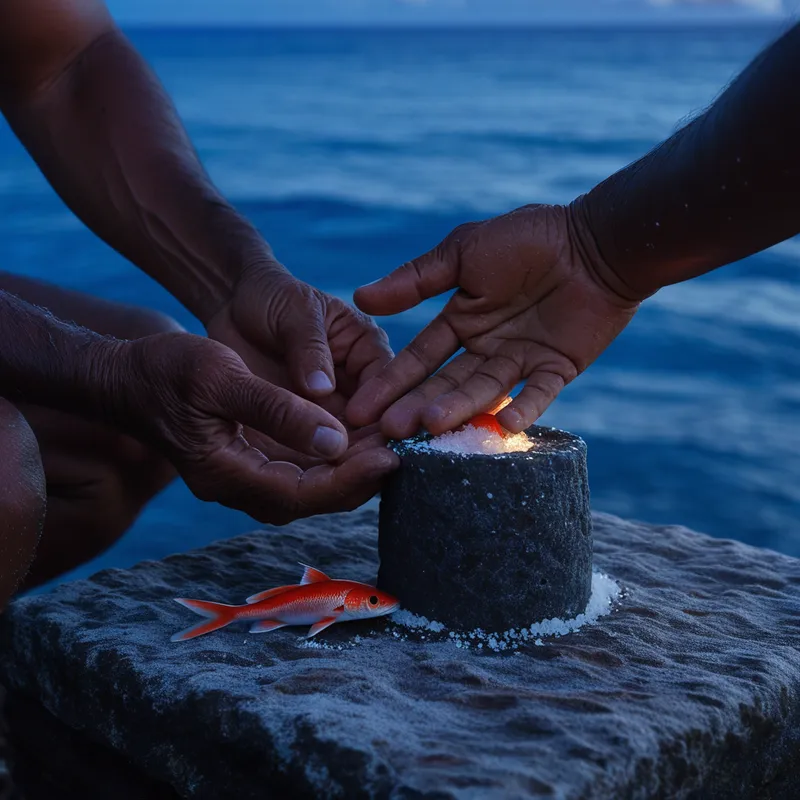
But Kūʻula walked to the water’s edge. He did not plead to the chief, but to the ocean. From a small, smooth stone, he built a humble altar, a koʻa. Upon it, he placed the most precious offering he had: the first, the finest, the most beautiful fish from his next catch—a vibrant, red ʻāweoweo. He gave back to the source before taking for himself.
The sea responded. It was not a roar, but a profound stillness, then a gathering. The waters darkened with life. Fish of every kind swam to Kūʻula’s shore, leaping into his waiting nets, filling his baskets without a struggle. The intended place of starvation became a place of miraculous, overflowing bounty. The chief’s men, sent to witness their failure, saw instead a man in sacred dialogue with the deep. In their fear and awe, they attacked, but Kūʻula, Hina, and ʻAiʻai did not fight with spears. They stepped into the waves and were transformed. Kūʻula became the great stone koʻa itself, the first and eternal fishing shrine. Hina became the ʻiao fish, the bait that attracts. ʻAiʻai became the guardian, traveling the islands to establish koʻa and teach the sacred law of the fisherman.
The man was gone. The god remained.
Cultural Origins & Context
The myth of Kūʻula is not merely a story; it is the foundational mana of Hawaiian fishing practice. It originates from the ancient Polynesian understanding of the world as a vast kinship network, where humans, gods (akua), and nature are intimately related. Kūʻula is one of the many manifestations of Kū, representing his specific role as the provider culture.") from the sea.
This myth was the living curriculum of the fishing guilds. It was passed down by kahuna and master fishermen (lawaiʻa) not just for entertainment, but for survival. It encoded the essential ethics of resource management: take only what is needed, offer thanks, and give back the first fruits. The physical koʻa shrines built on coastlines were the ritual enactment of this story, turning every fishing ground into a temple and every catch into a sacrament. The myth served as the psychic and ecological regulator, ensuring that the relationship with the ocean remained one of reciprocal exchange, not exploitative extraction.
Symbolic Architecture
At its heart, Kūʻula’s journey is an allegory of the psyche’s relationship with the Source—the unconscious, the wellspring of life, creativity, and nourishment.
The ocean is the vast, unknown unconscious, teeming with life and potential. The fish are the contents of that unconscious—instincts, insights, emotions, and psychic energy that can sustain the conscious ego.
Kūʻula represents the conscious attitude that can successfully engage this depth. His “secret” is the principle of sacred reciprocity. He does not see the ocean as an “it” to be conquered, but a “Thou” to be honored. His offering of the first fish is the critical symbolic act: it is a sacrifice of the immediate ego-gratification to honor the source. This establishes a circuit. The envy of the chief and the community symbolizes the ego’s tendency to want to seize and control the bounty of the unconscious without respect, turning magic into manipulation, which always leads to barrenness (exile).
His transformation into the stone koʻa is the ultimate symbol of psychic integration. He does not die; he becomes the permanent, stable structure (the conscious ritual or attitude) that allows for a sustainable flow between the depths and the surface. Hina as the bait represents the attractive, inviting quality of the feminine principle that lures forth the contents of the deep. ʻAiʻai, the son who spreads the shrines, symbolizes the internalized principle becoming a practice that structures one’s entire life.

The Dreamer's Resonance
When this myth stirs in the modern dreamer, it often signals a crisis or opportunity in one’s relationship with their inner source of nourishment. Dreaming of an abundant, teeming sea you are afraid to fish in may point to untapped creative or emotional resources, blocked by a fear of engaging the unknown depths. Dreaming of a dried-up sea or empty nets speaks to a feeling of psychic or creative depletion, where the circuit of reciprocity with the unconscious has been broken—you have been taking without giving back.
Dreams featuring a specific, small, perfect object that must be offered (like the red fish) often highlight the need for a sacrifice. This isn’t about loss, but about investing a prized piece of your current identity, time, or energy back into the source to re-establish flow. The punishing chief or hostile community in a dream may represent internalized societal pressures or a tyrannical inner critic that demands productivity without respect for the process, leading to inner exile.
Somatically, this process can feel like a tension between scarcity and fullness, a hollow hunger in the gut, or conversely, a swelling, almost overwhelming sense of potential energy with no outlet. The myth calls for building your internal koʻa—a ritual of return and thanks.

Alchemical Translation
The alchemy of Kūʻula is the transmutation of ego-centric consumption into a participatory, sacred economy of the soul. The modern individual is perpetually tempted by the chief’s paradigm: to demand the secrets of productivity, creativity, and abundance as techniques to be mastered and hoarded. This leads to the wasteland of burnout—a spiritual exile on the rocky coast of one’s own life.
The individuation process modeled here is one of becoming the shrine, not just using it. It is the conscious development of a personal practice of reciprocity with all that feeds you.
The “first fish” sacrifice is the alchemical solve—the dissolution of the immediate ego’s claim. It is the act of dedicating the first hour of your day to meditation instead to-do lists, the first fruits of a project to gratitude before profit, the first impulse of an emotion to mindful observation before reaction. This voluntary offering “coagulates” (coagula) into a new, stable structure of being—the koʻa of your character.
You are no longer a person trying to extract fish from the sea. You become the embodied point of exchange where the sea willingly gives of itself. Your work, your creativity, your relationships cease to be acts of depletion and become rituals of circulation. The envy of others loses its power, because your abundance is not a private hoard, but evidence of a functioning covenant with a reality larger than yourself. You transform, like Kūʻula, from a hungry human into a conduit of sacred flow, your very presence a shrine that teaches the law: life sustains life only through a cycle of respectful give, and graceful receive.
Associated Symbols
Explore related symbols from the CaleaDream lexicon: