Kukulkan Myth Meaning & Symbolism
A celestial serpent descends, bringing law, knowledge, and the cycles of time, weaving the fabric of civilization from the primal jungle.
The Tale of Kukulkan
Hear now the rustle in the high canopy, the whisper that comes not from the wind but from the turning of the world. In the time before time was counted, when the jungle was a green, swallowing mouth and men huddled in its shadow, the sky was a distant, indifferent bowl. The earth was raw, and the hearts of the people were ruled by the chaos of the storm and the silence of the stone.
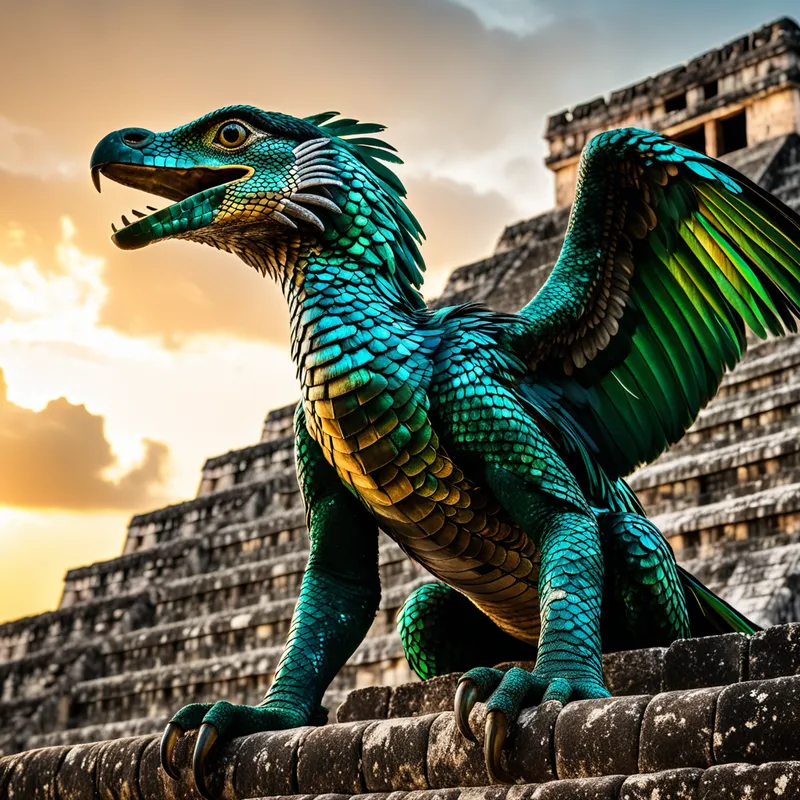
Then, from the east, from the place where the sun is born from the sea, a shadow fell upon the land. But it was a shadow of light. The people looked up and saw the sky rippling, the clouds parting not for the sun, but for a being that was of both heaven and earth. It was the great Kukulkan. His body was the powerful, coiled muscle of the serpent, scaled in emerald and jade, the creature that knows the secrets of the underworld, the dark soil, and the hidden root. But from this sacred body sprang a glorious plumage—the long, iridescent green feathers of the quetzal, the bird that sings in the highest branches and drinks the cloud mist. He was the union of the crawling earth and the soaring sky.
He descended not with thunder, but with a sound like a million leaves sighing in unison. He did not come to conquer, but to teach. With a motion of his feathered brow, he calmed the wild floods. With the flick of his serpent’s tongue, he tasted the air and taught the reading of the seasons. He walked among the people, and where his scaled belly touched the earth, the first straight roads were born, cutting through the chaotic green. He showed them how to stack stone upon stone, not just for shelter, but to reach for the heavens—to build temples whose corners kissed the four cardinal directions, aligning human ambition with cosmic law.
His greatest gift was the count of days. He drew in the dust the sacred Tzolk'in and the solar Haab', weaving them together into the great Calendar Round. “See,” his presence seemed to say, “chaos is but order not yet understood. The sun will die in the winter, but here, in this stone, you will see it reborn.” He taught the arts of peace: the cultivation of maize, the observation of Venus, the sacred ballgame that mirrored the celestial struggle.
And then, as he had come, he departed. Not in death, but in transformation. He journeyed to the coast, to the edge of the world. Some say he built a raft of serpents; others, that he simply shed his earthly form like an old skin. He promised to return, one day, when the count of the years was complete. He left behind not an empty sky, but a world imbued with meaning—a world where the pyramid’s shadow becomes the serpent’s body at the equinox, a perpetual promise of return, order, and enlightened wisdom.
Cultural Origins & Context
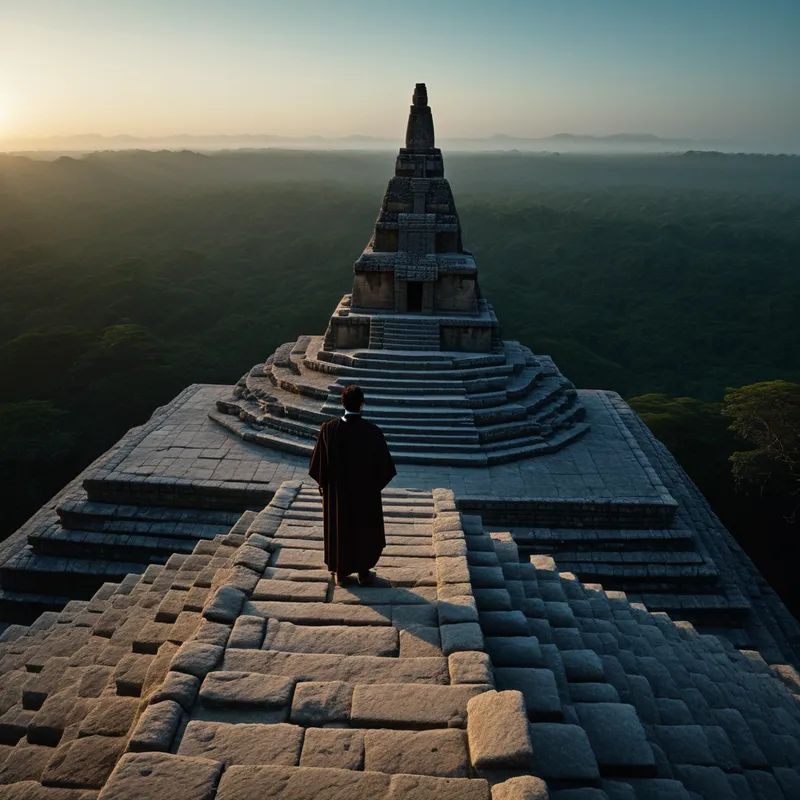
This is not a single story from a single book, but a living pattern etched into the stone of pyramids and the pages of surviving codices like the Dresden Codex. The figure of the Feathered Serpent is a pan-Mesoamerican archetype, known as Quetzalcoatl to the Aztecs and Kukulkan (meaning literally “Feathered Serpent”) to the Maya of the Yucatán Peninsula, particularly during the Postclassic period at great centers like Chichen Itza.
The myth was the foundational narrative of priestly and royal authority. It was passed down through elaborate rituals, calendrical ceremonies, and the iconography of power. To rule was to channel the wisdom of Kukulkan—to be the mediator between the earthly realm and the celestial order. The myth served as a societal blueprint, justifying social hierarchy, agricultural practice, and astronomical study as sacred duties. It transformed kings into living conduits of the serpent’s wisdom, responsible for maintaining the cosmic balance their patron deity had instituted.
Symbolic Architecture
At its core, the myth of Kukulkan is a profound symbol of synthesis and conscious evolution. The serpent is the quintessential symbol of the earth, the unconscious, the cyclical nature of life, death, and rebirth—the prima materia of the psyche. The bird, particularly the quetzal, represents spirit, intellect, consciousness, and the aspiration toward the heavens.
Kukulkan is the embodied reconciliation of opposites: instinct and intellect, earth and sky, time and eternity, the winding path and the straight road.
This is not a conquest of one over the other, but a sacred marriage. The serpent does not grow wings; it grows feathers. Its wisdom is not abandoned but transformed into a vehicle for higher understanding. Psychologically, Kukulkan represents the emergence of a guiding consciousness from the depths of the instinctual psyche—a consciousness that does not reject its origins but is beautified and elevated by them. He is the archetype of civilizing wisdom, the force that brings law (logos) to the inner and outer wilderness (chaos). His departure and promised return speak to the cyclical nature of this wisdom; it is not a permanent possession, but a state of grace that must be continually remembered and re-aligned with, especially during times of collective forgetting.
The Dreamer's Resonance
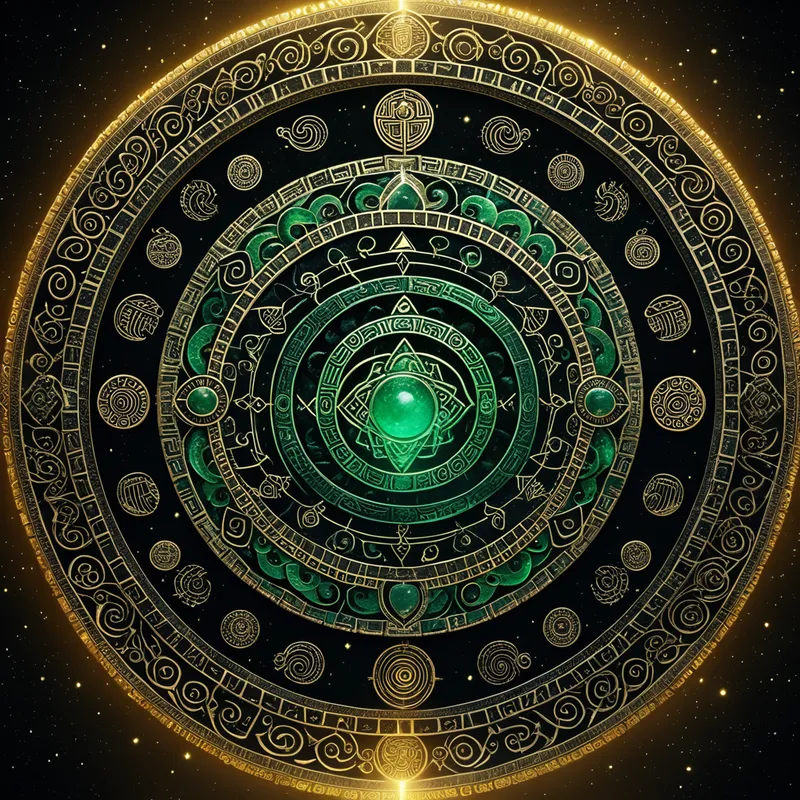
When this myth stirs in the modern dreamer, it often signals a profound process of psychic integration. To dream of a feathered serpent may feel awe-inspiring, not monstrous. It speaks to a moment where deep, instinctual drives (a career change, a creative urge, a relational pattern rising from the “gut”) are beginning to find a conscious, articulate form. The raw “snake” energy of passion or survival is growing the “feathers” of understanding, purpose, and expression.
Somatically, this can feel like a rising energy up the spine—a quickening, a sense of latent potential coalescing into directed power. Psychologically, it is the process of giving intelligent form to what was once inchoate emotion or impulse. The shadow of the serpent descending the pyramid in the dreamer’s mind is the moment of insight, when the patterns of one’s life (the pyramid’s steps) suddenly align with a greater, guiding pattern (the serpent’s body), revealing order within personal chaos. Conversely, dreaming of a serpent shedding its skin into feathers can indicate a painful but necessary transition where an old self-identity is being sloughed off to make way for a more authentic, integrated one.
Alchemical Translation
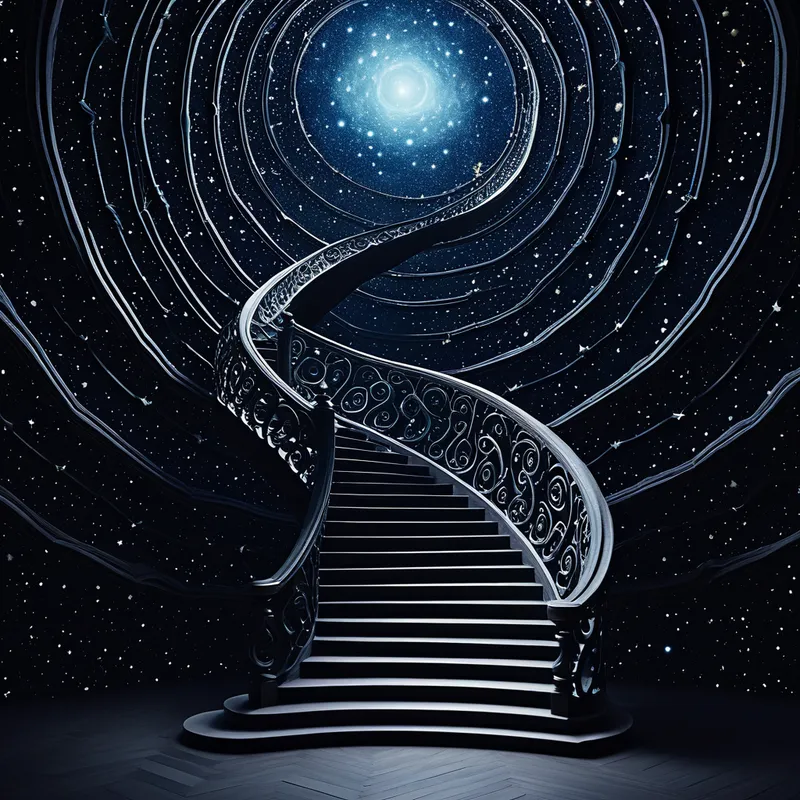
The alchemical journey mirrored in Kukulkan’s myth is the opus of individuation—the forging of the whole self. The process begins in the nigredo, the black chaos of the unexamined life, the “green jungle” of undifferentiated impulses and societal expectations. The call of Kukulkan is the first stirring of the Self, the central archetype of wholeness, which appears as this impossible, reconciling image.
The hero’s work here is not to slay the dragon, but to become the dragon in its highest form. The albedo (whitening) is the cultivation of consciousness—learning the “laws,” observing one’s own inner seasons and patterns. The building of the inner “temple”—a stable psyche aligned with one’s true north. The citrinitas (yellowing) is the illumination of applying this wisdom, the gifts of creativity and insight that come from this union.
The ultimate goal is the rubedo, the reddening: not the arrival at a static state of perfection, but the embodiment of the living, breathing synthesis. One becomes a vessel for a wisdom that is both grounded and visionary.
The promised return of Kukulkan is the enduring truth that this is a cyclical process. Each equinox of the soul—each crisis, each new beginning—is an invitation to once again walk the serpent’s shadowed path, to remember the count of one’s own days, and to re-commit to building a life that honors both the serpent’s wisdom of the earth and the quetzal’s aspiration for the sky. We do not find the Feathered Serpent; we enact it, stone by stone, day by day, in the temple of our own becoming.
Associated Symbols
Explore related symbols from the CaleaDream lexicon:
- Serpent — The foundational energy of the myth, representing the primal earth, the unconscious, cyclical time, instinct, and the potential for transformative healing and rebirth.
- Feather — The celestial counterpoint, symbolizing spirit, truth, ascension, and the light of consciousness that must be integrated with the serpentine depths.
- Pyramid — The human-made structure aligning with cosmic order; it represents the disciplined psyche, the ascent toward enlightenment, and the meeting point of heaven and earth.
- Calendar — The gift of Kukulkan, symbolizing the imposition of meaningful order on chaos, the understanding of cycles, and the sacred nature of time and destiny.
- Journey — The deity’s arrival and departure frame a sacred passage, modeling the soul’s journey from chaos to order and its promise of cyclical return and renewal.
- Order — The central theme of the myth, representing the civilizing principle, cosmic harmony (logos), and the structured wisdom that emerges from understanding natural law.
- Rebirth — Inherent in the serpent symbol and the equinox phenomenon; it signifies the perpetual renewal of life, wisdom, and the promise of return after a period of absence or dormancy.
- Temple — The sacred space created by the myth’s influence, representing the constructed self, a life built in alignment with higher principles, and a vessel for divine connection.
- Light — The illuminating wisdom Kukulkan brings, contrasted with the jungle’s shadow; it represents knowledge, consciousness, and the revelation of pattern and truth.
- Shadow — The tangible, moving manifestation of the serpent on the pyramid; it represents the unconscious made visible, the hidden pattern revealed, and the interface between spirit and matter.