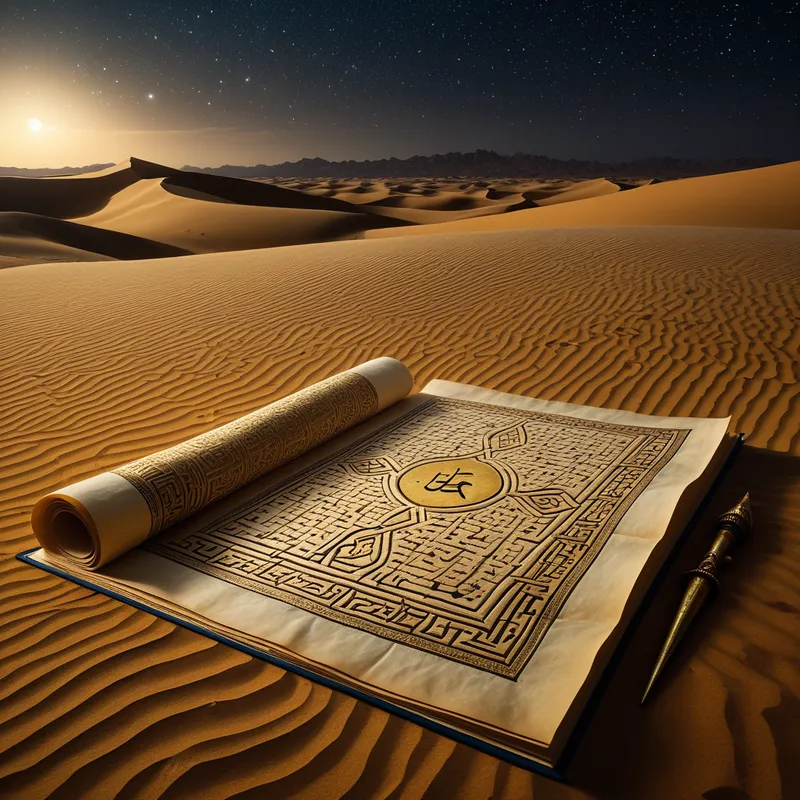
Kufic script Myth Meaning & Symbolism
A myth of divine revelation made manifest in geometry, where the sacred Word descends into form, demanding a human hand to shape its infinite silence.
The Tale of Kufic script
Listen. Before the ink, there was the silence. A silence so vast it filled the spaces between the stars, a silence that was the breath held before the first command. In that silence dwelt the Kalām, the Divine Utterance, a presence of pure meaning without sound, a light without shadow.
But a word yearns to be known. From the throne of divine command, a whisper stirred—not a sound, but a vibration in the fabric of possibility. It was a decree of manifestation: “Be.” And from that imperative, the first shape was born. It was not a letter, but a principle: the vertical. A line reaching from the unknowable height to the receptive earth, a bridge of intent. The scribes of old named this the Alif, the silent pillar of the alphabet, the channel.
Then came the conflict. The pure, vertical light of meaning could not settle upon the page of the world. It was too brilliant, too absolute. It needed a vessel, a discipline. So the angel Jibrīl did not bring a book of flowing script, but a compass of light and a ruler of crystal. He presented these not to a prophet first, but to the spirit of Form itself, saying, “The Word descends. You must give it a house that does not confine it, a body that does not obscure its soul.”
Thus began the great labor. The spirit of Form took the compass and drew a circle, perfect and endless, the symbol of divine unity and eternity. With the ruler, it bisected the circle, creating axes, angles, a grid of cosmic order. Upon this grid of potential, the descending light of the Alif met the horizontal plane of the world. Their intersection created tension, a right angle—the birthplace of all other shapes. From this marriage of vertical revelation and horizontal law, the other letters emerged: the Bā’ cradling meaning like a cupped hand, the Wāw arching like a vault of heaven.
But these shapes were still spirits, dancing in the air. They needed an anchor. So the call was sent to the human realm, to the one whose heart was still enough to hear the geometry of the divine. He was the first Scribe. In a room lit by a single lamp, the scent of oak gall and gum arabic thick in the air, he felt the shapes descend into his hands. His task was not to invent, but to witness and fix. With a reed pen cut at a precise angle, he began. Each stroke was a meditation, a surrender. The verticals were drawn with a held breath, unwavering faith. The horizontals were drawn with the measured patience of the earth. The curves were drawn with the loving attention of one tracing a sacred boundary.
And so, Kufic was born. Not written, but revealed through the hand. It was the Word, cooled from the fire of pure meaning into the crystalline structure of form, caught forever in the tension between divine infinity and human finitude, between the circle of heaven and the square of the earth.
Cultural Origins & Context
The tale of Kufic is not a single narrative from a sacred text, but a myth born from the collective soul of early Islamic civilization. It coalesced in the vibrant intellectual centers like Kufa, from which it takes its name, and Damascus. It was passed down not by bards, but by master calligraphers to their apprentices in the quiet of the scriptorium, whispered alongside technical instructions on grinding ink and cutting reeds.
Its societal function was profound. In a culture where the depiction of the divine form was prohibited, the written word—specifically the Qur’an—became the primary visual and spiritual encounter with the divine. Kufic was the architectural vessel for that encounter. Its development paralleled the building of the first great mosques; just as the mosque housed the community of believers, Kufic script housed the revealed Word. It was a myth of legitimacy and sanctification, transforming the act of writing from mere transcription into a liturgical art, a direct participation in the ongoing process of revelation’s manifestation in the world.
Symbolic Architecture
At its core, the myth of Kufic is a profound meditation on the paradox of revelation: how the infinite becomes finite without being diminished.
The straight line is the descent of the absolute; the curve is its embrace of the world.
The Alif, the primordial vertical, symbolizes the direct, unmediated connection between the divine source (Allah) and creation. It is the axis mundi, the individual soul standing in prayer, the moment of pure intuition. The subsequent grid and geometric rules represent the Shari’ah, the necessary structure and law that gives form to spiritual impulse, preventing it from dissipating into chaos or subjective fancy.
Psychologically, the myth maps the journey of an insight or a profound emotion from its birth in the unconscious (the silent Kalām) to its conscious integration. The raw, vertical “aha!” moment must be brought down to the horizontal plane of reality—given structure, language, and form—so it can be communicated and made durable in the world of time and space. The Scribe represents the conscious ego, whose role is not to generate the content but to provide the disciplined, attentive vessel for its manifestation.
The Dreamer's Resonance
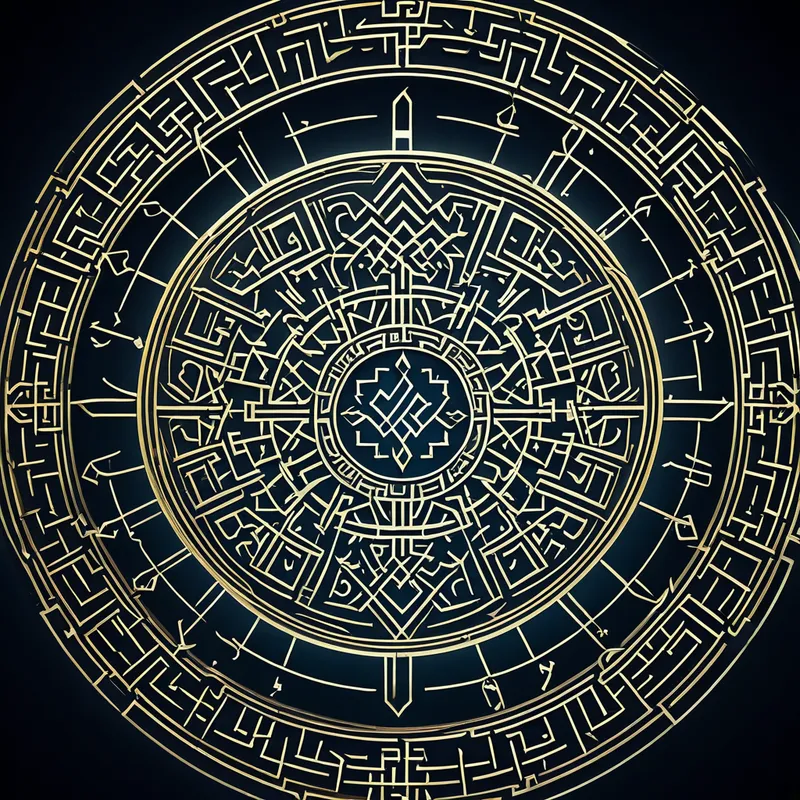
When Kufic script appears in modern dreams, it rarely appears as legible text. It manifests as powerful geometric patterns—lattices, grids, interlacing lines, or stark, imposing verticals against empty space. The dreamer may be trying to read it but finds the letters shifting, or they may feel compelled to trace its forms with their hand.
Somatically, this dream points to a process of psychic structuring. The dreamer is likely grappling with a flood of new ideas, a spiritual awakening, or a deep emotional truth that feels too vast and formless to integrate. The appearance of the script is the unconscious offering a template for containment. The anxiety of not being able to read it reflects the fear of not yet understanding the new content emerging within them. The act of tracing it signals the beginning of the ego’s work: the slow, patient, and reverent process of giving personal form to transpersonal energy. It is a dream of receiving a blueprint for the soul’s next stage of development.
Alchemical Translation
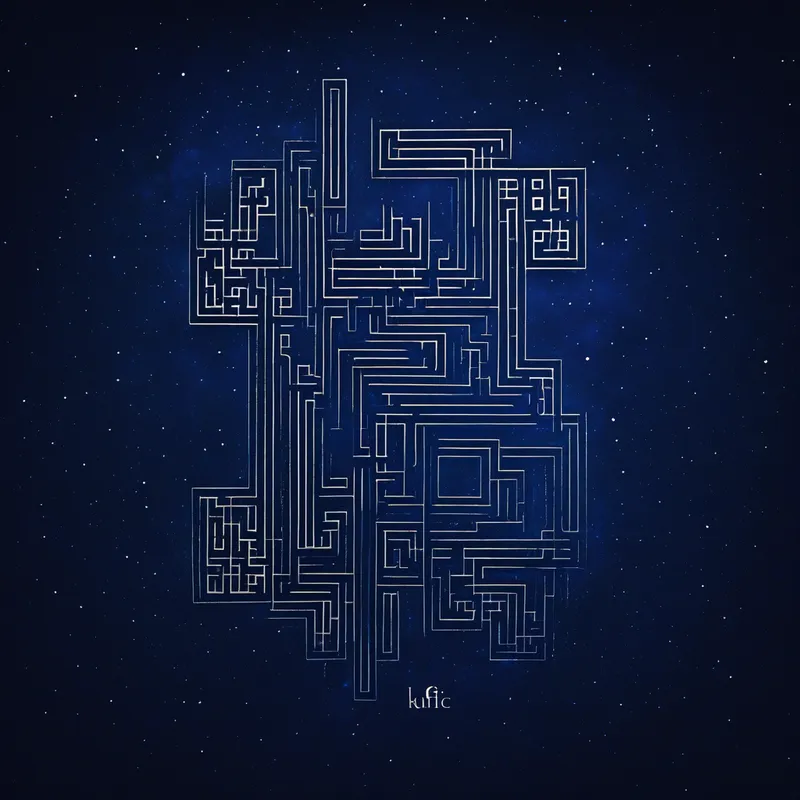
The alchemical process modeled by the Kufic myth is that of Coagulatio—the transformation of the volatile spirit (Spiritus) into a fixed, enduring substance (Corpus). In the individuation journey, this is the critical phase where luminous but fleeting inspirations, visions, or insights must be “made flesh” in one’s life work, relationships, or creative output.
The prima materia is the silent, overwhelming revelation; the finished lapis is the beautifully bound book.
The modern individual undergoes this when they take a profound inner experience—a dream, a loss, a moment of clarity—and commit to the labor of shaping it. The “compass and ruler” are the personal disciplines we adopt: a daily practice, a therapeutic framework, an artistic medium. The “reed pen” is our focused attention and skill. The struggle is against the temptation to leave the revelation in its pristine, spiritualized state (where it remains impotent) or to force it into a cheap, conventional form (which kills its essence).
The triumph is the creation of a “Kufic form” in one’s own life: a marriage where the vertical truth of the Self finds authentic, structured expression in the horizontal reality of one’s personal world. The script becomes legible not just to the individual, but to others, thus completing the cycle of revelation by enabling transmission. One becomes, like the first Scribe, a co-creator in the manifestation of meaning.
Associated Symbols
Explore related symbols from the CaleaDream lexicon: