Kubera's Pushpaka Myth Meaning & Symbolism
The story of the divine flying chariot Pushpaka, its theft from the god of wealth, and its ultimate return, symbolizing the sovereignty of the true self.
The Tale of Kubera's Pushpaka
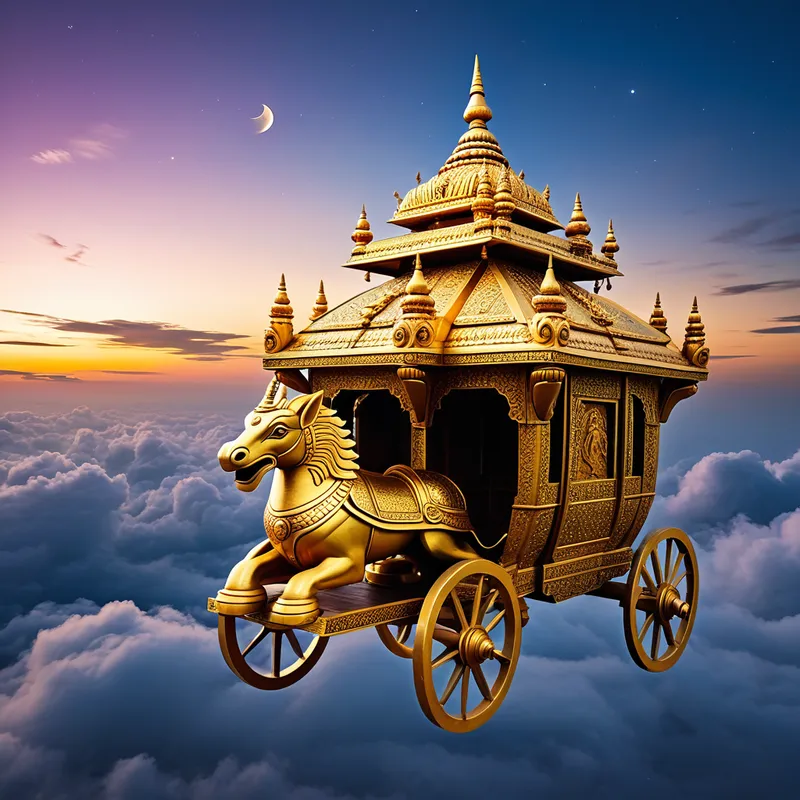
Listen, and let the scent of celestial blossoms carry you back. Before the great war, before the exile, there was a city of impossible gold. Lanka gleamed upon the ocean, a fortress of arrogance and art, ruled by the ten-headed Ravana. But its first lord was another: Kubera. His was a kingship of abundance, his breath the minting of coins, his touch the greening of the earth. And his most prized possession was not a mountain of gems, but a vehicle of the soul—the Pushpaka Vimana.
It was not built by mortal hands. It was born from the laughter of the divine architect, Vishvakarma, for the creator-god Brahma. A palace that could fly, a chariot that was a home. Its spires were of pearl, its floors of lapis lazuli, and its very essence was perfumed with the scent of eternal spring—pushpaka, the flower-bearer. Brahma, pleased with Kubera’s austerities and governance, gifted it to him. Thus, the Lord of Wealth took to the skies, surveying his vast domains from a throne of moving beauty.
But shadow grows in the presence of such light. Ravana, Kubera’s half-brother, consumed by a fire of ambition no ocean could quench, gazed upon Pushpaka. He did not see a gift of grace; he saw an instrument of dominion. His own power, earned through terrible penance to Shiva, was immense, yet earthbound. The sky belonged to Kubera. So, with the cold calculus of envy, Ravana marched upon Lanka. The battle was not of armies, but of essence: the consolidating, hoarding energy of Ravana against the generous, distributing spirit of Kubera. Kubera, a ruler of prosperity, not of war, was defeated. The victor’s prize was clear. Ravana seized the Pushpaka Vimana, and with a roar that shook the foundations of the world, ascended into the heavens, leaving his brother king standing amidst the ruins of his own splendor, sovereign of nothing but his own silent grief.
For ages, Pushpaka served the ego of its thief. It carried Ravana across the world, to the culmination of his folly: the abduction of Sita. It became the chariot of a crime that would summon its own end. And that end came with the ringing twang of Sharanga, the arrows of Rama. When Ravana fell on the battlefield, his ten heads severed, his monstrous form collapsing, the great chariot shuddered, as if released from a nightmare.
It did not wait for command. It glided of its own will to Rama, the true king, the embodiment of dharma. Rama, his duty fulfilled, looked upon the magnificent vehicle. He saw not a trophy of war, but a responsibility. His journey was not yet complete. With Sita and his loyal brother Lakshmana, he boarded Pushpaka. It carried them not as a conqueror, but as a restorer, back to the northern kingdom of Ayodhya. And when his reign was established, Rama, in an act of supreme sovereignty, did the unexpected. He did not keep it. He sent the Pushpaka back. On his command, the self-willed chariot flew across the skies once more, not to a thief, but to its original, rightful lord. It returned to Kubera, completing the great circle, restoring not just an object, but an order.
Cultural Origins & Context
This myth is woven into the epic tapestry of the Ramayana, attributed to the sage Valmiki. It functions as a crucial narrative hinge, connecting the realm of the gods (Devas) and nature spirits (Yakshas) with the central human (and demonic) drama. The story was transmitted for millennia through oral recitation by bards and temple storytellers, a vibrant thread in India's performative and devotional traditions.
Its societal function was multifaceted. On one level, it explained the origin of Ravana’s formidable power and his connection to the divine world through his brother. On another, it served as a moral and political allegory. It illustrated the consequences of adharma (unrighteousness)—Ravana’s theft leads ultimately to his annihilation—and the principle of righteous restoration. The return of Pushpaka to Kubera by Rama is a powerful statement on the duties of a true king: to defeat disorder and to re-establish the proper, harmonious alignment of all things, returning stolen sovereignty to its legitimate holder.
Symbolic Architecture
The Pushpaka Vimana is far more than a fantastical vehicle. It is a profound symbol of conscious agency and the vehicle of the Self.
The true vehicle is not what you possess, but what possesses you—the guiding intelligence that carries you toward your destiny.
Kubera represents legitimate, dharmic wealth and lordship. His possession of Pushpaka signifies a state where one’s inner resources (wealth) are perfectly aligned with one’s means of navigating the world (the vehicle). It is a state of integrated sovereignty. Ravana’s theft symbolizes the ego’s hijacking of this inner vehicle. He uses the power of consciousness (the Vimana) not for governance or connection, but for aggrandizement, possession, and ultimately, self-destruction. The chariot under Ravana is consciousness enslaved to desire.
Rama’s role is pivotal. He is the archetypal Self in Jungian terms. He does not seek the vehicle; it comes to him after the defeat of the inflated ego (Ravana). His use of it is purposeful and temporary—to return to his rightful place and restore order. His final act of sending it back to Kubera is the masterstroke of symbolism.
Individuation is not about acquiring the symbols of power, but about recognizing their rightful place in the ecology of the psyche and restoring their flow.
The return signifies that once the ego is aligned with the Self (Rama’s kingship), the specialized functions of the psyche (Kubera’s wealth-management) can be reinstated to their autonomous, proper function. The vehicle of consciousness is returned to its legitimate, abundant source.
The Dreamer's Resonance
When this myth stirs in the modern unconscious, it often manifests in dreams of extraordinary vehicles—a car that drives itself, a spaceship, a bicycle that flies. The dreamer may be in the driver’s seat, a terrified passenger, or watching it be stolen. The somatic feeling is key: a thrilling sense of agency or a crushing loss of control.
To dream of stealing such a vehicle points to a psyche in the grip of Ravana-consciousness. The dreamer may be using their intellect, charm, or will (their “vehicle”) to take what isn’t theirs—usurping a role, forcing a relationship, pursuing success without integrity. There is a brittle, grandiose energy. To dream of losing the vehicle, like Kubera, speaks to a profound disempowerment. The dreamer feels their means of navigating life—their confidence, their creativity, their health—has been seized by an external force (a job, a person, an addiction) or an internal complex (anxiety, depression).
The most healing dream in this cycle is to be returning the vehicle, or to have it returned. This signals the psyche’s deep work of restitution. It is the moment one realizes, “This power, this talent, this path, is not mine to own and hoard. It is mine to steward, and its source must be honored.” It is the end of identification with the tool and the beginning of relationship with the source.

Alchemical Translation
The myth of Pushpaka models the complete alchemical cycle of psychic transmutation: from nigredo (blackening) through albedo (whitening) to rubedo (reddening), the creation of the philosophical gold.
The initial state is Kubera’s integrated rule (the gold). The theft by Ravana plunges the system into nigredo—the chaos of the ego’s inflation, the “dark night” where our highest faculties are used for shadow purposes. We feel powerful but are profoundly lost. The battle between Rama and Ravana is the fierce albedo, the purification. It is the conscious, often painful, confrontation with the inflated ego. One must “decapitate” the ten heads of Ravana—the myriad grasping, knowing, demanding voices of the ego-complex.
Victory in this battle is not the end. The rubedo, the final reddening and creation of the true gold, is Rama’s act of return. This is the stage most modern individuation journeys neglect. We seek to defeat our demons and claim our prize (the chariot for ourselves). But the myth insists the final step is restitution. The alchemical gold is not a trophy on your shelf. It is the restored circulation of value within the entire psyche.
The ultimate sovereignty is the power to give back, to complete the circle, thereby making the whole system sovereign.
For the individual, this translates thus: You identify a talent (your Pushpaka) that you’ve been using for egoic gain (Ravana’s theft). You confront that pattern (the battle). You reclaim the talent for a dharmic purpose (Rama’s use). Then, you perform the crucial alchemical act: you consciously dedicate that talent, that energy, back to the source from which it ultimately springs—be it the divine, the unconscious, life itself, or the principle of abundance (Kubera). You stop being the owner of your gift and become its conduit. In that act of return, you are no longer riding the vehicle. You have become, like Kubera restored, the rightful ground from which it rises and to which it faithfully returns.
Associated Symbols
Explore related symbols from the CaleaDream lexicon: