Kshana Myth Meaning & Symbolism
A myth of a single, all-destroying moment personified, born from the wrath of Shiva to annihilate a cosmic demon, revealing the power of the eternal now.
The Tale of Kshana
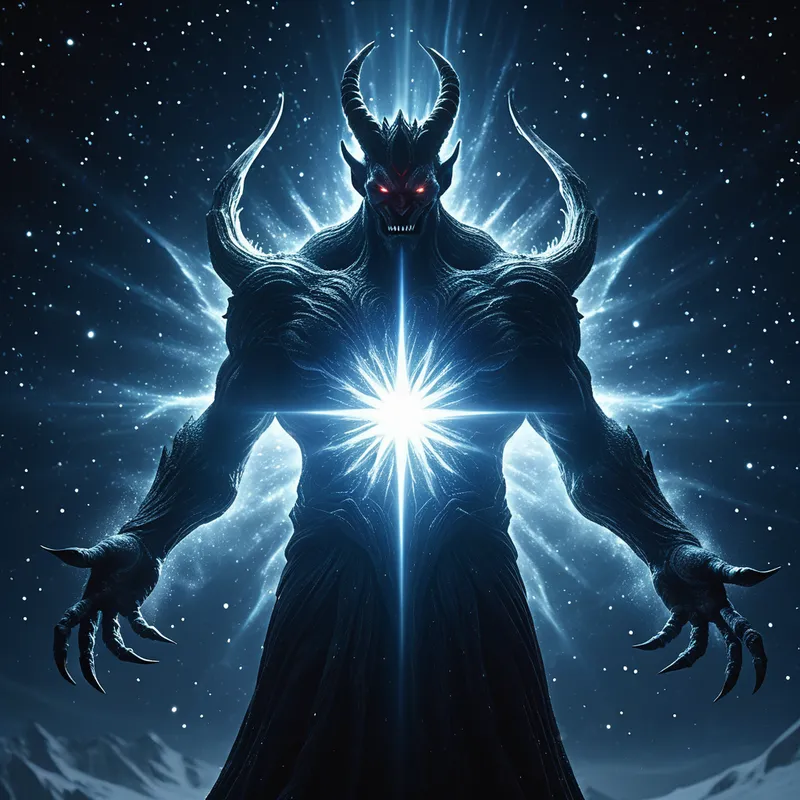
Listen. Before the worlds were counted, when the great rhythm of the cosmos was still a new song, there existed a darkness that was not mere absence of light, but a hunger. This was Andhaka, the demon of obscurity. He was born of a drop of sweat from the brow of the great ascetic, Shiva, a being so potent his very essence could spawn monsters. Andhaka grew in the shadows, his form vast and nebulous, a blot against the tapestry of stars. His blindness was not of the eyes, but of the soul—a refusal to see the light of consciousness, a desire to swallow all creation back into undifferentiated night.
He performed terrible austerities, his penance a perversion of Shiva’s own, and won a boon: he could not be killed by day or by night, inside or outside, by man or beast, by weapon or tool. Swollen with invincibility, Andhaka set his sight on the ultimate transgression. He desired Parvati, the very embodiment of cosmic energy and Shiva’s beloved. His armies of shadow swarmed the heavenly realms, and a war erupted that shook the pillars of time. The gods fought, but their weapons passed through Andhaka like mist. He was a paradox, a living loophole in the laws of reality.
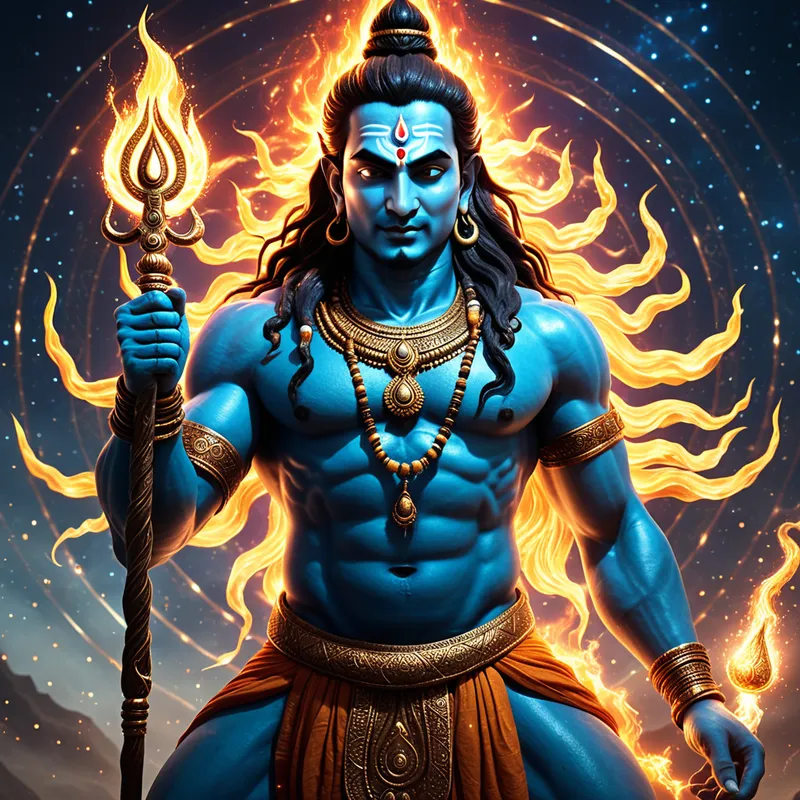
On the peak of Mount Kailash, the air grew cold with a silence deeper than the void. Shiva, the Adiyogi, opened his eyes. They were not the eyes of a warrior, but of an absolute principle. In the space between one breath of the universe and the next, in the twilight that is neither day nor night, he acted. He did not reach for a weapon. He did not summon a beast. He simply focused the totality of his being—his boundless, transformative wrath—into a single, infinitesimal point.
From the blazing eye of wisdom on his forehead, his Ajna Chakra, a spark was born. But this was no ordinary spark. It was a condensation of absolute now. It was a moment given form, a sliver of eternity made manifest. This was Kshana. It emerged not with a roar, but with the sound of a universe holding its breath—a high, silent frequency that vibrated in the bones of creation.
Kshana flew, a shimmering, dimensionless point of light. It found Andhaka not on a battlefield, but in the liminal space between attack and defense, a place that was neither inside nor outside. In that suspended instant, Kshana touched the demon’s heart. There was no explosion, no clash of steel. There was only dissolution. Andhaka, the eternal, undying darkness, encountered the one thing he could not withstand: a moment so pure, so complete, so utterly present, that it contained the power of all beginnings and all ends. His form unraveled like a thread of smoke in a sudden wind, not into nothingness, but into a shower of luminous sparks, each a potential for light. The hunger was satiated by its own extinction in the fullness of the now.
Cultural Origins & Context
The myth of Kshana is woven into the vast tapestry of Puranic literature, specifically within the Shiva Purana and related tantric texts. Unlike the grand, linear epics of the Ramayana or Mahabharata, this story belongs to a more metaphysical stratum of mythology. It was likely preserved and elaborated upon by Shaivite ascetics and tantrikas—practitioners who sought to understand the nature of reality through the lens of Shiva as the ultimate consciousness.
Its societal function was not merely to explain the slaying of a demon, but to model a profound cosmological and psychological principle. In a culture with a sophisticated philosophy of time—encompassing the fleeting kshana (moment), the yuga (age), and the eternal kalpa (cosmic cycle)—this myth served as a dramatic illustration of time’s dual nature. It showed that time is not just a river that carries us, but a weapon, a tool, and a state of being that can be mastered by the awakened consciousness. It taught that the ultimate power lies not in duration, but in depth of presence.
Symbolic Architecture
Kshana is not a deity of time’s passage, but of its point. It is the personification of the eternal present, the nunc stans of medieval mystics, seen through a Hindu lens of divine agency.
The demon is not slain in time, but by the very essence of time stripped bare to its core: the indivisible now.
Andhaka symbolizes the obscuring, undifferentiated mass of the unconscious—the psychic inertia that resists consciousness, the "blind" drives and complexes that seek to pull all differentiated experience back into a state of primal, ignorant unity (his desire for Parvati, the conscious organizing principle). His boon-made invincibility represents the ego’s clever defenses; our neuroses and patterns cannot be defeated by conventional, binary means (day/night, inside/outside).
Shiva, as the transcendent consciousness, does not fight the shadow on its own terms. He generates Kshana from his third eye, the seat of intuitive perception. This signifies that the power to dissolve psychic obstruction arises from a shift in perception itself—a move from sequential, analytical thinking to a direct, non-dual apprehension of reality.
Kshana, the moment-weapon, symbolizes the laser-like focus of absolute attention. It operates in the liminal space (twilight, neither in nor out), which in psychology is the temenos or sacred space of transformation, where old rules dissolve. Its action is not destruction, but dissolution—the breaking down of rigid, complex-ridden structures (Andhaka) into their constituent, luminous parts (sparks of light), freeing energy for reintegration.

The Dreamer's Resonance
When this myth stirs in the modern unconscious, it may manifest in dreams not of epic battles, but of profound temporal dislocations and pinpoint transformations.
A dreamer might experience: The Singular Point Dream: A dream where everything converges on one object—a keyhole, a dot on a wall, a still drop of water—that holds immense, terrifying, and liberating power. The entire dreamscape feels drawn into it. The Suspended Instant Dream: A dream narrative that freezes at a critical moment of decision or confrontation. The dreamer exists in that freeze-frame, feeling immense pressure and potential, as if the outcome of their life depends on the quality of their awareness in that static scene. The Dissolution Dream: Dreaming of a looming, oppressive problem or figure (a monster, a tower, a vast machine) that simply vanishes, not by being fought, but by being seen through—it unravels, pixelates, or turns to sand when directly confronted with steady, non-reactive observation.
Somatically, the dreamer may awaken with a sensation of crystalline clarity, a sudden release of chronic tension, or a feeling of having passed through a needle’s eye. Psychologically, this signals a confrontation with a "blind" complex—a long-held pattern of resentment, fear, or identity—that is ready to be dissolved not by years of analysis, but by a moment of radical, uncompromising self-honesty and presence.
Alchemical Translation
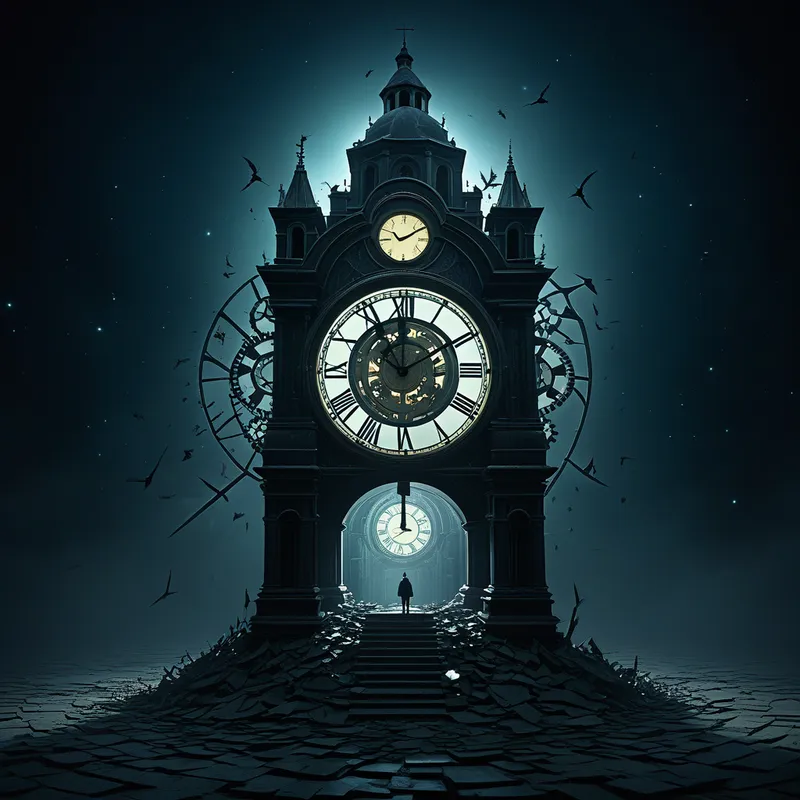
The alchemy modeled here is the transmutation of chronic psychological time—the burden of the past and anxiety for the future—into the liberating gold of conscious presence. The process of individuation often gets stuck in the "Andhaka phase": we are besieged by shadow contents that seem invincible, protected by the clever boons of our own rationalizations and avoidance strategies.
Individuation is not a marathon of self-improvement, but a series of annihilating moments of pure seeing.
Shiva’s role is the archetype of the inner transcendent function. The practitioner must learn to access this "third eye" consciousness—a state of witness that is neither for nor against the complex, neither identified nor repulsed. From this detached center, one generates the "Kshana."
In practical terms, this is the disciplined application of mindfulness at the precise point of trigger. When the old wound flares, the habitual story arises, instead of engaging in the internal battle (day/night, fight/flight), one focuses the full intensity of awareness on the raw sensation and emotion in the immediate present. This focused attention is the Kshana. It shines the light of consciousness into the very heart of the unconscious formation.
The result is not the violent killing of a part of oneself, but its alchemical dissolution. The complex loses its cohesive, demonic power. Its energy—once used to fuel blindness and hunger—is freed, breaking down into "luminous sparks." These are the insights, the released creative potentials, and the reclaimed psychic energy that can now be integrated into a more whole, more present Self. The myth teaches that enlightenment is not a distant future state, but a quality of the moment we are capable of wielding, right now, to dissolve the darkness that binds us.
Associated Symbols
Explore related symbols from the CaleaDream lexicon: