Krishna's Flute Myth Meaning & Symbolism
The divine call of Krishna's flute enchants all of creation, drawing souls from their worldly duties into a timeless, ecstatic dance of love and longing.
The Tale of Krishna's Flute
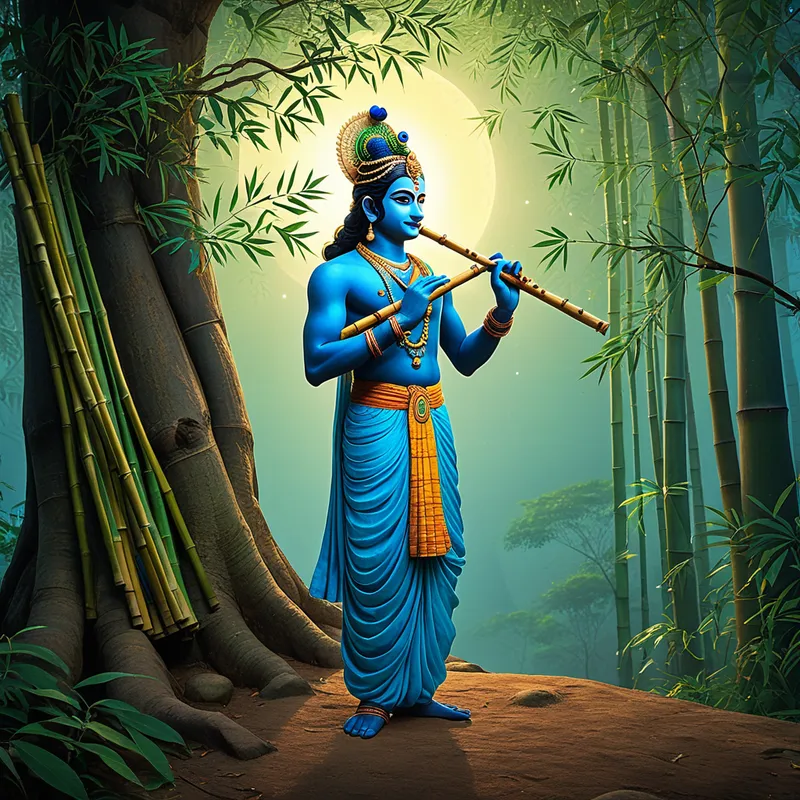
Listen. In the deep, emerald heart of Vrindavan, where the Yamuna river whispers ancient secrets, there lived a cowherd boy who was not a boy. His skin was the color of a thundercloud heavy with rain, his eyes held the mischief of a thousand suns, and on his brow sat a single, iridescent peacock feather. His name was Krishna.
But the true magic was not in his form. It was in the sound he drew from a simple bamboo flute. When dusk painted the sky in hues of saffron and violet, Krishna would wander to a quiet bend in the river, beneath the sheltering arms of a Kadamba tree. He would raise the flute to his lips, close his eyes, and breathe.
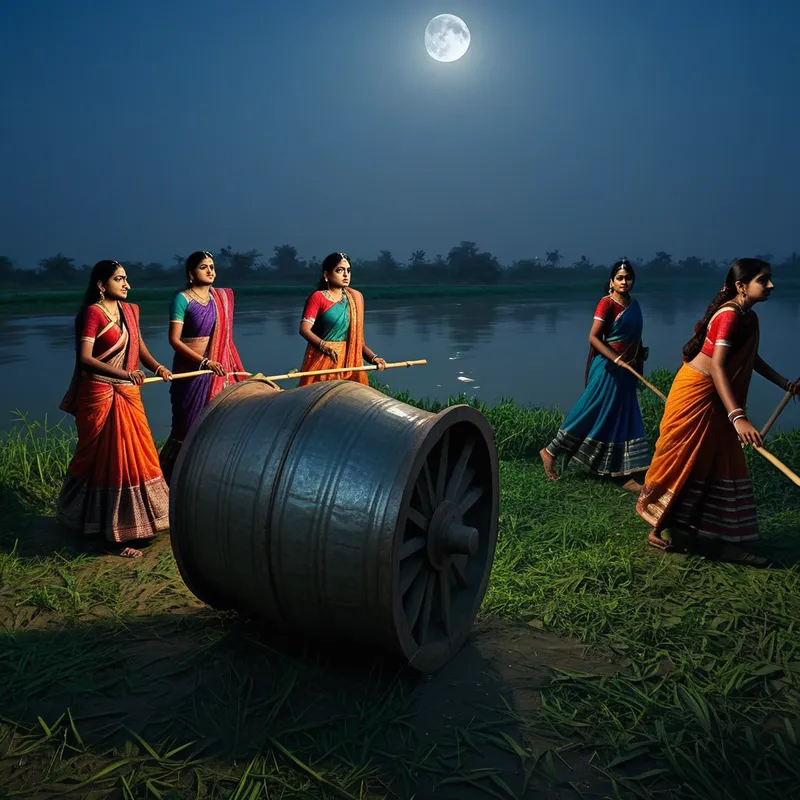
The first note was not a sound, but a sigh that parted the very fabric of the evening. It was a call that bypassed the ears and spoke directly to the marrow of the soul. In the villages, the gopis—the milkmaids—would freeze. Jars of butter slipped from their hands, spilling gold upon the earth. Spinning wheels fell silent, their threads forgotten. A fire of impossible longing ignited in their chests. They heard their own names woven into the melody, a summons they could not, would not, deny.
Leaving behind half-cooked meals, sleeping children, and the strictures of their worldly duties, they fled into the night. Saris caught on thorns, ankles turned on roots, but they did not stop. The flute was a golden thread pulling them through the dark forest. When they found him, the scene was one of impossible, divine madness. Under the swollen moon, Krishna was not one, but many. To each gopi who arrived, he appeared to be dancing with her alone, his flute now silent, its work done. They danced the Rasa Lila, a whirling circle of ecstasy where lover and beloved, seeker and sought, merged into a single, pulsing rhythm of pure joy. The very stars leaned down to watch. In that clearing, time ceased. Duty was a forgotten dream. There was only the dance, the divine beloved, and the eternal echo of the call that made it all possible.
Cultural Origins & Context
This myth is not a singular story but a living, breathing constellation of poetry, song, and theology that has flourished for over two millennia. Its primary sources are the Puranas, particularly the Bhagavata Purana (circa 9th-10th century CE), and the lyrical genius of poets like Mirabai and the Alvars. It was passed down not just by priests, but by wandering bards, temple singers, and grandmothers telling tales by firelight.
Its societal function was multifaceted. On one level, it established the doctrine of bhakti—devotional surrender—as a powerful, egalitarian spiritual path open to all, regardless of caste or gender. The gopis, simple village women, became the ultimate devotees. On another level, it provided a sacred container for the experience of intense human emotion—erotic love, separation (viraha), and union—transmuting them into metaphors for the soul's relationship with the divine. The myth served as a cultural dream, articulating a truth that rationality could not: that the ultimate reality is not a cold principle, but a personal, attractive, and loving presence that calls to us.
Symbolic Architecture
The myth is a masterclass in symbolic language, where every element is a door to deeper understanding.
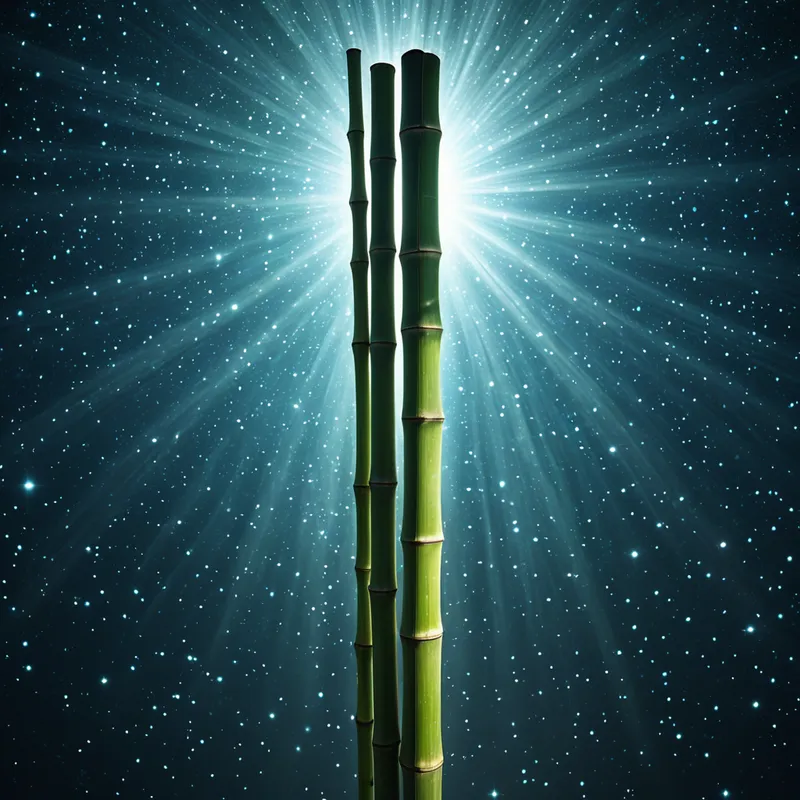
The Flute: It is not an instrument of mastery, but of surrender. The hollow bamboo, once a proud reed, must be emptied, pierced, and carved open to become a vessel. It represents the human soul or body, which must become empty of ego and personal desire to be played by the divine breath.
The most profound music is not made by the flute, but by the emptiness within it that allows the divine breath to pass through.
Krishna, the Flute-Player: He is the Purusha, the supreme soul, the source of all attraction. His flute playing is the active principle of creation—the divine call that initiates the cosmos and continuously draws consciousness back to its source. He is the archetypal beloved, the animus of the world soul.
The Gopis and Their Abandonment: They symbolize individual souls (jivatmas) and the faculties of the mind and senses. Their dramatic abandonment of household duties is the central, shocking imperative of the myth. It represents the necessary, often disruptive, moment of total commitment—where the conventional, orderly "world" (the home, social duty, the ego's projects) is left behind in answer to a higher calling. Their desperate search through the dark forest is the soul's journey through the confusion of life and the unconscious.
The Rasa Lila Dance: This is the symbol of consummation and harmonious union. The circular dance signifies the cyclical nature of creation and the non-hierarchical, playful relationship between the one and the many. Krishna multiplying himself signifies the divine's capacity to be intimately, uniquely present for each individual soul simultaneously.
The Dreamer's Resonance
When this myth stirs in the modern unconscious, it rarely appears as a literal scene of Krishna and gopis. Instead, it manifests as the psychology of the call and the abandonment.
To dream of hearing an irresistible, beautiful sound (a bell, a voice, a melody) that draws you away from a mundane or urgent task is to touch this archetype. You might dream of leaving a critical meeting, a sink full of dishes, or a car in traffic to follow this sound into a forest or unknown city. The somatic feeling is one of pulling—a magnetic attraction in the chest or gut that overrides logical planning.
Psychologically, this signals a powerful activation from the Self (the inner equivalent of Krishna), urging a reorientation of life energy. The "abandoned tasks" represent the current ego-identity and its commitments, which may have become sterile or confining. The dream is not advocating literal irresponsibility, but is highlighting a deep, soul-level imperative that is demanding attention. It often precedes or accompanies a period of significant life transition, a calling to a new vocation, relationship, or creative endeavor that requires leaving a familiar, but now outgrown, shore.

Alchemical Translation
The process modeled here is the alchemy of individuation, framed as a love affair with the deepest Self. It is a three-stage transmutation.
First, the Piercing (Nigredo): The ego, like the bamboo reed, experiences a "piercing"—a crisis, a loss, a deep dissatisfaction. This suffering hollows out pride and prepares the vessel. One feels empty, purposeless. This is the necessary dark night.
Second, the Call and Abandonment (Albedo): From this emptiness arises the "call"—an intuition, a new idea, a pull toward something that feels more authentic. The albedo stage is the dawning moonlit clarity of the gopis' flight. It requires the immense courage to abandon—not necessarily physically, but psychologically. We must abandon the old identity, the safe but soul-killing narratives, the "shoulds" imposed by family and society. This is the most critical and perilous stage, a leap into the dark forest of the unknown.
The transformation occurs not in the finding, but in the fierce, unequivocal act of leaving everything to seek the source of the song.
Third, the Divine Play (Rubedo): The final stage is not a static "achievement" of the goal, but the rubedo—the embodied, joyful participation in the dance. It is the state where one's life itself becomes the flute. The ego, now properly aligned as an instrument, allows the energy of the Self to flow through one's actions, relationships, and creativity. Life becomes a "Lila," a divine play. One works, loves, and creates not from compulsion or for personal gain, but as a spontaneous expression of the music that now moves from within. The seeker realizes they were never separate from the beloved; they were, all along, the very space through which the beloved's song was yearning to be heard.
Associated Symbols
Explore related symbols from the CaleaDream lexicon: