Krishna's Blue Myth Meaning & Symbolism
The story of how the god Krishna's skin turned blue, symbolizing the infinite, all-encompassing nature of divine love and consciousness.
The Tale of Krishna's Blue
Listen. In the deep, dark hour before the world remembers itself, a prophecy echoed through the celestial realms. A great evil, the tyrant king Kamsa, had been told his death would come from the eighth child of his sister, Devaki. In his terror, he imprisoned Devaki and her husband, Vasudeva, and slaughtered each newborn that arrived. But when the eighth child was born, on a night when thunder rolled without rain and the river Yamuna held its breath, the prison doors swung open of their own accord. The guards slept a sleep of stone. This child was different. His skin was the color of a rain-washed sky at dusk, a dark, luminous blue.
Vasudeva, cradling the infant, was guided by a divine voice. He carried the babe through the raging Yamuna, the waters parting before his feet, to the village of Gokula. There, in the home of the cowherd chieftain Nanda and his wife Yashoda, he exchanged the blue child for their newborn daughter. The divine child, named Krishna, grew in the pastoral bliss of Vrindavan, his blue skin a constant wonder.
But the shadow of Kamsa stretched long. He sent demons to kill the boy. One such was Putana, a creature who could assume any form. She came as a beautiful, benevolent woman and offered her poisoned breast to the infant Krishna. He, knowing her true nature, suckled not just the milk, but drew forth her very life force. As Putana died, screaming, releasing her monstrous form, the poison within her milk stained Krishna’s skin. But it did not merely stain; it transformed. The blue of his skin deepened from a twilight hue to the profound, infinite blue of the midnight sky, the blue of the deepest ocean abyss. It was not a taint, but a transmutation. The poison of hatred and death, consumed by divine love, became the visible mark of the all-encompassing, the boundless. His blue was the color that had swallowed the universe and found it sweet.
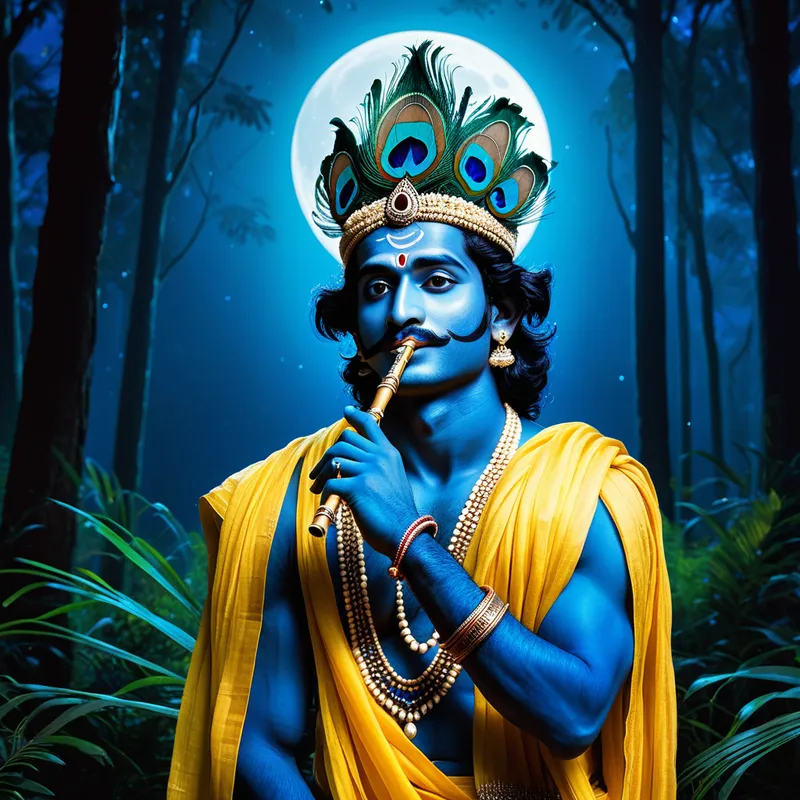
From then on, Krishna of the Blue Skin played his flute, and the world danced. His blue was the canvas upon which the gold of his robes shone, the backdrop for the peacock feather in his crown. It was the color that drew the Gopis into the moonlit forest, the color that calmed the serpent Kaliya in the Yamuna. It was the hue he wore when he revealed his cosmic form, the Vishvarupa, to the warrior Arjuna, containing within its expanse all time, all space, all creation, and all dissolution. The blue was not his covering; it was his essence revealed—the infinite made intimate, the cosmic made personal.
Cultural Origins & Context
The figure of Krishna, and the specific lore of his blue skin, emerges from a vast tapestry of texts and traditions, primarily the epic Mahabharata, the Brahmanas, and later, profoundly, the Bhagavata Purana (circa 9th-10th century CE). This was not a static, monolithic myth but a living story sung by bards, elaborated by poets like Mirabai and Surdas, and performed in folk theatre.
The myth functioned on multiple societal levels. For the philosophical elite, it was a theological discourse on the nature of the absolute (Brahman) taking personal, accessible form. For the agrarian communities, it grounded the divine in their world—a god who was a cowherd, who stole butter, whose blue mirrored the monsoon sky that brought life. The Bhakti (devotional) movements, which swept across India from the 7th century onward, seized upon Krishna's blue as the ultimate symbol. It represented a divinity that was not distant and colorless (nirguna) but immanent and full of qualities (saguna)—a god you could love, a god whose very color was an embrace. The story was passed down not just to explain, but to evoke—to inspire the rasa, the aesthetic emotion of devotional love.
Symbolic Architecture
Krishna's blue is a symbol of staggering depth, a multi-faceted jewel reflecting different lights of understanding.
It is, first, the color of the infinite. Blue is the color of the sky and the ocean, the two most vast, horizon-less phenomena known to earthly experience. Krishna's blue skin signifies he contains all of space, is unbounded by form or limit.
The blue is the container that holds the universe, yet it is also the intimate hue of the beloved's skin. In this paradox lies the heart of the myth: the infinite is not "out there," but is the very substance of the personal.
Second, it is the color of psychic and spiritual poison transformed. The encounter with Putana is not merely a physical battle; it is an alchemical process. The infant god consumes the toxic intent—the shadow, the hatred, the death-drive—and does not repel it. He integrates it. The poison loses its destructive power and becomes the visible sign of his invulnerability and all-encompassing nature. The blue, therefore, is the color of integration, of the conscious entity that has digested its own darkness and made it a source of radiance.
Finally, it is the color of divine attraction. In the aesthetic theory of Rasa, blue is associated with Shringara. Krishna's blue is magnetically beautiful, drawing the Gopis, representing the individual souls (Jivas), into the divine dance (Rasa Lila). It symbolizes the pull of the transcendent on the human heart, a love that is both intimate and cosmic.
The Dreamer's Resonance
When the symbol of Krishna's Blue appears in a modern dream, it rarely arrives as a literal deity. It manifests as a profound somatic and psychological process. One might dream of a blue light emanating from their own chest, of swimming in an ocean of luminous indigo, or of touching a surface that stains the fingers with an intelligent, living azure.
Psychologically, this signals a confrontation with and attempted integration of a profound "poison"—a deep-seated trauma, a core wound, a toxic pattern or complex that feels alien and destructive. The dreamer is in the process of the "Putana moment." The ego is being asked not to fight the shadow, not to project it onto others, but to take it in, to "suckle" it, to metabolize it fully. This is a terrifying prospect to the conscious mind, which views such contents as deathly.
The resulting "blueing" in the dreamscape signifies the beginning of a transmutation. The ego-skin is changing color. It is becoming less personal, less identified with the small self, and more identified with a larger, more impersonal consciousness. The dream may carry feelings of awe, sacred terror, and immense beauty—the hallmark of a numinous encounter with the Self, the central archetype of wholeness. It is the somatic marker of the psyche moving from a state of fragmentation to a more integrated, boundless state of being.

Alchemical Translation
The myth of Krishna's Blue is a master blueprint for the Jungian process of individuation—the journey toward becoming an integrated, whole individual. The "poison" of Putana represents the personal and collective shadow: all we disown, fear, and reject within ourselves—our rage, our greed, our pettiness, our trauma.
The first alchemical stage is nigredo, the blackening, represented by the confrontation with the poisonous demoness. The conscious self (the infant Krishna) must engage this shadow, not in battle, but in a terrifying intimacy. It must "drink it in."
The act of transformation is not one of purification, but of ingestion. Wholeness is not achieved by remaining pure, but by consciously consuming one's own darkness and discovering it is the very pigment of the soul.
The blue skin is the result of this process—the caeruleum, or blue phase, a profound and mysterious stage in alchemy signifying the celestial, the spiritualization of matter. In psychological terms, this is the emergence of a new attitude. The ego is no longer at the center; it becomes a vessel for a broader, more cosmic perspective. The personal identity is tinged with, and eventually saturated by, the transpersonal Self.
For the modern individual, this translates to a profound inner shift. One stops fighting their flaws and wounds as alien invaders and begins to see them as the very substance from which their depth, compassion, and resilience are formed. The "blue" is the feeling of no longer being solely defined by personal history, but of touching a timeless, boundless ground of being within. It is the color of a love that has faced the poison of hatred and found it to be, in the final alchemy of the soul, just another form of itself. The flute then plays from this blue center, calling all fragmented parts of the psyche into a harmonious, divine dance.
Associated Symbols
Explore related symbols from the CaleaDream lexicon: