Krishna and the Gopis Myth Meaning & Symbolism
A myth of the divine flute-player Krishna, whose music draws the village women into a mystical night of cosmic dance and ultimate union.
The Tale of Krishna and the Gopis
Listen. The night is not empty. It is a vessel, waiting to be filled. In the land of Vrindavan, where the Yamuna flows like a ribbon of dark silk, the air grows heavy with the perfume of [jasmine](/myths/jasmine “Myth from Persian culture.”/) and unspoken desire. The day’s heat has bled into a deep, velvet dusk. The cows are penned, [the hearth](/myths/the-hearth “Myth from Norse culture.”/) fires banked. In every home, the women of the village—the Gopis—feel a strange restlessness in their blood, a pull as inexorable as [the moon](/myths/the-moon “Myth from Tarot culture.”/) on the tide.
Then, it comes. Not a sound, but a summons. The flute of [Krishna](/myths/krishna “Myth from Hindu culture.”/). It drifts from the kadamba groves, a melody woven from starlight and shadow. It does not enter the ear; it bypasses flesh and bone to resonate directly in the chamber of the heart. It speaks of a joy so profound it aches, of a belonging so complete it shatters [the self](/myths/the-self “Myth from Jungian culture.”/).
One by one, they rise. A mother leaves her child sleeping. A wife abandons her half-woven garland. A daughter forgets her father’s house. Their saris are hastily tied, their hair unbound. They do not walk; they are drawn, pulled by an invisible thread of sound through the dark forest. Thorns tear at their clothes, branches snag their ornaments, but they are heedless. The only reality is the flute, growing clearer, sweeter, more intoxicating.
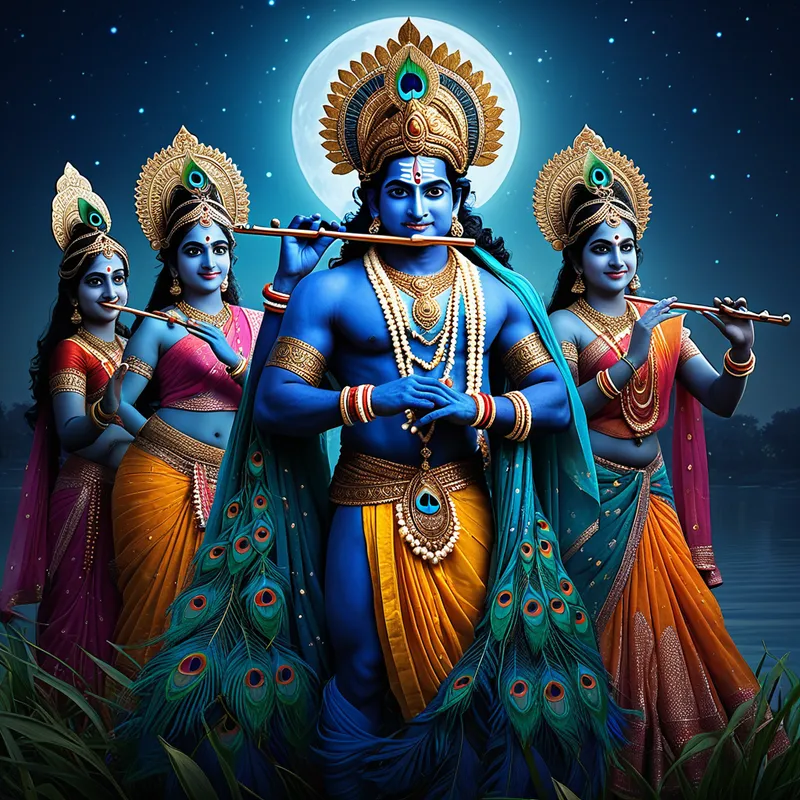
They burst into a moon-drenched clearing. And there he is. Krishna, the dark one, the butter-thief, the divine cowherd. His skin is the color of a monsoon cloud, his eyes hold universes. A single peacock feather dances in his crown. His lips are pressed to [the bamboo](/myths/the-bamboo “Myth from Taoist culture.”/) flute, and from it pours the very essence of creation and call.
He smiles, and the dance—the [Rasa Lila](/myths/rasa-lila “Myth from Hindu culture.”/)—begins. Not a dance of steps, but of souls. Krishna multiplies himself, becoming a perfect companion for each Gopi. Each woman feels him dancing with her alone, his gaze meant only for her. They circle in an ecstatic wheel, a whirling [mandala](/myths/mandala “Myth from Buddhist culture.”/) of devotion under the watchful moon. Time dissolves. Duty, identity, fear—all are burned away in the fire of this union. They are not women dancing with a god; they are sparks merging back into the divine flame.
But the night must end. As the first hint of dawn stains the eastern sky, a profound test arrives. Krishna vanishes. One moment he is there, the center of their world; the next, he is gone. The music stops. The clearing is suddenly cold and empty. A cry of pure, desolate longing rises from a hundred throats. They search frantically, calling his name into the silent trees. In their agony, they begin to imitate him—one pretends to be Krishna, another becomes his flute, enacting his deeds in a desperate pantomime of love.
It is in this state of utter surrender, when [the ego](/myths/the-ego “Myth from Jungian culture.”/)’s last claim has been scorched away by longing, that he returns. Not as the playful dancer, but as the supreme reality. He reveals that his disappearance was the final gift, the necessary void that made their love absolute, not for his form, but for his essence. In that moment of reunion, they understand: the separation was the deepest part of the dance. The flute’s call was not to pleasure, but to pilgrimage. The night in Vrindavan was an eternity, and they had come home.

Cultural Origins & Context
This myth, immortalized in texts like the Bhagavata Purana and the poetic masterworks of [saints](/myths/saints “Myth from Christian culture.”/) like Mirabai and the Varkari [saints](/myths/saints “Myth from Christian culture.”/), is a cornerstone of the Bhakti movement. This devotional revolution, which swept across India from the early centuries CE onward, democratized the divine. It proclaimed that the path to the ultimate was not through ritual or asceticism alone, but through passionate, personal love.
The story of Krishna and the Gopis was the ultimate template for this love. Told and retold in temple recitations, folk songs, dance dramas (like the traditional Rasa Lila performances of Manipur and Mathura), and epic poetry, it served a profound societal function. It provided a sacred language for ecstatic experience, validating a form of spirituality that was emotional, embodied, and available to all, regardless of caste or gender. The Gopis, often simple village women, became the ideal devotees. Their myth taught that the divine could be encountered in the sweetness of relationship and the agony of separation, transforming human emotion itself into a vehicle for transcendence.
Symbolic Architecture
At its core, this is not a [story](/symbols/story “Symbol: The symbol of ‘Story’ represents the narrative woven through our lives, embodying experiences, lessons, and emotions that shape our identities.”/) about a god and some women. It is a cosmic map of the [soul](/symbols/soul “Symbol: The soul represents the essence of a person, encompassing their spirit, identity, and connection to the universe.”/)’s [relationship](/symbols/relationship “Symbol: A representation of connections we have with others in our lives, often reflecting our emotional state.”/) with the absolute. Krishna represents the Brahman, the divine [source](/symbols/source “Symbol: The origin point of something, often representing beginnings, nourishment, or the fundamental cause behind phenomena.”/)—all-attractive, the center that calls all fragments back to itself. The Gopis symbolize the individual [human](/symbols/human “Symbol: The symbol of a human represents individuality, complexity of emotions, and social relationships.”/) souls (jivatmas), entangled in the worldly duties and identities of the [village](/symbols/village “Symbol: Symbolizes community, connection, and a reflection of one’s roots or origins.”/) (the ego’s domain).
The flute is the hollow reed through which the breath of the infinite becomes a song the finite heart can hear. It represents the purified individual, empty of ego, through which the divine will flows unimpeded.
The dark [forest](/symbols/forest “Symbol: The forest symbolizes a complex domain of the unconscious mind, representing both mystery and potential for personal growth.”/) is the unconscious, the tangled [wilderness](/symbols/wilderness “Symbol: Wilderness often symbolizes the untamed aspects of the self and the unconscious mind, representing a space for personal exploration and discovery.”/) of the [psyche](/myths/psyche “Myth from Greek culture.”/) one must traverse, leaving behind the familiar light of the conscious “village.” The Rasa Lila, the circular dance, is the dynamic, joyful interplay of the One and the many, the still center and the moving periphery. The critical, alchemical [moment](/symbols/moment “Symbol: The symbol of a ‘moment’ embodies the significance of transient experiences that encapsulate emotional depth or pivotal transformations in life.”/) is Krishna’s disappearance. This symbolizes the via negativa, the dark [night](/symbols/night “Symbol: Night often symbolizes the unconscious, mystery, and the unknown, representing the realm of dreams and intuition.”/) of the soul, where the comforting form of the deity is withdrawn to force the devotee to love the essence beyond the form. The Gopis’ imitation of Krishna is the ultimate act of identification—the soul realizing its own divine [nature](/symbols/nature “Symbol: Nature symbolizes growth, connectivity, and the primal forces of existence.”/).
The Dreamer’s Resonance
When this myth stirs in the modern dreamer, it signals a powerful activation of the Anima or Animus archetype in its spiritual dimension. To dream of hearing an irresistible, haunting melody from an unseen source speaks to a deep, perhaps neglected, call from the Self—the inner “Krishna.” It is a summons to leave the well-ordered but soul-starved “village” of one’s [persona](/myths/persona “Myth from Greek culture.”/) and conscious adaptations.
Dreams of searching desperately through a dark, labyrinthine space for a lost, luminous presence mirror the Gopis’ anguish. Somatically, this can feel like a profound heart-ache, a literal tightening in the chest, or a feeling of restless energy. Psychologically, it is the process of “divine discontent.” The ego is being confronted with the fact that its achievements and relationships, while valuable, cannot provide the ultimate sense of belonging it craves. The dream is orchestrating a crisis of longing, necessary to break one’s allegiance to lesser gods.

Alchemical Translation
The individuation process modeled here is one of enchantment, abandonment, and essentialization. First, the flute’s call: the psyche is captivated by a vision of wholeness (the symbol, the ideal, the creative impulse). This draws the conscious mind away from its conventional moorings into the unconscious.
The alchemical gold is not found in the comfort of the known, but forged in the desolation of the loss of the known. The vanished god is the crucible.
The second, crucial stage is the “vanishing.” In our lives, this is when the inspiring project loses its magic, the beloved mentor disappoints, the spiritual high fades. The conscious mind feels betrayed and abandoned. This is the alchemical [nigredo](/myths/nigredo “Myth from Alchemical culture.”/), the blackening, where all forms are dissolved. The modern individual must, like the Gopis, stay in that desert and not rush back to the old village. They must “imitate” the lost ideal—not through empty ritual, but by embodying its principles of love, creativity, or truth even in the absence of feeling.
This practice leads to the final transmutation: the realization that what one sought externally was an internal quality all along. The “Krishna” that returns is not an external savior, but the integrated Self. The union achieved is not with another, but with the core of one’s own being. The Rasa Lila then becomes the ongoing dance of a life lived in alignment with this inner center, where every action, in joy or in duty, becomes an expression of that recovered wholeness. The separation is forever healed, not because the beloved is always present, but because the lover has discovered she was never truly separate.
Associated Symbols
Explore related symbols from the CaleaDream lexicon: