Krishna Myth Meaning & Symbolism
The story of the divine cowherd whose cosmic play and sacred duty reveal the nature of reality, love, and the soul's journey.
The Tale of Krishna
Listen. Before time hardened into history, when the world was thick with the scent of jasmine and the shadow of tyrants, the heavens grew heavy. The earth, Bhumi, groaned under the weight of adharma—the crushing disorder of a thousand corrupt kings. In the celestial city of Vaikuntha, the preserver, Vishnu, plucked a single, dark hair from his head.
And so he descended, not with thunder, but with a baby’s cry in a prison cell in Mathura. His father, Vasudeva, carried this midnight-blue infant across a raging Yamuna, the waters parting for his feet, the storm-drenched night his only witness. He left the child in the cow-dust and simplicity of Vrindavan, a swap made in darkness.
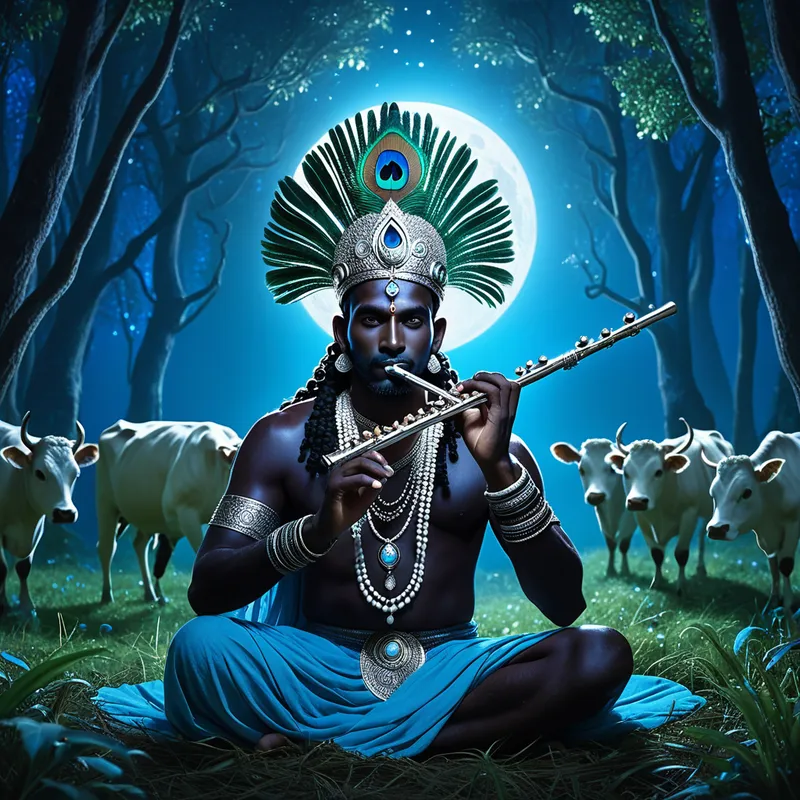
Here, as Krishna, he grew. Not as a prince, but as a butter-thief, a mischief-maker whose laughter was the currency of the village. He danced on the hood of the serpent-demon Kaliya, purifying the waters with his tiny feet. He lifted the hill of Govardhan like a mushroom on his little finger, sheltering an entire world under his grace. And in the moon-drenched forests, he played his flute. Its notes were not mere sound; they were a call that pulled the very soul from the bodies of the gopis. They abandoned their homes, their duties, everything, to dance the Rasa Lila—a whirl of devotion and ecstasy where each gopi felt him dancing with her alone.
But the shadow of Mathura lengthened. The tyrant Kamsa summoned the boy to a festival of death. In the wrestling arena, amidst the roar of the crowd, the adolescent cowherd did not fight; he played. He moved like liquid shadow between the charging assassins, until he stood before his uncle, not in anger, but with a smile of terrifying compassion. He fulfilled the prophecy.
Years flowed. He became a kingmaker, a prince, a friend. The core of his tale shifted to a field of sacred duty: Kurukshetra. Here, his dearest friend and disciple, the warrior Arjuna, stood paralyzed, his bow heavy, his heart shattered at the prospect of killing his kin. Krishna, now his charioteer, did not offer comfort. He offered vision.
“Behold my Vishvarupa,” he said. And in that moment, the friendly god vanished. In his place blossomed the universe itself—swallowing suns, birthing galaxies, with time as the flashing of his eyes, and all warriors, living and dead, flowing into his fiery mouths. It was not a form of peace, but of terrifying, total reality. “I am time, the great destroyer,” he thundered. “These men are already slain. Be merely the instrument, Arjuna. Surrender to me. Fulfill your dharma.”
The bow was lifted. The war was fought. And at the end of his long play, sitting beneath a tree, the dark god closed his eyes as a hunter’s arrow found his foot, his one vulnerable place. He left the world as he entered it—in a manner that seemed ordinary, yet was the most profound leela of all.

Cultural Origins & Context
The myth of Krishna is not a single story but a vast, living tapestry woven over millennia. Its earliest threads are found in the epic Mahabharata (circa 400 BCE–400 CE), where he appears primarily as the divine statesman and charioteer. The pastoral, erotic, and childhood stories flourished later in texts like the Harivamsa and, most profoundly, the Bhagavata Purana (circa 9th–10th century CE).
This myth was carried not just by priests but by poets, dancers, and wandering bhaktas. Saints like Mirabai and Chaitanya Mahaprabhu breathed ecstatic, personal devotion into the narrative, making Krishna accessible to every heart. Societally, the myth functioned on multiple levels: as a theological framework for understanding the divine as both transcendent and intimately personal; as a philosophical discourse on duty and detachment (via the Bhagavad Gita); and as a cultural vessel for exploring the full spectrum of human emotion—from maternal love (Yashoda) to romantic longing (the gopis) to friendship (Arjuna) and political wisdom.
Symbolic Architecture
Krishna is the archetype of the divine that plays. His entire life is termed leela, suggesting the cosmos itself is a dynamic, joyful expression, not a grim mechanical process.
The flute is the human heart, hollowed by longing, through which the breath of the divine blows its irresistible melody.
His blue-black skin is the color of the infinite sky and the deep, fertile cosmos—all-encompassing and mysterious. The peacock feather in his crown symbolizes the integration of the serpentine earth (the peacock can digest poison) into a crown of breathtaking beauty. As the divine child, he represents the irreducible, spontaneous Self that exists before conditioning, whose mischief upends sterile order. As the lover, he embodies the soul’s ecstatic, maddening yearning for union with the absolute, a love that requires the “death” of the petty, egoic self. The Vishvarupa is the ultimate symbol of the psyche confronting the objective reality of the unconscious—not a personal father-god, but the terrifying and awe-inspiring totality of the Self, where creation and destruction are inseparable.
The Dreamer's Resonance
When the figure of Krishna appears in modern dreams, it often signals a profound call from the Self. Dreaming of the flute’s sound may indicate a deep, wordless longing for a connection that transcends rational understanding, pulling the dreamer away from a sterile, over-structured life. Dreaming of the Rasa Lila can reflect a psychological process of fragmentation and re-integration, where parts of the personality (the gopis) are being called to dance with a central, organizing principle.
To dream of the Vishvarupa is a potentially shattering numinous experience. Somaticly, it may be preceded by anxiety or a feeling of cosmic dread. Psychologically, it represents the ego’s confrontation with the sheer, amoral scale of the unconscious—the realization that one’s personal drama is a tiny part of a vast, impersonal psychic process. It is the dream equivalent of the “dark night of the soul,” where old structures of meaning dissolve in the face of the sublime.
Alchemical Translation
The alchemical journey modeled by Krishna’s myth is not one of linear conquest, but of paradoxical embrace. It begins in the prison of the known (Mathura, the ego’s fortress) and moves to the forest of the unconscious (Vrindavan), where the divine child-Self is nurtured in seeming insignificance. Here, the first operation is play—the dissolution of rigid personas through mischief, creativity, and the call of the flute (individuating desire).
The alchemist does not kill the dragon of chaos; he dances on its heads, and the venom becomes the nectar of immortality.
The middle passage is the journey to Kurukshetra, the inevitable confrontation with one’s own shadow—the “kin” we must engage within the inner conflict. The charioteer here is not the warrior, but the guiding consciousness (Krishna) that must reveal the Vishvarupa: the horrifying yet necessary vision that one’s battle is part of a vast, impersonal cycle of death and rebirth within the psyche. The triumph is not victory, but the ability to act with skill while surrendered to this larger process—the essence of karma yoga.
The final transmutation is in the manner of his departure. The arrow to the foot, his sole vulnerability, signifies that the embodied journey must end. The fully realized individual, having played their part in the leela, must ultimately release identification with the form itself, merging back into the blue infinite from which they came, leaving behind not a monument, but a melody that forever stirs the heart.
Associated Symbols
Explore related symbols from the CaleaDream lexicon: