Korah's Rebellion Myth Meaning & Symbolism
A Levite priest challenges Moses's authority, leading to a divine judgment that swallows the rebels, questioning the very nature of sacred order and ambition.
The Tale of Korah's Rebellion
Hear now a tale from the furnace of the desert, a story etched not in stone but in the shuddering memory of the earth itself. The people of Israel were a murmuring multitude, a body of dust and spirit camped beneath the shadow of a holy mountain. They were led by Moses, a man who walked with a limp from the mountain, his face still glowing with a terrifying light from speaking with the Divine Presence. And beside him stood Aaron, adorned in the breastplate and bells of the sacred office.
But in the heart of the camp, a fire of a different kind was kindling. Korah, son of Izhar, of the tribe of Levi—the very tribe set apart for the service of the Tabernacle—looked upon his cousins and saw not prophets, but merely men. He gathered to him two hundred and fifty princes of the assembly, men of renown, their hearts swelling with a sacred envy. "You take too much upon you!" he cried to Moses and Aaron, his voice cutting through the desert air. "For all the congregation are holy, every one of them, and the Divine is among them. Why then do you lift yourselves above the assembly of the Divine?"
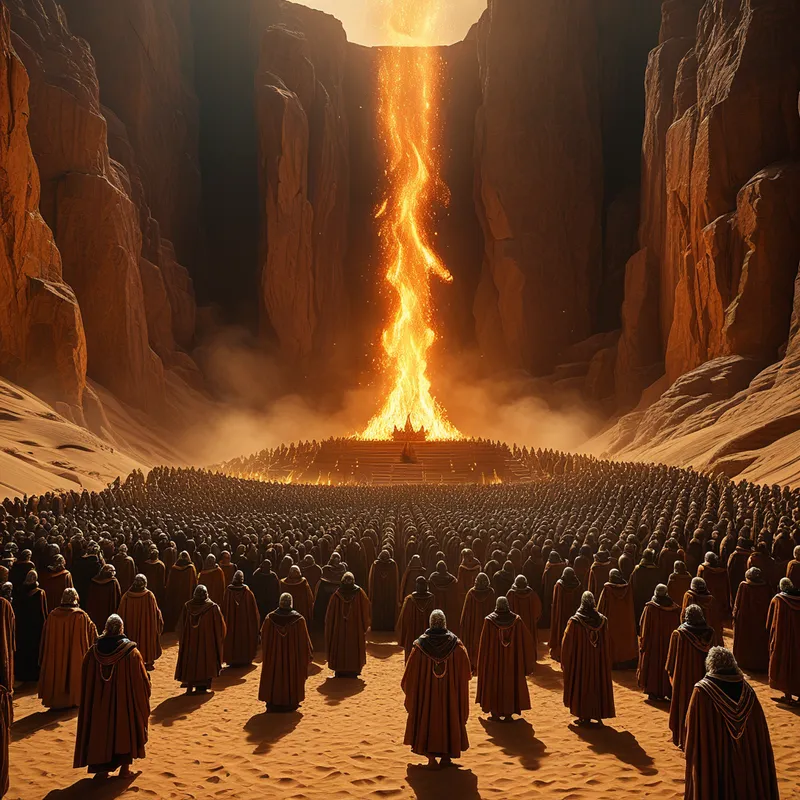
The challenge hung like smoke from an unsanctioned fire. With them stood Dathan and Abiram, who refused even to come when summoned, accusing Moses of bringing them from a land of milk and honey only to let them die in the wilderness. The next morning, the air was thick with tension and the scent of incense. Korah and his entire company, each man with his bronze censer, stood at the entrance of the Tabernacle. Moses and Aaron stood opposite them, the fabric of the community tearing between them.
Then Moses spoke, his words heavy with prophecy: "By this you shall know that the Divine has sent me to do all these works, for they are not from my own heart. If these men die as all men die, then the Divine has not sent me. But if the Divine creates something new, and the ground opens its mouth and swallows them up with all that belongs to them, and they go down alive into Sheol, then you shall understand that these men have despised the Divine."
As he finished speaking, the ground beneath their feet groaned. A deep, seismic sigh rose from the abyss. Then, with a sound like a giant's cloth ripping, the earth split apart. A yawning chasm opened beneath the tents of Korah, Dathan, and Abiram. It swallowed them, their households, and all their possessions. They went down alive into the pit, and the earth closed over them, leaving no trace but a terrible silence. A fire then flashed from the presence of the Divine and consumed the two hundred and fifty men offering the incense, their censers falling to the ground, now holy and horrifying artifacts. The congregation fled, a cry of primordial terror rising to the heavens. The rebellion was ended, not by the hand of man, but by the very fabric of creation asserting a dreadful order.

Cultural Origins & Context
This story is preserved in the Book of Numbers, a text woven from priestly and narrative traditions during and after the Babylonian Exile. Its telling served a critical function for a community defining itself in the crucible of trauma and displacement. The myth is not merely a historical anecdote but a foundational political theology, told by priestly custodians to solidify the Aaronic priesthood and the unique, non-democratic sanctity of its order.
In a culture where holiness was not a universal condition but a graded, contagious, and dangerous force, the story of Korah is a terrifying parable about boundaries. It answers the perennial question of a people chosen yet struggling: "Who has the right to approach the Absolute?" The rebellion is framed not as a fight for freedom, but as a catastrophic confusion of categories—a blurring of the lines between the sacred, the set-apart, and the profane that threatened the community's very cosmic structure. It was a warning etched in fire and earth: the sacred order is not a human bureaucracy but a divine ecology, and to violate its principles is to invite chaos not as a metaphor, but as a geological event.
Symbolic Architecture
At its core, Korah's Rebellion is a myth about the psychology of order and the shadow of equality. Korah represents the ego's brilliant, righteous argument against perceived hierarchy. His cry, "All the congregation are holy!" is the seductive voice of inflation, the part of the psyche that cannot tolerate differentiation or the painful, necessary stages of development. He mistakes potential universality ("all could be holy") for actualized reality, refusing the arduous, individual process of becoming so.
The earth that opens its mouth is the unconscious itself, revolting against a consciousness that seeks to bypass its laws. It is not punishment, but a terrifying act of re-integration.
Moses and Aaron symbolize the established principle of order—the ego in its role as mediator of the transcendent (Moses) and the specialist of sacred ritual (Aaron). They do not fight Korah with armies, but submit the conflict to a divine judgment, representing the ego's proper stance: it administers but does not originate the laws of the deeper Self. The censers, meant for offering, become symbols of usurped mediation. The fire that consumes the rebels is the raw, unmediated power of the numinous, which destroys when approached without the proper vessel of humility and ordained structure.

The Dreamer's Resonance
When this myth stirs in the modern dreamer, it often manifests as dreams of profound structural collapse. The dreamer may find the floor of their house giving way, or the ground opening up beneath them in a city street. There is a somatic sense of the foundational—the psychological "ground of being"—becoming unstable. This is not a dream of external catastrophe, but of an internal rebellion coming to a head.
The dreamer is likely in a life phase where they are challenging an internal or external authority—a job, a relationship, a long-held belief system, or their own super-ego. The Korah energy is active: a righteous, indignant part that shouts, "Why should I submit to this? I am just as good, just as capable!" The dream of the swallowing earth is the psyche's drastic correction to this inflation. It signals that the rebellion, while perhaps containing a kernel of legitimate grievance, is being conducted in a way that threatens the integrity of the entire psychic system. The dream is a call to examine the manner of one's challenge. Are you seeking to transform the order, or to annihilate it in a blaze of undifferentiated pride?

Alchemical Translation
The alchemical process mirrored here is the separatio followed by a terrifying solutio—the separation of elements leading to a dissolution. Korah attempts to force a coniunctio, a union of all in holiness, by sheer will and argument. He tries to shortcut the alchemical work. The psyche's response is to enact the solutio in its most literal, chaotic form: dissolving the rebels back into the prima materia, the undifferentiated ground.
The individuation journey requires us to honor the priesthood within—that specialized, humble function that knows how to approach the fire without being consumed.
For the modern individual, the myth models the peril of spiritual or psychological bypassing. The urge to be "enlightened," "healed," or "empowered" without submitting to the necessary disciplines, the humble stages, and the accepted mediators (which can be internal, like patience, or external, like a teacher or therapy) is the Korah impulse. True psychic transmutation begins when we take up our own censer—our unique capacity for offering and connection—but do so within the recognized "tabernacle" of our own earned integrity and hard-won humility. The goal is not to destroy Aaron (the inner principle of sacred order) but to understand his function, so that our rebellion, when it comes, is not one of chaotic envy, but a sacred struggle that refines the order itself. The swallowed censers are later hammered into a covering for the altar—a stunning image of alchemical redemption. Even the energy of the failed rebellion can be reclaimed and integrated into the structure of the sacred, transforming raw ambition into a protective skin for the place where heaven and earth meet.
Associated Symbols
Explore related symbols from the CaleaDream lexicon: