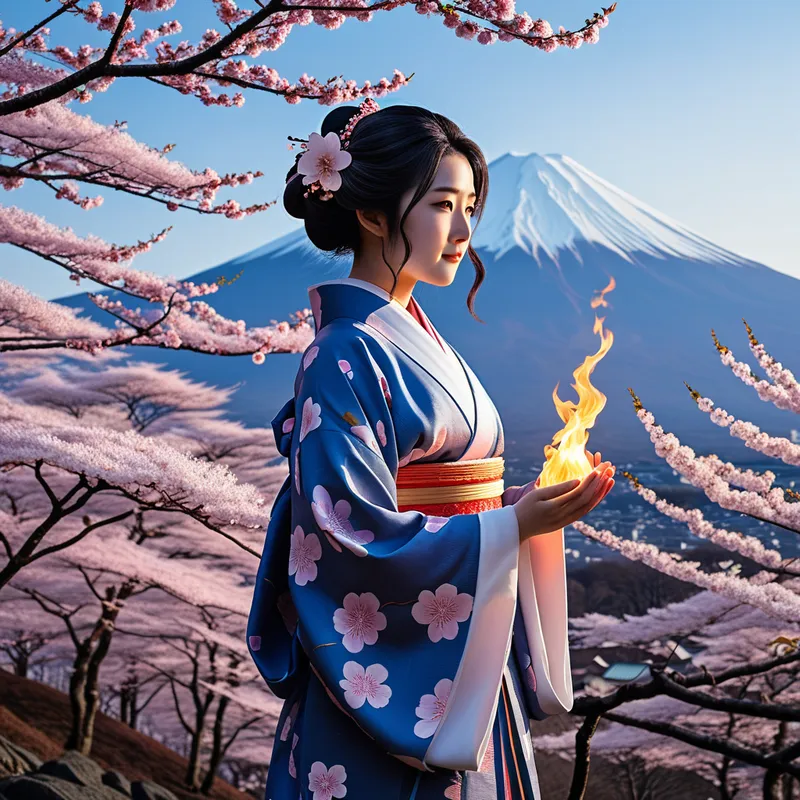
Konohana Sakuya Hime Myth Meaning & Symbolism
A goddess of blossoms proves her divine nature through a trial by sacred fire, birthing three sons and embodying the volatile, life-giving power of the volcano.
The Tale of Konohana Sakuya Hime
Listen, and hear the tale whispered on the wind that scatters the cherry blossoms and rumbles deep within the sacred mountain.
In the age when the world was still being woven, the mighty mountain deity, Oho-yama, had two daughters. The elder was Iwa-Naga-Hime, Princess of the Lasting Rock. Her form was as steadfast as the ancient stone, promising endurance and stability. The younger was Konohana Sakuya Hime, Princess of the Blossoming Trees. Her beauty was that of the spring ephemeral—a breathtaking, fragrant flash of life that arrives, dazzles, and is gone on the breeze.
Their father offered both in marriage to Ninigi-no-Mikoto, the heavenly grandchild who descended to rule the reed plains. Seeing the divine grace of the blossom princess, Ninigi’s heart was captivated. He chose Konohana Sakuya Hime alone for his bride. Oho-yama, troubled, warned him. “The rock endures, but the blossom falls swiftly. Choose the elder for the stability of your lineage.” But Ninigi’s choice was made, drawn by the radiant, living beauty before him.
The union was swift, and conception immediate. Yet, a shadow of doubt, sown by the rejected father’s warning, took root in Ninigi’s heart. How could a pregnancy be known so soon? Was this child truly of his divine seed, or of some other, earthly spirit? When he voiced his suspicion, the world held its breath.
Konohana Sakuya Hime did not weep or plead. Her eyes, usually soft as petals, hardened like flint. In answer to the accusation against her sacred honor and the life within her, she made a vow that echoed with the power of the earth’s core. She would enter a doorless hut woven of fresh cypress bark and, by her own divine power, give birth within a trial of sacred fire. “If the children born are yours,” she declared, “they will be untouched by the flames. If they are not, they will perish, and I with them.”
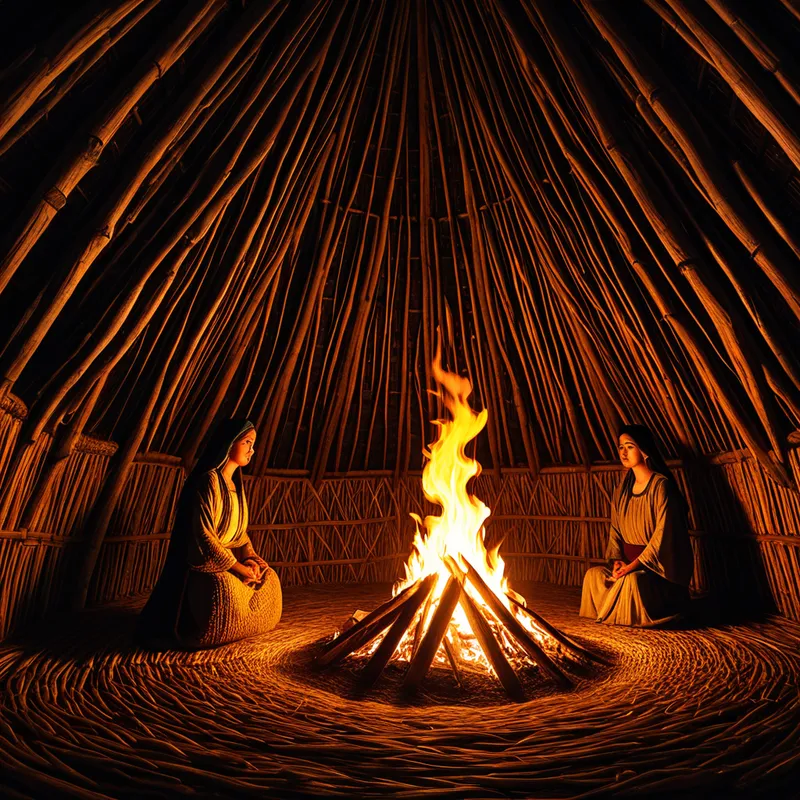
The hut was built. The air grew thick with the scent of resin and dread. As the sun fled the sky, she entered her chamber and sealed it from within. Then, she commanded the fire to be set. Orange tongues of flame licked the dry bark, then roared into a towering inferno, a blazing pillar against the night. The heat drove onlookers back; the crackle drowned all sound. Inside that roaring womb of flame, a miracle unfolded.
As the fire consumed the hut, Konohana Sakuya Hime, in her agony and power, brought forth not one, but three sons: Hoderi, Hosuseri, and Hoori. And when the flames died to embers and the morning light touched the ashes, there she sat, serene and unharmed, her three divine sons cradled in her arms, crying their first cries into the newborn dawn. Her faith had been her shield, her divine nature the crucible, and from the union of accusation and fire, life triumphed, threefold.
Cultural Origins & Context
This myth is preserved in Japan’s oldest chronicles, the Kojiki (712 CE) and the Nihon Shoki (720 CE). These texts were not mere storybooks but political and spiritual foundations, crafted to legitimize the ruling Yamato line by tracing its ancestry directly back to the gods (kami). Konohana Sakuya Hime’s story is a vital link in that divine genealogy, as she is the mother of Hoori, who is in turn the grandfather of Japan’s first legendary emperor, Jimmu.
Beyond courtly genealogy, her myth is deeply rooted in the animistic heart of Shinto. She is the kami of two seemingly opposite forces: the delicate, fleeting cherry blossom (hanami) and the violent, creative force of the volcano. Her primary shrine is at the foot of the ultimate symbol of this duality: Mount Fuji. The myth served to explain and sacralize the terrifying yet fertile nature of volcanoes—the earth’s destructive fire that also creates new, rich land. She embodies the profound understanding that life’s most vibrant bloom is inextricably linked to the presence of a consuming, transformative heat.
Symbolic Architecture
At its core, this is a myth about the vindication of authentic life force in the face of skeptical, patriarchal judgment. Konohana Sakuya Hime represents the principle of becoming over being—the dynamic, creative, and inherently risky process of life, as opposed to the static safety of stone.
The blossom does not apologize for its brevity; it is the very condition of its breathtaking beauty. To demand permanence of it is to misunderstand its nature entirely.
Her chosen trial—the fiery hut—is the ultimate symbolic act. Fire is the universal symbol of transformation, purification, and revelation. She does not argue her case with words, which are the currency of doubt, but with an act of existential proof. The sealed hut is a sacred, solitary container, the alchemical vessel where base accusation is transmuted into proven divinity. Her three sons, born of this ordeal, symbolize the multifaceted fruits of such a trial: different aspects of life (fire, sea, and the heroic hunt) emerging from a single act of unwavering faith in one’s own creative truth.
Psychologically, Ninigi’s doubt represents the ego’s fear of the unconscious, creative feminine principle. It seeks to control and question the mysterious, rapid processes of inspiration, intuition, and new life emerging from the psyche. The myth asserts that this life force does not require external validation; it validates itself through its own fierce, transformative power.
The Dreamer's Resonance
When this mythic pattern stirs in the modern dreamer, it often signals a profound somatic and psychological crisis of legitimacy. One may dream of being falsely accused, of being trapped in a burning building that is also a place of safety, or of giving birth in impossible, dangerous circumstances.
Somatically, this can feel like a fire in the belly—a churning, heated anxiety centered in the solar plexus or womb space, coupled with a paradoxical sense of immense, pent-up creative power. Psychologically, the process is one of confronting an internalized “Ninigi”—a skeptical, demanding voice (often tied to parental or societal expectations) that questions the validity of one’s feelings, creations, or very identity. The dream is the psyche’s enactment of the trial by fire: a demand to prove, to oneself, that what is growing within is authentic and resilient. The resolution, if the process is embraced, is not escape from the fire, but the realization that one is the fire, and the life it nurtures.
Alchemical Translation
The journey of Konohana Sakuya Hime is a perfect map for the stage of individuation where one must differentiate their true self from the projections and expectations of others. The alchemical operation here is calcinatio—reduction by fire.
The ego’s doubt is the kindling; the soul’s self-knowledge is the spark. The conflagration that follows is not punishment, but the necessary heat for revelation.
First, one must choose the blossom—to honor the fleeting, passionate, beautiful call of one’s own nature, even when the world recommends the safer, harder path of stone. Second, one must seal the hut—withdraw into a necessary, protected interiority to gestate the new Self, shutting out the noise of external opinion. Third, and most crucially, one must command the fire. This is the active, terrifying step of submitting one’s tender new growth to the test of reality, to criticism, to the heat of action and exposure.
The birth of the three sons is the outcome of successful psychic transmutation. They represent the new capacities forged in the fire: perhaps the fiery passion for one’s work (Hoderi), the emotional depth to navigate life’s changes (Hosuseri), and the heroic ability to venture into the unknown and retrieve what is lost (Hoori). The myth teaches that wholeness is not born from comfortable certainty, but from the courageous, fiery affirmation of one’s own mysterious and blossoming truth. We do not find ourselves by staying safe; we are forged, and found, in the sacred blaze of our own becoming.
Associated Symbols
Explore related symbols from the CaleaDream lexicon: