Kohaku Myth Meaning & Symbolism
A spirit of light and purity, Kohaku's sacrifice to mend a fractured world embodies the alchemy of consciousness and the eternal return to wholeness.
The Tale of Kohaku
Listen. Before the world was as it is, when the mountains were young and the rivers still learning their songs, there was a great fracture. It was not a crack in stone or earth, but in the very spirit of things. A shadow had seeped from a place of forgotten sorrow, a cold silence that stilled the songs of birds and made the leaves of the ancient cedars tremble. The land grew heavy, its vibrant ki growing thin and faint.
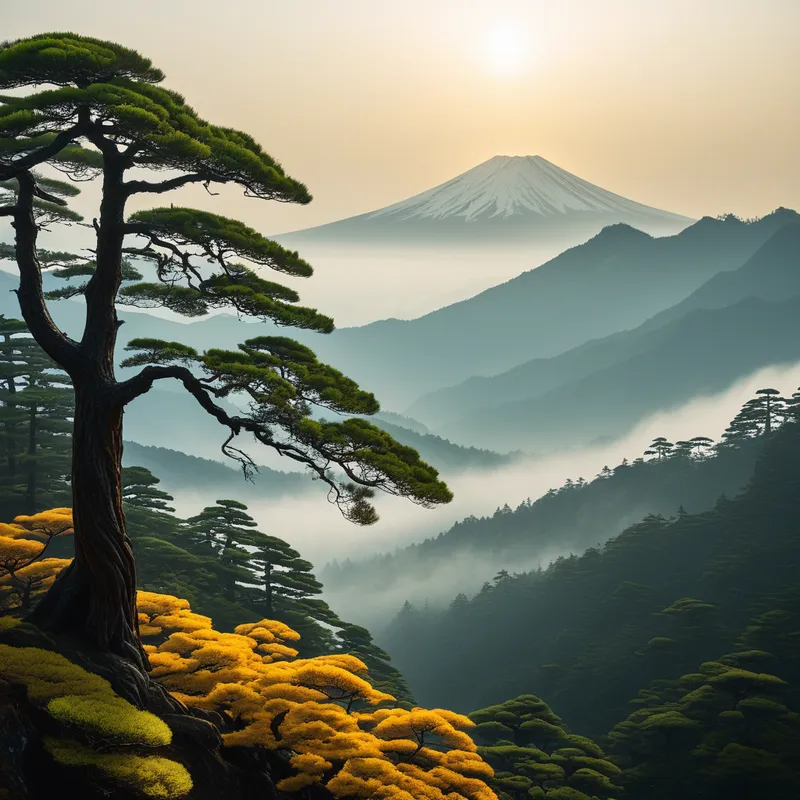
In that time of gathering dusk, there existed a being of pure spirit, known to the whispering pines and the patient stones as Kohaku. It was not a kami of thunder or harvest, but a gentle luminosity, a consciousness of light held in a form like flowing amber and clear water. It dwelled in the high, lonely places where the first light of dawn kisses the snow, and its only language was the soft glow it cast upon the world—a glow that nurtured the shy blossoms and comforted the weary creatures.
Kohaku felt the world's ache as its own. It watched as the fracture widened, a jagged line of nothingness that drank color and sound. The great kami of the land convened, their voices like distant storms and shifting tectonic plates. They could command the seas and shake the earth, but this was a wound in the essence, a sickness of spirit. Their power could not mend it; it could only contain the bleeding edges.
Then, in a moment of profound stillness, Kohaku understood. The fracture was a mirror. It was not an invasion, but an absence—a place where the world's own inherent light had been forgotten. To mend it required not force, but a willing infusion of that very light. A sacrifice of essence to remind the wound what it was to be whole.
Without fanfare or a final proclamation to the gods, Kohaku descended from its luminous perch. It flowed like a river of gentle fire down to the very lip of the fracture. The void there was cold, a hunger that threatened to extinguish its core. Gathering its entire being—every memory of dawn, every echo of a bird's song it had ever illuminated—Kohaku began to pour itself into the crack.
It was not a violent act, but a slow, deliberate dissolution. Its form softened, breaking into a million points of light like amber-hued stars. Each spark drifted into the darkness, not to be consumed, but to ignite. Where they landed, the cold nothingness recoiled, replaced by a faint, golden warmth. The fracture began to hum, then to glow from within. The shadow did not vanish; it was transfigured, woven through with threads of Kohaku's spirit, becoming part of the tapestry once more.
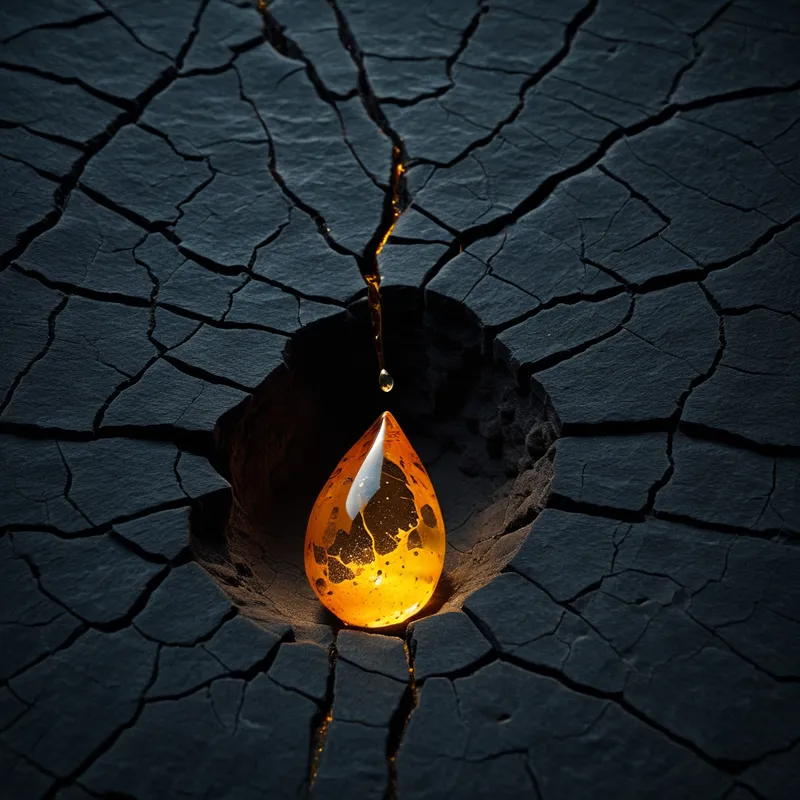
When the last gleam of its conscious form had flowed into the earth, the fracture was gone. In its place lay a seam of radiant, warm stone that pulsed with a slow, steady light. The land breathed a sigh that became the wind. The rivers remembered their songs. And the people who later came to that place spoke of a spirit that had given its light to the world, so that the world would never again forget its own.
Cultural Origins & Context
The tale of Kohaku is not found in the canonical texts of Kojiki or Nihon Shoki. It belongs instead to the rich stratum of regional folklore, a mukashibanashi passed down by village elders and itinerant storytellers, particularly in mountainous regions of central Honshu. Its transmission was oral, its details fluid, adapting to the specific landscape and community that cherished it.
This mode of preservation is key. Unlike the grand cosmogonic myths that establish the imperial lineage, Kohaku’s story served a more intimate, ecological, and psychological function. It was a narrative tool to explain the unique spiritual presence felt in certain landscapes—a warm, glowing stratum in a cliff face, a particular grove that felt eternally peaceful, a hot spring whose waters seemed imbued with a healing calm. The myth provided an etiology for these phenomena, rooting them in a foundational act of compassionate sacrifice.
Societally, it reinforced core Shinto values of harmony (wa) and purity (kiyome), but from a uniquely passive and receptive angle. Here, the heroic act is not conquest, but total, selfless giving. It modeled a relationship with the world where the spirit (tamashii) of a place or being could actively choose to nurture and sustain the whole, a concept that resonates deeply with the interdependent view of nature in Japanese spiritual thought.
Symbolic Architecture
At its heart, Kohaku is an archetypal drama of consciousness confronting the void. The "fracture" represents more than physical decay; it is the psychological abyss—the experience of meaninglessness, deep depression, trauma, or the fundamental alienation of the ego from the unconscious. It is the crack in the psyche where shadow content leaks out, poisoning one's inner landscape.
Kohaku symbolizes the integrated Self, or the transcendent function in Jungian terms. It is not pure, untested innocence, but a conscious luminosity that has observed the suffering. Its nature as light-in-amber is profoundly symbolic: amber is fossilized resin, light captured and solidified through time, representing consciousness that contains and preserves experience.
The most profound healing is not the eradication of darkness, but the courageous infusion of conscious awareness into its very heart.
Its sacrifice is not an annihilation, but a distribution of consciousness. By fragmenting its unified light into a million sparks, it seeds the void with awareness. This is the alchemical solve et coagula—dissolve and reconstitute. The ego-consciousness (the singular spirit) dissolves so that a new, more complex order (the illuminated seam in the world) can coagulate. The shadow is not defeated; it is integrated, its energy now part of a healed, more resilient whole. The warm stone that remains is the symbol of the new psychic structure born from this ordeal—no longer a fragile, isolated light, but a durable, radiating core of transformed selfhood.

The Dreamer's Resonance
When this myth stirs in the modern unconscious, it often manifests in dreams of profound, quiet transformation. The dreamer may not see a literal amber spirit, but the symbolic patterns are unmistakable.
You might dream of a cherished, glowing object—a gem, a vial of light—that you must consciously choose to break open and pour into a dark, cracked floor or a sickened loved one. There is a somatic quality of release and diffusion accompanying this action, often followed by a deep, melancholic peace. Alternatively, dreams of finding warm, light-emitting stones in dark places, or of seeing intricate, golden veins suddenly illuminate within black marble, speak directly to Kohaku’s resolution.
Psychologically, these dreams signal a process of psychic expenditure for the sake of deeper integration. The dream-ego is engaging in an act of radical self-surrender, spending its stored "light"—perhaps its hard-won insights, its compassion, or its very sense of a bounded identity—to address a foundational fracture in its life. This could relate to healing ancestral trauma, sacrificing a rigid self-image to save a relationship, or pouring creative energy into a seemingly hopeless cause. The process feels like dissolution because it is; the old, centralized way of being is ending to nourish a new, more embedded wholeness.

Alchemical Translation
For the individual on the path of individuation, the myth of Kohaku maps the ultimate stage of shadow integration and the servicing of the Self to the world. The initial stages of psychological work often involve heroic struggle—battling personal demons, reclaiming projections. Kohaku’s journey begins where that heroics ends.
The first step is The Recognition of the Essential Fracture. This is moving beyond personal neuroses to perceive a deeper, archetypal brokenness within one's world or psyche—a fundamental sense of disconnection that personal achievements cannot mend.
Next is The Descent of the Conscious Spirit. This is the voluntary move from the mountain of isolated enlightenment or ego-stability into the messy, "cold" realm of the problem. It is the therapist who uses their own healed wounds as a tool, the artist who pours their vulnerability into their work, the individual who brings their hard-earned consciousness into family dynamics they once fled.
The core operation is The Sacrificial Diffusion. This is the alchemical fire. It is the act of allowing one's consolidated understanding, one's "light," to be broken apart and applied piecemeal to the crack. In practical terms, it is the patience to apply a general insight to a hundred specific, dark moments. It is the dissolution of the "I am healed" identity into the countless, small, healing actions.
The Self does not grow by becoming larger, but by becoming distributed, weaving its light into the very fabric of its perceived reality.
The result is Transfigured Landscape. The fracture does not disappear; it becomes a luminous seam, the kizuato that is more beautiful for having been healed. The individual no longer possesses their light; they are now in relationship with a world that reflects that light back to them through its healed wholeness. Their identity is less that of a "light-bearer" and more that of a citizen of a now-luminous world, which they nourish and which nourishes them in an eternal return. This is the Kohaku process: the spirit becomes the soil, and in doing so, finds its eternal, distributed form.
Associated Symbols
Explore related symbols from the CaleaDream lexicon: