Knotwork Myth Meaning & Symbolism
A tale of the primal Weaver-Goddess who binds the world from chaos, her sacrifice creating the endless, unbroken patterns that hold reality together.
The Tale of Knotwork
Listen. Before the green hills rose and the first salmon leaped in the silver river, there was only the Cauldron of Ceugant. Not water, but a seething, grey mist of un-made things—thoughts without minds, songs without voices, shapes without edges. It was the raw breath of potential, beautiful and terrible in its emptiness.
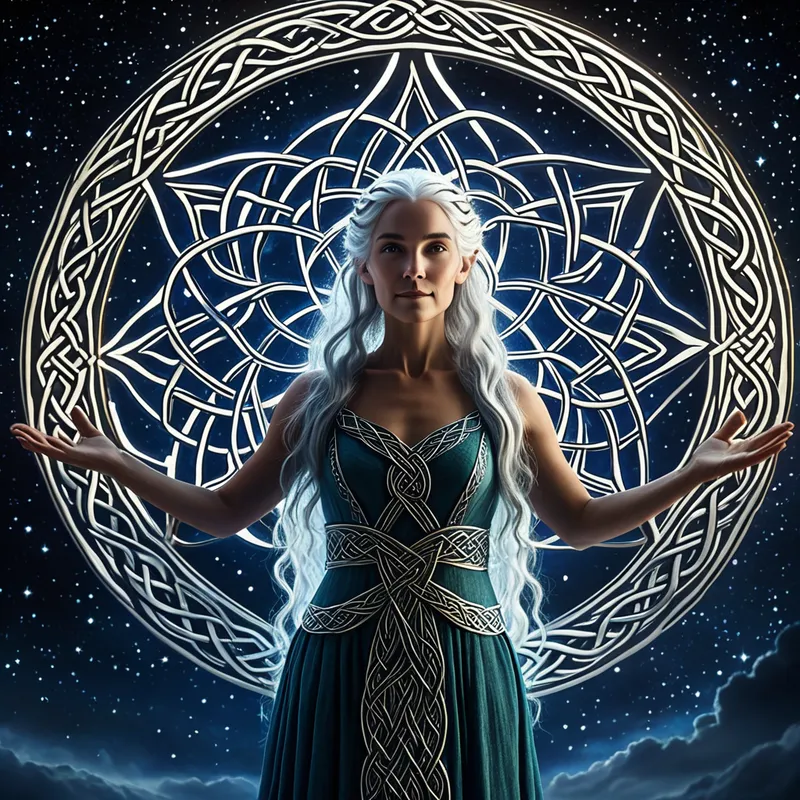
From the heart of this mist, she awoke. Not born, but become. She was Anu of the Unspooling Thread. Her hair was the first silver, her eyes the deep wells where light pooled. She felt the ache of the un-made. With a sigh that became the first wind, she reached into the Cauldron and drew forth not matter, but relationship—a single, humming strand of silver possibility.
She began to weave. Not on a loom, but in the air itself. Her fingers danced, and the strand looped and crossed, forming a simple, perfect circle. Where the thread passed, the grey mist flinched, then stilled, held in a cradle of order. But the mist—the Chaos—hated the stillness. It writhed and pressed against her creation, a formless hunger seeking to unravel the first pattern.
Anu wove faster. From the first circle, she led the thread outward, creating a path that doubled back upon itself, a labyrinth in a line. Each intersection was a choice made solid; each loop, a promise of return. She wove the pattern of the seasons, the path of the sun, the cycle of the salmon’s run. The world began to be: here a knot of solid earth, there a loop of flowing water, a crossing of crackling fire.
But the Chaos was relentless. It found the loose end of her silver thread, the very beginning, and began to pull. The beautiful patterns trembled. The new hills groaned, the young rivers threatened to spill their banks back into nothingness. Anu saw that a pattern with a beginning must have an end, and an end could be found and undone.
So, she made the ultimate weave. With a cry that split into the first birdcall and the first wolf’s howl, she took the loose end of her silver thread and the thread of her own life-force—a golden, singing cord from her heart—and she began the final knot. She wove the silver end not into another part of the pattern, but back into its own beginning. And then, she wove the golden thread of her spirit into that same junction.
The knot sealed. There was no beginning to pull. No end to unravel. The pattern became eternal, unbroken, a continuous flow where every line led back into itself, sustained by her sacrifice. The Chaos screamed and fell back, forever held at bay by the endless dance of the knot. Anu’s body dissolved into the pattern—her breath the wind in the loops, her voice the whisper in the crossings, her watchful presence the integrity of every line. The world was not built, but bound—a sacred, living knotwork.
Cultural Origins & Context
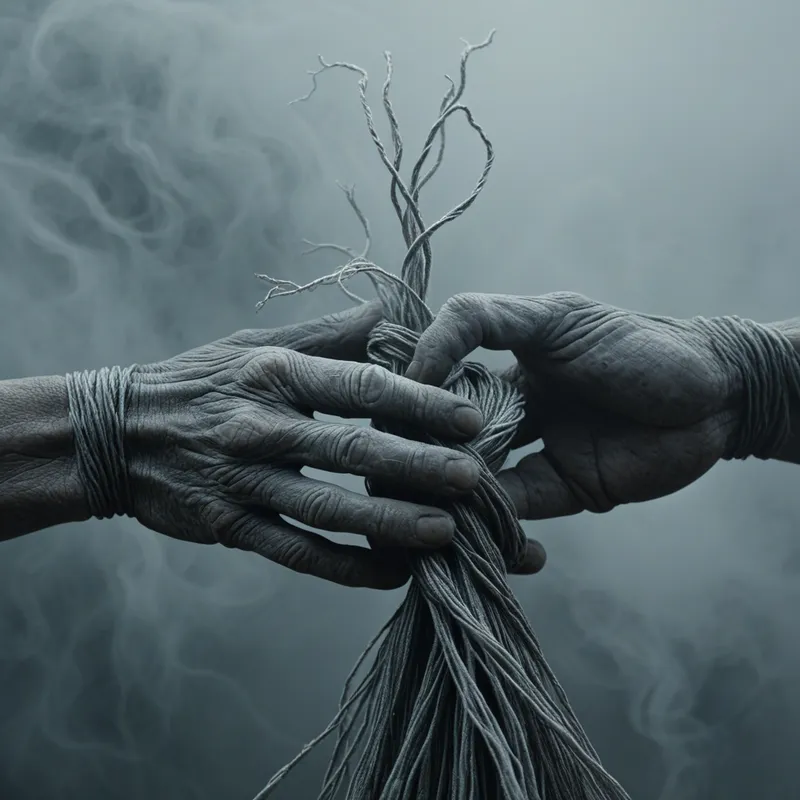
The myth of the primal weaver is not found in a single, canonical text. The ancient Celts transmitted their sacred knowledge orally, through the revered class of the Druids and later, the seanchaidht. This story is the whispered subtext behind the tangible artifact: the endless knotwork that adorns High Crosses, illuminates manuscripts like the Book of Kells, and curves across ancient jewelry and weaponry.
Its societal function was multifaceted. On one level, it was a cosmological map, a narrative explaining how a world of beautiful, terrifying complexity emerged from unity and was maintained by sacred sacrifice. On another, it was a moral and spiritual compass. The unbroken line symbolized honor, integrity, and the interconnectedness of all things—the truth that one’s actions inevitably return. To depict a knot was to invoke the goddess’s binding power, offering protection, denoting sacred space, and reminding the community of the eternal contract that kept their world from dissolving back into chaos.
Symbolic Architecture
At its core, the knotwork myth is a profound symbol of the psyche’s own structure and its relationship to the formless unconscious.
The knot is not a wall against chaos, but a dance with it. The line must enter the tangle to create the pattern.
The Cauldron of Ceugant represents the undifferentiated unconscious, the prima materia of the soul, full of potential but also terrifying in its lack of form. Anu is the archetypal force of consciousness itself—the Ego that dares to reach into the unknown and attempt to make meaning, to create identity from the swirl of impulses, memories, and instincts.
The act of weaving is the process of psychic differentiation. Every loop is a complex emotion examined; every crossing is a difficult decision made; every knot is a core belief or trauma consolidated. The relentless Chaos is the shadow, the repressed, the part of the unconscious that resists order and threatens to dissolve hard-won progress in moments of crisis or despair.
The final, sacrificial knot is the myth’s master symbol. It represents the transcendence of linear, ego-driven consciousness (“I started this, I will finish it”) into a systemic, self-sustaining understanding. It is the moment one realizes that the psyche is not a linear narrative but an ecosystem. The “golden thread” of the personal spirit must be woven into the universal pattern. The ego (the silver thread) must lose its separate end to become part of a greater, endless whole—the Self.
The Dreamer's Resonance
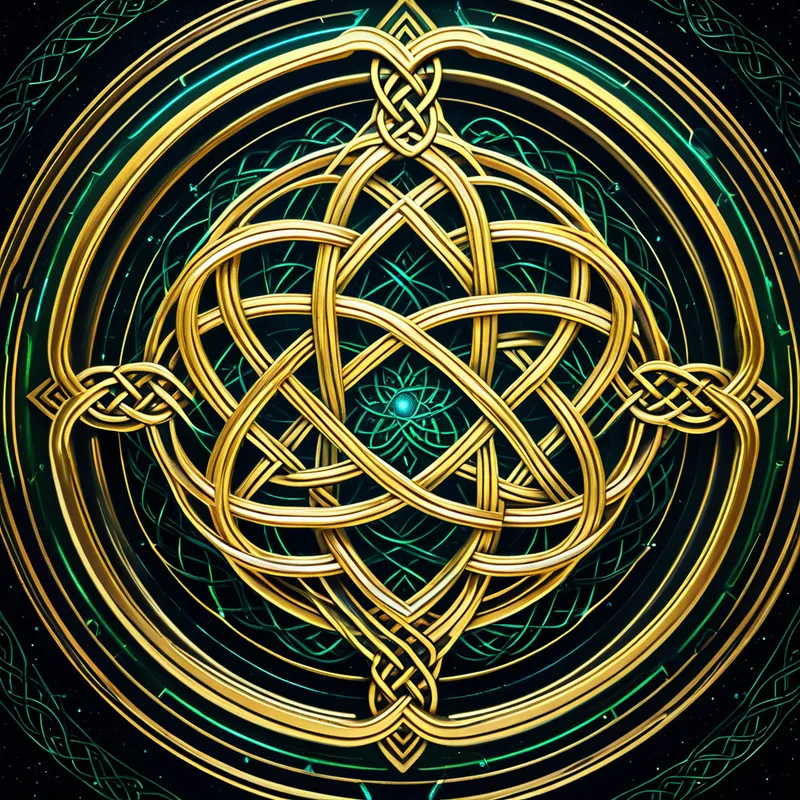
When knotwork appears in modern dreams, it is rarely a passive image. The dreamer is often tangling or untangling it, tracing its path with a finger, or feeling trapped within its loops. This is a somatic signal of a profound psychological process: integration.
Dreams of successfully following a knot’s single, unbroken path to its (non-)end often coincide with periods of synthesis, where disparate life experiences—career, relationship, personal loss—suddenly feel meaningfully connected. The dream body feels calm, purposeful. Conversely, dreams of frayed, broken, or impossibly tangled knots speak to a crisis of integrity. The dreamer may feel their life is losing its cohesive narrative, that actions and consequences feel disconnected, or that they are “coming undone.” The somatic feeling is one of anxiety, breathlessness, or being caught in a snare.
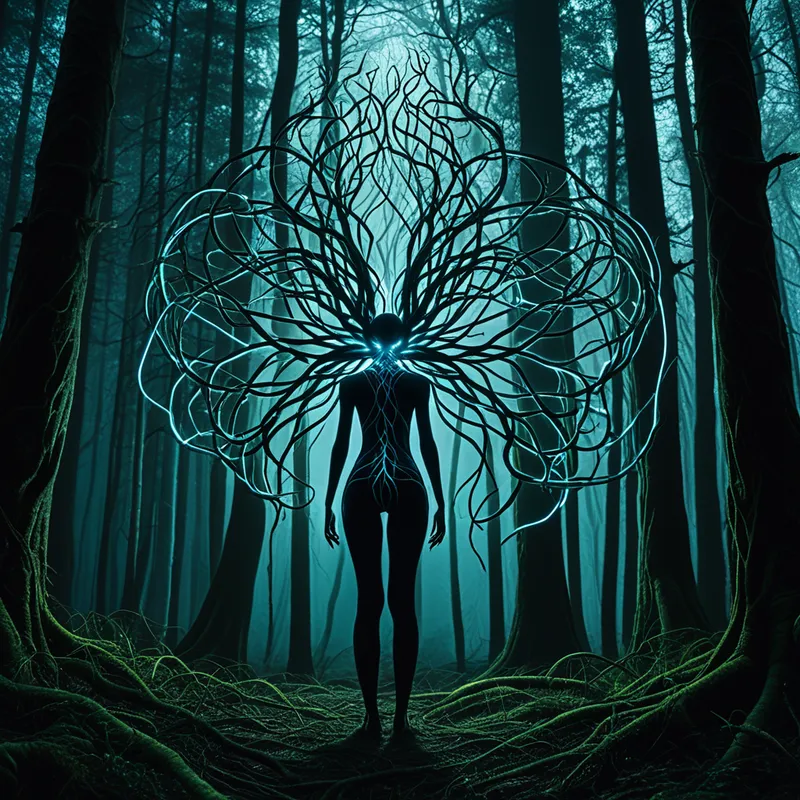
Most potent are dreams where the dreamer becomes the knotwork, feeling their veins, thoughts, or life story configured into its pattern. This is a direct encounter with the archetype of wholeness, a glimpse of the Self as a living, dynamic system. It can be awe-inspiring or claustrophobic, reflecting one’s readiness to surrender the illusion of simple, linear control.
Alchemical Translation
The myth of Knotwork provides a precise model for the alchemical process of individuation—the forging of the integrated Self.
The initial state is the nigredo, the chaotic blackness of the Cauldron: a depression, a loss of meaning, a fog of unprocessed emotion. The Anu archetype activates as the individual, in their despair, makes the first, brave act of attention: writing in a journal, finally speaking a shameful truth, creating art from pain. This is the drawing of the first silver thread—the albedo, or whitening, the dawn of consciousness.
The work of the soul is not to defeat chaos, but to marry it, to bind it into the pattern where its energy becomes design, not destruction.
The long, laborious weaving is the citrinitas, the yellowing, the work of analysis and conscious living. We make connections, see patterns in our behavior, understand our complexes. But repeatedly, the Chaos (our shadow, our old wounds) attacks, threatening to unravel progress. The crisis point arrives when we realize our conscious efforts alone are insufficient. We must offer up something essential—a cherished self-image, a long-held grievance, the ego’s claim to sole authorship of its life. This is the sacrificial knot, the rubedo, the reddening.
The final, eternal knot is the lapis philosophorum, the philosopher’s stone of the psyche. It is not perfection, but resilient, dynamic wholeness. The individual realizes they are both the weaver and the pattern, the creator and the creation. Their personal story (the silver thread) is forever woven into the greater, timeless human experience (the golden thread). Chaos is not gone; it is the necessary negative space that defines the pattern, the source of creativity and adaptation. The individual achieves a stance of grounded awe, understanding their life as an unbroken, ever-unfolding knot—a sacred bind that holds, protects, and endlessly regenerates the world of their soul.
Associated Symbols
Explore related symbols from the CaleaDream lexicon: