Knights' Armor Myth Meaning & Symbolism
A myth of divine smiths forging sacred armor, binding knights to a destiny of protection, sacrifice, and the heavy grace of a chosen identity.
The Tale of Knights' Armor
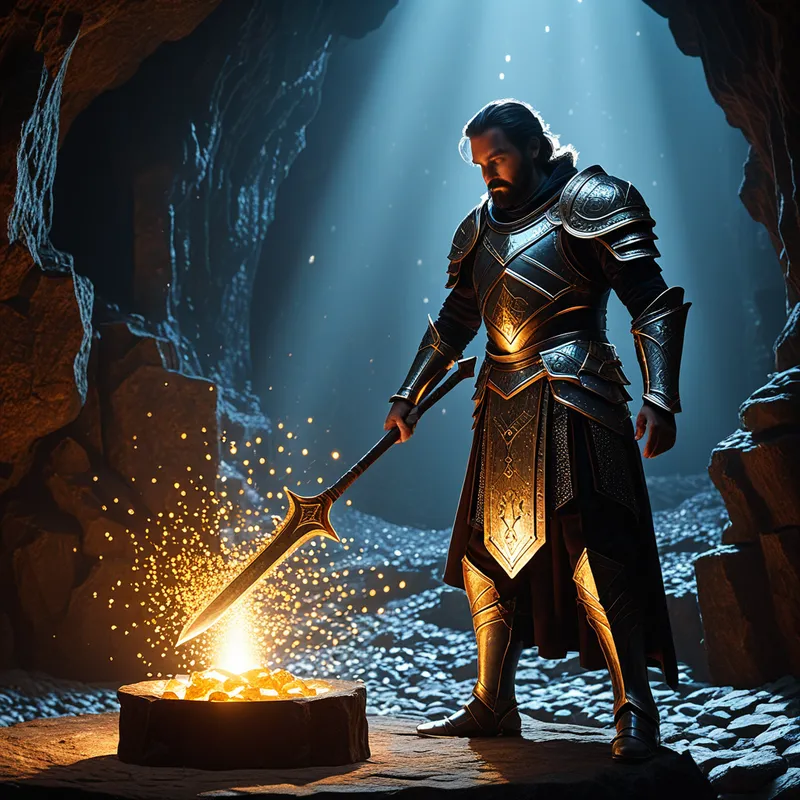
Listen, and hear the tale not of a knight, but of the shell that made him. Before the first stone of Camelot was laid, in the deep places of the world where earth’s blood runs as fire and the air hums with the song of the Anvil of Creation, the Wayland worked. They were not men, but spirits of forge and flux, and they heard a weeping—the weeping of the land itself, pierced by spear and axe, its green mantle torn by greed and spite.
From a vein of ore that had never seen the sun, ore that remembered the first light of the stars, they drew the metal. It was not iron as men know it, but the solidified breath of the Annwn. Into the crucible it went, and the bellows were not blown by wind, but by the sighs of the sleeping dragons of the island. The fire was not mere flame, but the concentrated justice of a yet-unborn king.
The hammer fell. Each blow was a syllable of an ancient vow. With one strike, they sang of Protection. With the next, of Sacrifice. Another, Service. Another, Restraint. The metal folded, not to strengthen it against sword-points, but to weave these vows into its very soul. They shaped the greaves to remember the steadfastness of oak roots. The cuirass was curved to echo the dome of the sky, a personal heaven for the heart within. The pauldrons were wrought like the shoulders of hills, meant to bear great burdens. And the helm… the helm was fashioned last, a cage and a crown in one, its visor a narrow gate through which a man must view the world, his own breath loud in his ears, his vision focused only on what lay ahead.
When the armor cooled, it did not lie dull. It held a soft, moonlit gleam, and when touched, it hummed a low, resonant note that vibrated in the bones. It was taken to the sacred pool of Nimue. There, under a silent moon, she held each piece beneath the black water, whispering the final enchantment: a bond of blood and spirit. This armor would not clothe just any warrior. It would choose. It would find the heart that echoed its forged vows—the heart capable of bearing its terrible grace.
And so it came to pass. A youth, pure of purpose but untested, would come to the stone where the armor lay. As his hands closed upon it, the metal would grow warm. To don it was not to dress, but to be adopted. The weight was immense, not of steel, but of responsibility. The world’s clamor faded, replaced by the internal symphony of the vows: the song of the shield-wall, the dirge of the fallen, the quiet hymn of the guarded hearth. He was no longer merely a man. He was a vessel. He was a walking citadel. He was a knight.
Cultural Origins & Context
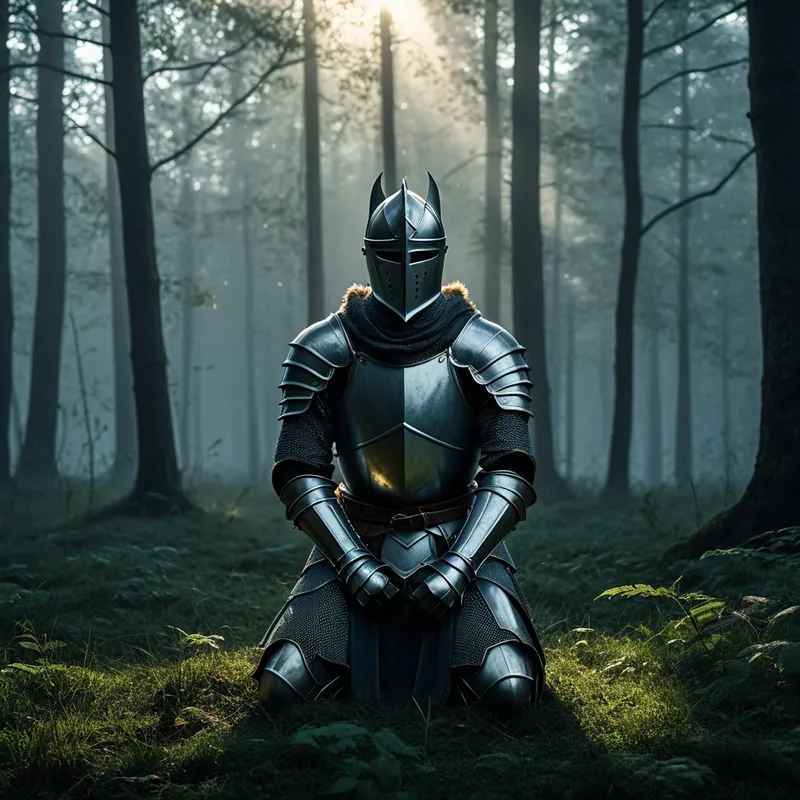
The motif of sacred or destined armor is woven deeply into the tapestry of Arthurian romance, a literature that blossomed in the High Middle Ages but drew from much older Celtic and Brythonic wells. While no single, standardized "myth of the Knights' Armor" exists in a discrete text, its elements are pervasive. We see it in the sword in the stone—a test of worthiness for a weapon, which is but one piece of a knight’s panoply. We see it more fully in the tales of individual knights like Gawain and his connection to his gear, or in the mystical armor gifted by faerie ladies like the Lady of the Lake to Lancelot.
These stories were not chronicles but moral and spiritual compasses, recited by bards and written by clerks like Chrétien de Troyes and Sir Thomas Malory for courtly audiences. The armor myth functioned as a powerful social and psychological narrative. In a feudal society built on martial service and sacred oaths, it visualized the transformation of a man into his office. The armor was the tangible symbol of the Code of Chivalry—an external carapace for an internal ideal. It taught that authority and power (the strength of the armor) were inseparable from duty and vulnerability (the man who must live within it).
Symbolic Architecture
The knight’s armor is perhaps the ultimate symbol of the Persona, but one infused with sacred purpose. It is the forged identity, the conscious ideal we strap on to engage with the battles of the world. Yet, in its mythic form, it transcends mere social mask.
The armor is not a hiding place, but a crucible. It does not conceal the self; it defines the self through relentless, resonant pressure.
Each component is psychically charged. The helm represents focused consciousness and the necessary limitation of perception—one cannot see all things, one must choose one’s front. The cuirass protects the emotional and spiritual heart, but also encases it, demanding emotional control. The gauntlets enable action but inhibit delicate touch. The armor is a paradox: it empowers and restricts in equal measure. It grants the superhuman strength to stand against dragons and armies, yet it renders the knight dependent on squires to mount his horse, vulnerable in its very weight.
The divine origin of the armor is crucial. It signifies that a true vocation, a true identity of service, is not self-manufactured. It is received. It is a calling from the deeper, transpersonal realms (the collective unconscious), forged in the fires of ancestral need and archetypal pattern. The knight does not create his duty; he discovers it, and in donning the armor, he submits his personal will to a greater pattern.
The Dreamer's Resonance
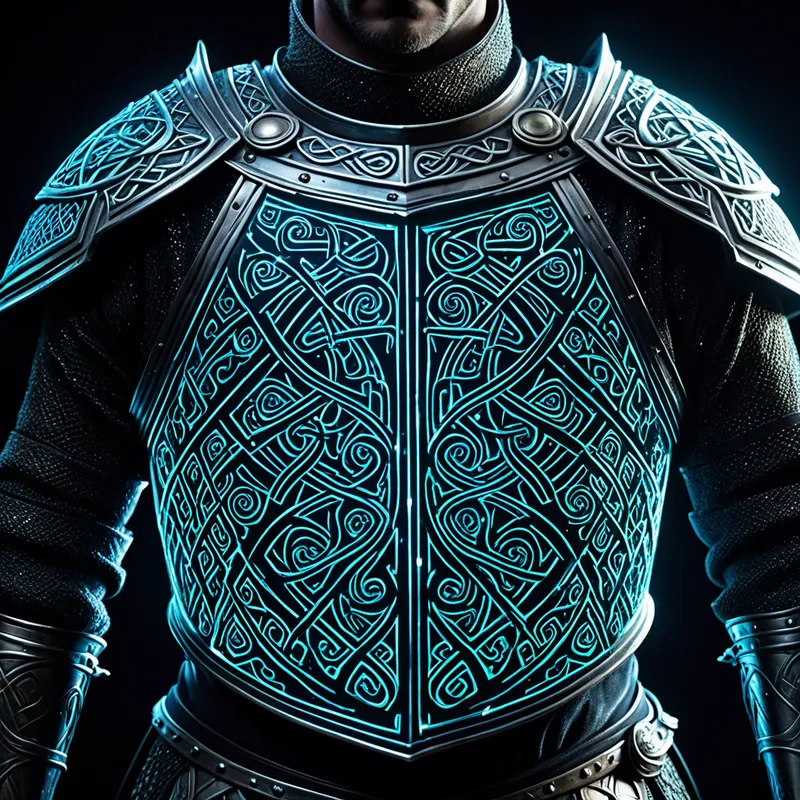
When the myth of the armor surfaces in modern dreams, it rarely appears as a literal suit of plate mail. It manifests as the feeling of an imposed, heavy, yet luminous identity. One might dream of wearing a uniform of brilliant light that is unbearably hot, or a business suit made of lead that grants immense respect but crushes the breath. It is the dream of the doctor feeling her white coat as a shell of infinite responsibility, or the parent experiencing their love as a formidable shield that also isolates.
The somatic experience is key: a sensation of weight on the shoulders, constriction around the chest, a helmet-like pressure on the skull. This is the psyche signaling that the Persona has become overloaded. The sacred duty has curdled into mere burden; the forged identity has rusted shut, no longer serving the soul within but imprisoning it. The dream asks: Is this armor still your chosen vessel, or has it become your tomb? Is the hum you hear the song of your vocation, or the tinnitus of exhaustion?
Alchemical Translation
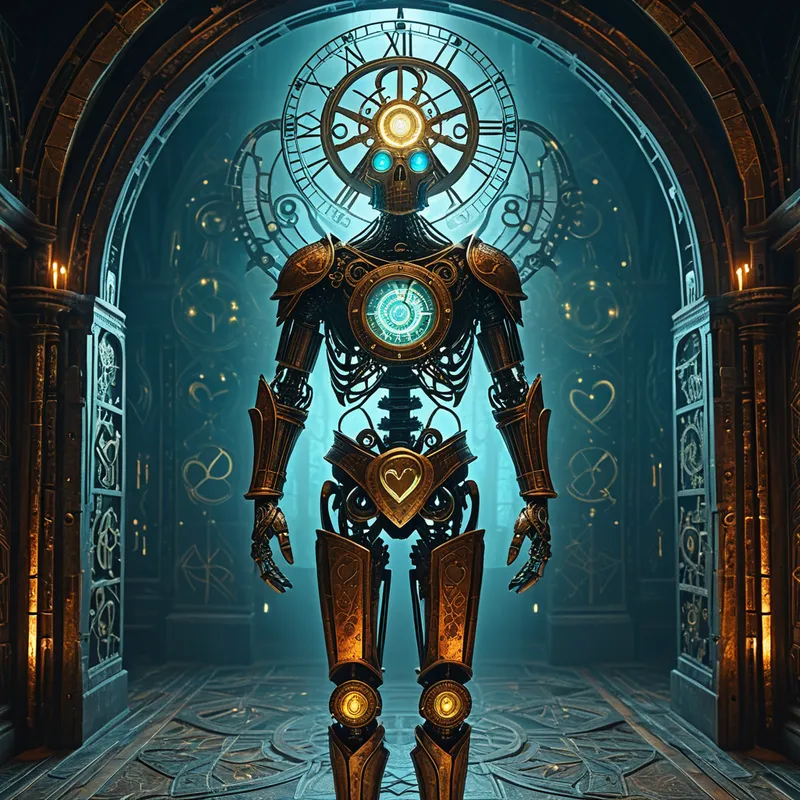
The alchemical journey modeled by this myth is the transmutation of leaden duty into golden purpose. It is the path of the Individuation, where one must consciously relate to the archetypal role one has taken on.
The first stage is Nigredo: the donning of the armor, the conscious acceptance of the heavy, limiting role. This is the necessary death of the uncommitted, "unarmored" self. The second, Albedo, is the long service within the armor—the polishing of the metal through action, the slow realization of its flaws (the weak point at the joint, the visor that fogs). This is self-reflection within the confines of the duty.
The crucial transformation is Citrinitas, the yellowing, often symbolized by the rusting or damaging of the armor. A knight’s armor is never pristine after true battle. It is dented, scarred, stained. This is not failure, but the integration of experience. The perfect, divine ideal is humanized. The final stage, Rubedo, is achieved not by discarding the armor, but by realizing it has become a second skin. The knight and the armor are no longer separate. The vows are no longer external rules but the rhythm of his own heartbeat.
The ultimate alchemy is when the knight understands he was not born to wear the armor; the armor was forged to awaken the knight that was always sleeping within the man.
The myth teaches that our highest callings are both a glorious gift and a terrifying weight. The triumph is not in avoiding the weight, but in learning to carry it so fully that its song becomes our own, and its protection extends not out of fear, but out of a love as hard and bright as forged star-iron.
Associated Symbols
Explore related symbols from the CaleaDream lexicon: