Kāla Myth Meaning & Symbolism
The story of how time and death, personified as Kāla, emerged from the cosmic dance of Shiva, teaching the ultimate acceptance of life's impermanent nature.
The Tale of Kāla
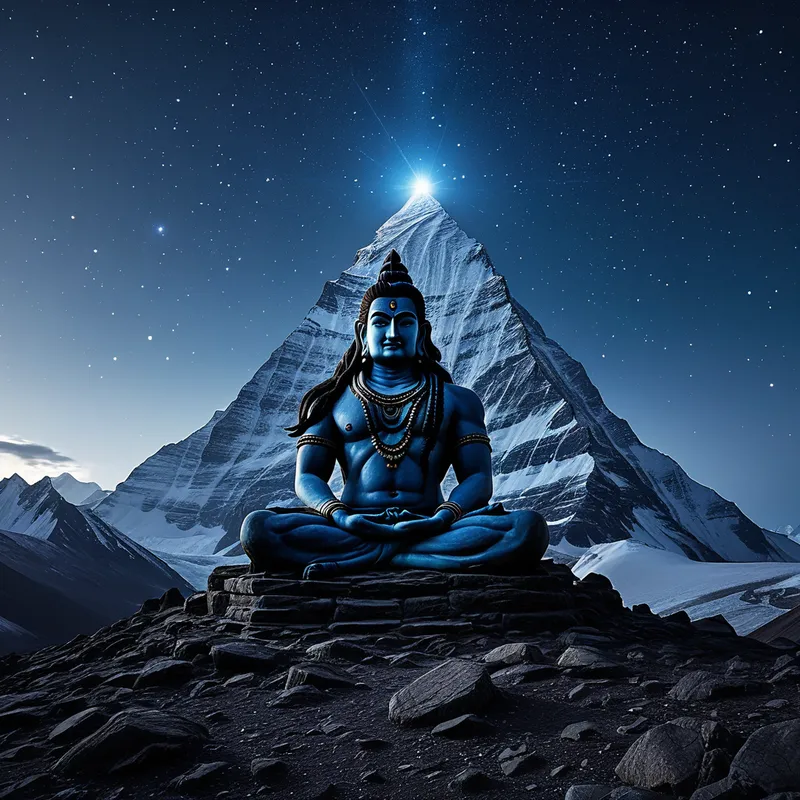
In the beginning, before the worlds learned to turn, there was only the great stillness. Shiva, the ascetic god, sat in perfect samadhi upon the icy crown of Mount Kailash. His form was motionless, a statue of pure consciousness, and in that stillness, the universe breathed. But within that breath lay a potential, a tension—the unmanifested truth of endings.
For the cosmos to live, it must also know how to die. For the dance to begin, the music must one day cease. This truth, vast and terrible, stirred in the depths of Shiva’s being. It was a pressure building behind his third eye, the eye of wisdom that sees beyond illusion.
Then, a tremor. Not in the earth, but in the fabric of being itself. From the space between Shiva’s brows, from the very seat of his supreme awareness, a darkness began to coalesce. It was not an absence of light, but a presence so profound it absorbed all vibration, all movement, all sequence. It swirled like smoke and stars, pulling substance from the void around the meditating god.
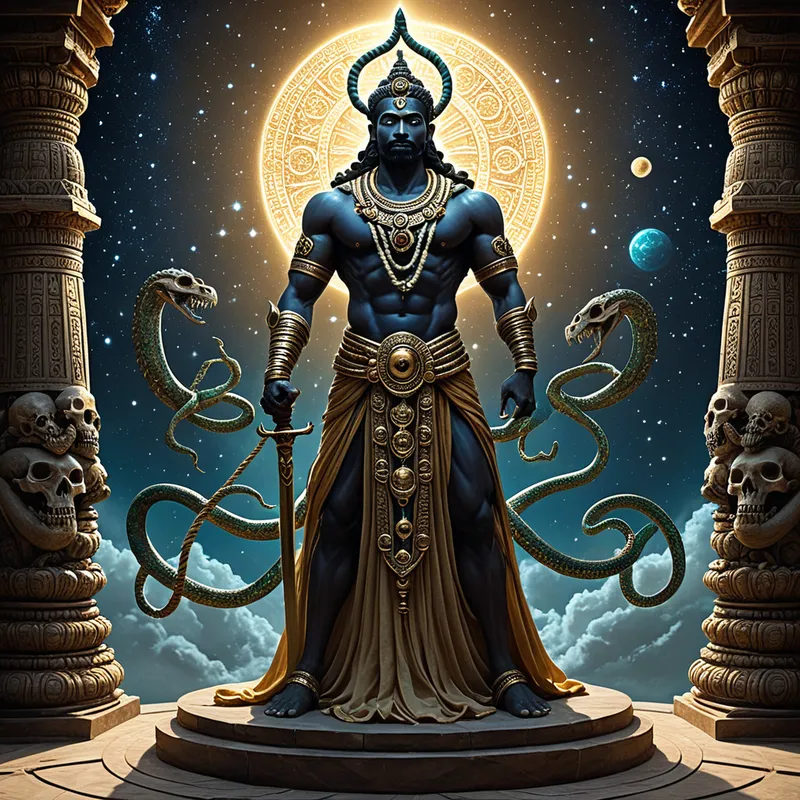
The form that emerged was formidable. His skin was the hue of a stormy midnight, his body adorned with serpents that were themselves circles, swallowing their own tails. In one hand, he held a gleaming sword, sharp enough to sever the thread of any life. In the other, a noose, ready to draw all things to their inevitable conclusion. His eyes were not eyes, but pools reflecting the birth and death of galaxies in a single instant. This was Kāla. He was Time itself, and therefore, he was Death.
Kāla did not bow. He did not speak. He simply was, an eternal fact given form. His first gaze fell upon his own progenitor, Shiva. And he advanced. The message was clear, written in the silent language of cosmic law: even you, O Lord, are not beyond my reach. Even your boundless consciousness is measured in the moments of its own expression.
Shiva, the great Mahākāla (the Great Time), did not resist. To resist Kāla would be to resist the truth of his own nature as the transformer. In a gesture of ultimate acceptance, Shiva offered himself. He lay prostrate upon the ground, placing his own neck upon the stone, submitting to the law he had birthed.
And in that moment of supreme surrender, the paradox was realized. The sword did not fall. Kāla, the force that devours all, stood upon the form of Shiva, using the god’s body as his eternal seat and throne. Time and Death did not destroy the source; they were revealed to be its inseparable aspect, its necessary instrument. Shiva had not been conquered; he had integrated the ultimate power of dissolution into his own being. From that day forth, Kāla became both Shiva’s fearsome manifestation and his devoted servant, the relentless principle that makes space for the new by clearing away the old.
Cultural Origins & Context
The concept of Kāla is woven into the earliest philosophical threads of the Vedas and Puranas. Unlike a myth with a single, fixed narrative, Kāla appears as a pervasive cosmological principle. Stories were told by sages (rishis) in forest retreats and by temple priests, not merely as entertainment but as ontological instruction. Its primary societal function was to frame human existence within an incomprehensibly vast temporal scale—from the blink of an eye to the lifetime of a universe (kalpa).
This myth served as the ultimate grounding mechanism. In a culture with elaborate rituals for birth, life, and afterlife, the figure of Kāla provided the "why." It taught that death is not a chaotic accident but a structured, inevitable, and sacred part of the cosmic order (dharma). By personifying time as a deity, it made the abstract tangible, allowing devotees to cultivate a relationship with mortality itself, moving from terror to reverence.
Symbolic Architecture
Kāla is the ultimate symbol of the reality principle. He represents the impersonal, non-negotiable framework within which all personal drama unfolds. Psychologically, he is the archetype of Limit.
Kāla is the boundary that gives shape to the vessel of life. Without him, existence would be an endless, undifferentiated spill; with him, it becomes a story with a beginning, middle, and end.
His emergence from Shiva’s brow signifies that time and death are not external enemies, but born from the deepest level of consciousness itself. They are inherent to the act of perception, the necessary cost of experiencing a world of form. The sword symbolizes decisive ending, the clean cut that allows for new growth. The noose represents inescapable destiny, the gradual, tightening pull of consequences and cycles.
The pivotal moment—Shiva submitting to and becoming the seat for Kāla—is the core symbolic act. It represents the ego’s surrender to a transpersonal law. It is the moment one stops fighting the fact of aging, loss, and personal mortality, and instead makes peace with it, allowing this awareness to become the foundation ("seat") of a wiser, more conscious life.
The Dreamer's Resonance
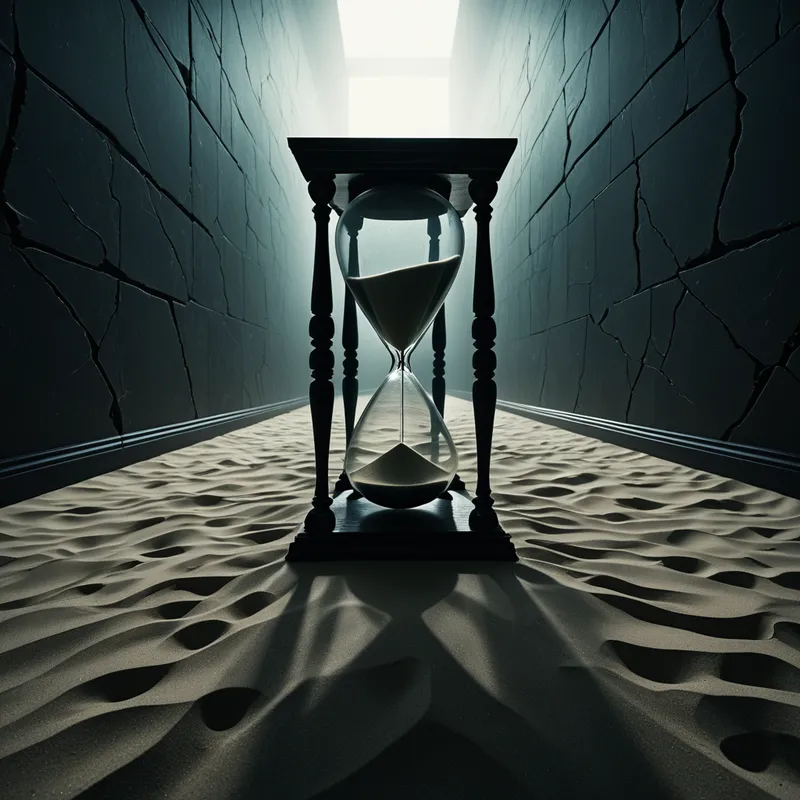
When the energy of the Kāla myth stirs in the modern psyche, it often surfaces in dreams of profound endings and temporal anxiety. One might dream of a relentless, silent pursuer in a decaying landscape, of watching a beloved clock shatter, or of being in a room where the walls are slowly, inexorably closing in. These are not dreams of violence, but of inevitability.
Somatically, this can feel like a deep, existential pressure in the chest or a cold stillness in the bones—the body sensing its own finitude. Psychologically, this dream-state marks a critical juncture: the individual is being confronted by their own shadow of impermanence. It is the psyche’s way of initiating a necessary dissolution of an outworn identity, a rigid self-concept, or an attachment to a phase of life that is passing. The dreamer is not literally dying, but a way of being within them is being summoned to its end by the inner Kāla.
Alchemical Translation
The individuation process modeled by the Kāla myth is the alchemy of sacred dissolution. For the modern individual, the "cosmic meditation of Shiva" is our own journey inward toward self-awareness. The "pressure behind the third eye" is the dawning, often uncomfortable, realization of our limits—our chronological limit (mortality), our energetic limits, the limits of our control.
The alchemical fire is lit not by seeking more, but by consciously consenting to the dissolution of what no longer serves the soul's true timeline.
The "emergence of Kāla" is the conscious facing of this truth, often triggered by a crisis—a major loss, a milestone birthday, a failure that shatters an old self-image. The instinct is to fight this dark, formless force, to deny time and decay.
The triumph of the myth is in Shiva’s response: prostration. The alchemical translation for us is not defeat, but profound acceptance. It is the act of laying down the ego’s frantic resistance to change and endings. We stop trying to be the exception to the rule of time. In that surrender, a transmutation occurs. The energy once spent on denial is freed. Time, once a persecutor, becomes a foundation. Mortality, once a terror, becomes the urgent, precious context for our choices. We become, in a sense, both the devoured and the devourer. We learn to willingly let parts of ourselves die so that more authentic parts can live, making us sovereigns, not victims, of our own fleeting, beautiful existence.
Associated Symbols
Explore related symbols from the CaleaDream lexicon: