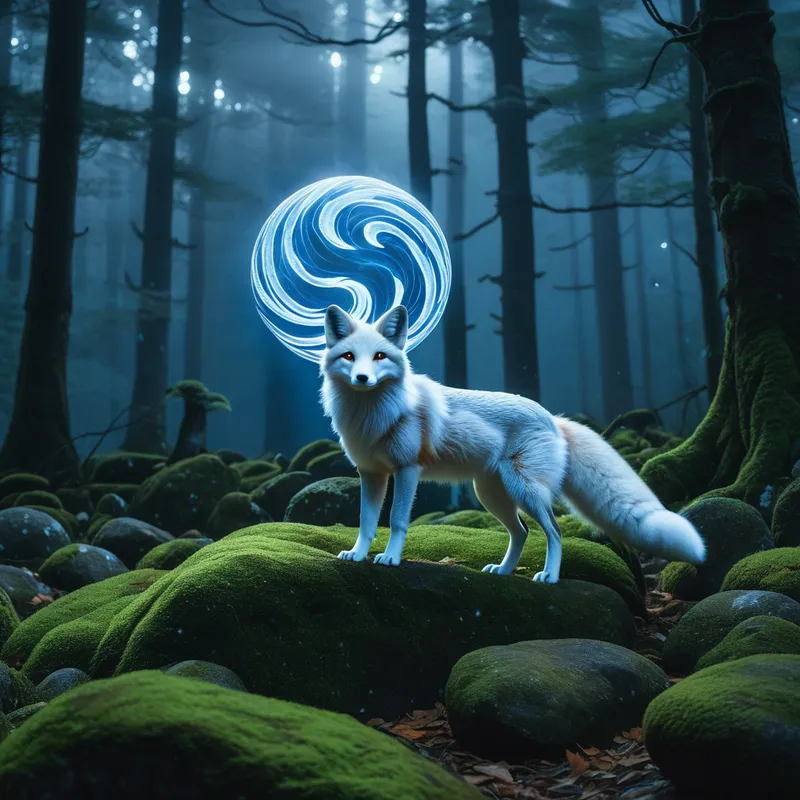
Kitsunebi Myth Meaning & Symbolism
The spectral fox-fire, Kitsunebi, is a luminous trick of the wild, guiding travelers to truth or ruin at the whim of the shape-shifting kitsune.
The Tale of Kitsunebi
Listen, and let the veil between worlds grow thin. The hour is the Ushimitsu-doki, when the world holds its breath. In the deep mountains, where the cedars are older than memory, a traveler has lost his way. The path has dissolved into shadow, and the moon is a sliver of tarnished silver, offering no comfort. Fear, cold and slick, coils in his belly. He is a man of the city, of ledgers and logic, and this primeval silence is a language he cannot speak.
Then, he sees it.
A soft, blue-white light blooms between the trees. Then another. And another. They drift like will-o’-the-wisps, but these are no mere swamp gases. They are Kitsunebi, cold flames that cast no warmth. They dance with an intelligence both playful and profound, weaving through the bamboo, illuminating patches of luminous moss and the watchful eyes of stone Jizō. The traveler’s fear melts into wonder, then into desperate hope. A light! A path! The fox-fires seem to arrange themselves into a glowing procession, leading away from the treacherous ravine, toward what looks like the lantern light of a remote inn.
His feet, heavy with mud, grow light. He follows, drawn by the promise of hearth and human voice. The lights bob and weave, always just ahead, leading him through a landscape that seems to shift subtly—a stream appears where none was, a familiar rock formation is gone. The air grows sweet with the scent of unseen plum blossoms. Finally, the lights converge before the gates of a magnificent estate he is certain was not there yesterday. Paper lanterns glow warmly. He hears the faint, elegant strain of a koto. A beautiful woman, her robes the color of twilight, slides the door open. Her smile is kind, her eyes hold a flicker of ancient gold. "You are lost," she says, her voice like wind through pines. "Rest."
For days, he rests in luxury, attended by the lady and her silent servants. He feasts on food that tastes of dreams and drinks sake that clarifies his mind to a razor's edge. He speaks of philosophy with his hostess, and she answers with wisdom that spans centuries. He is falling under a spell, not of fear, but of enchantment. He forgets his old life.
But on the third night, a dog barks in the distance—a sharp, prosaic sound. The traveler, stirring from a deep sleep, sees his beloved hostess startle. In the dim light, for a fraction of a heartbeat, he sees not a woman, but the silhouette of a great fox, ears pricked, before the image shimmers and resolves back. The illusion holds, but the seed of doubt is sown. The next morning, he pretends to drink the offered tea but spills it into his sleeve. His senses, no longer clouded by magic, now perceive the truth: the fine tatami is forest moss, the painted screen is a thicket of bamboo, the grand ceiling is the open, starless night sky. He has been sleeping in a hollow under a great camphor tree.
The beautiful woman approaches, but her smile is now sad, knowing. "You have seen," she says. With a sigh that is also the wind, she and the entire illusion dissolve. Where she stood, a magnificent kitsune with fur like spun silver regards him. It dips its head once, then turns and vanishes into the undergrowth. Where it went, a final cluster of Kitsunebi ignites, not leading him deeper into deception, but illuminating the true, hard-packed path back to the world of men. He is alone, cold, and on the right road, forever changed.
Cultural Origins & Context
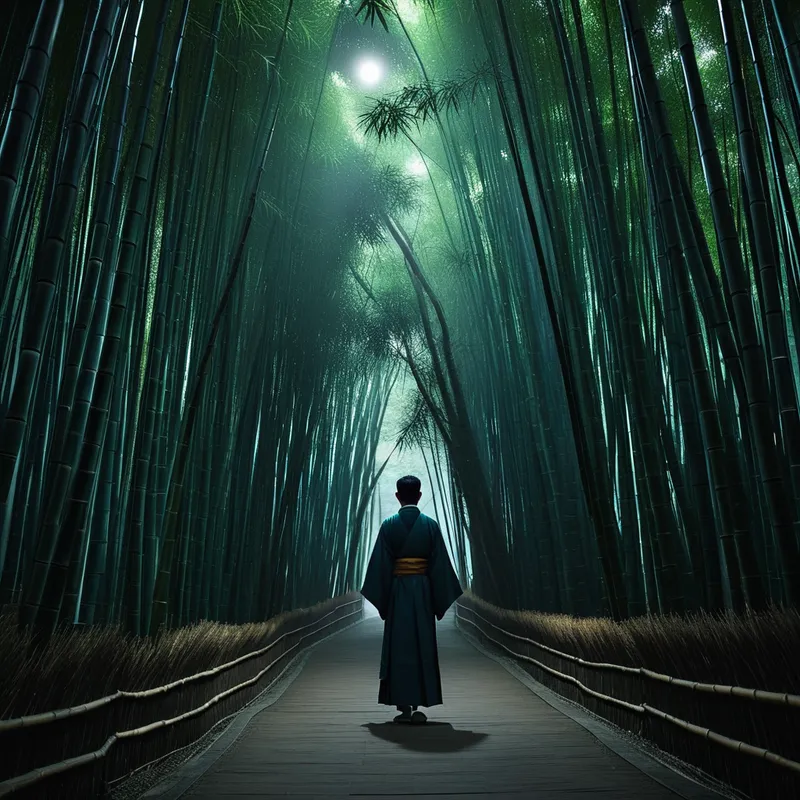
The myth of Kitsunebi is woven into the very fabric of Japan's animist heart, Shintō. It emerges not from a single text, but from the collective breath of countless oral tales (mukashibanashi) told by village elders, travelers, and monks around flickering hearths. These stories served as the people's psychology and physics, explaining the uncanny phenomena of the natural world. A strange light in the woods? It wasn't bioluminescence; it was a fox's craft.
The kitsune, as a yōkai (spirit being), held an ambivalent role. It was both a messenger of Inari, the deity of fertility and rice, and a independent trickster of the wild borderlands. Kitsunebi functioned as the visible signature of this ambiguity. For the peasant, it was a warning: the wilderness is enchanted, do not trust easy paths. For the mystic, it was a sign: the boundary between the mundane and the spiritual is thin and luminous here. The tales were societal tools, teaching vigilance, respect for the unknown, and the understanding that reality is often layered, with truth hiding just beneath the surface of appearance.
Symbolic Architecture
At its core, Kitsunebi is the symbol of psychic energy itself—the luminous, elusive, and potentially deceptive force of the unconscious mind. It is not a solid lantern but a drifting flame, representing intuition, inspiration, and the raw, untamed libido that fuels both creation and illusion.
The fox-fire does not illuminate the path; it illuminates the traveler's need for one, revealing the contours of his own longing and credulity.
The kitsune is the archetypal shape-shifter, the master of the kitsune-tsuki (fox illusion). It represents the autonomous complex within the psyche—a bundle of energy, often related to trickery, eros, or cunning intelligence, that can "possess" consciousness and project its own reality. The beautiful estate is the seductive fantasy, the inflated self-image, or the comforting delusion we construct to avoid a harsher truth. The traveler is the conscious ego, lost in the forest of life's complexities, desperate for guidance. The Kitsunebi leads him not to safety, but to a confrontation with the very parts of his own psyche he has neglected or romanticized.

The Dreamer's Resonance
When Kitsunebi flickers in a modern dream, it signals a moment of psychic ignition. The dreamer is at a crossroads, often feeling lost or directionless in waking life. The cold, blue light represents a guiding intuition or a nascent insight, but one that is not yet integrated. It is fascinating, compelling, but may lead to a mesmerizing dead end if followed without discernment.
Somatically, this can feel like a tingling of awareness, a "gut feeling" that is both exciting and unnerving. Psychologically, the dreamer is in a process of navigating enchantment. They are being shown the magical, imaginative possibilities of the unconscious (the illusory estate), but the dream is also testing their capacity for reality-testing. The barking dog in the tale is the counterpart in the dream—an intrusive, mundane, or jarring element that serves to break the spell and initiate disillusionment. To dream of finally seeing the fox behind the woman is to experience a moment of profound integration: the recognition that the enchanting, mysterious force is a natural, instinctual part of the self, not an external phantom.
Alchemical Translation
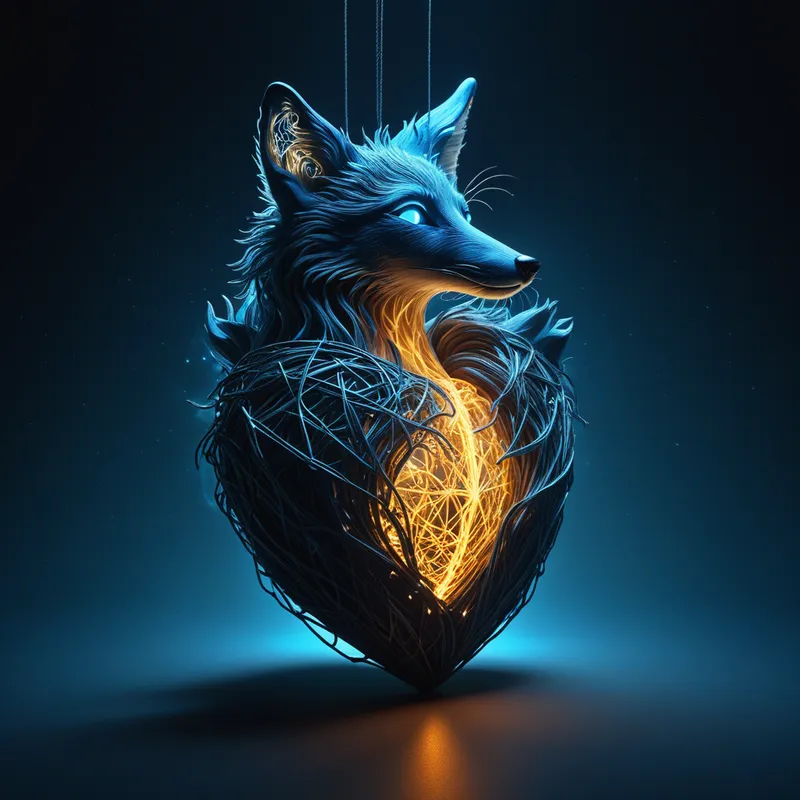
The myth of Kitsunebi models the alchemical stage of nigredo—the necessary descent into illusion and its subsequent breaking. The individuation process requires us to be led astray by our own inner Kitsunebi, to inhabit our fantasies fully, in order to discover their inorganic core. The luxurious estate is the persona or the complex we are identified with; it is comfortable, even glorious, but it is not our true home.
The ultimate purpose of the fox-fire is not to deceive, but to initiate. It leads the ego into the wilderness of the Self so that it may learn to see in the dark.
The transformation occurs not when the traveler escapes, but when he sees through the illusion while still within it. This is the alchemical albedo, the dawn of consciousness. The dissolution of the estate is not a punishment, but a release. The kitsune, now revealed in its true form, is no longer a deceiver but a psychopomp. The final, true Kitsunebi it leaves behind is the transformed psychic energy—the same intuition that once led into enchantment now illuminates the authentic, arduous path forward. The traveler returns to his world carrying the memory of the fox's gold-flecked gaze, forever knowing that reality is a collaboration between the seen path and the unseen light that dances just beyond it.
Associated Symbols
Explore related symbols from the CaleaDream lexicon: