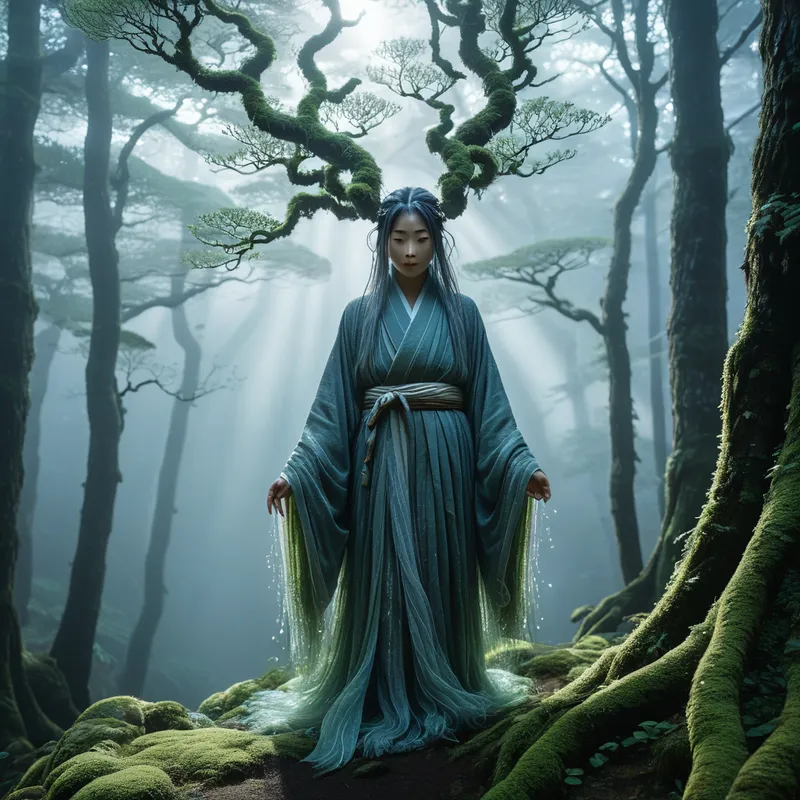
Kiri Myth Meaning & Symbolism
A tale of a spirit born from the mountain's sorrow, whose misty veil conceals and reveals the hidden truths of the world and the heart.
The Tale of Kiri
Listen, and let the veil between worlds grow thin.
In the ancient, breathing heart of Japan, where mountains are the bones of the earth and forests its whispering skin, there was a place of deep silence. It was not an empty silence, but a full one, heavy with the memory of rain and the patience of stone. Here, in a village clinging to the skirts of a sacred mountain, lived a woodcutter named Takeshi. His heart was a knot of quiet grief, for he had lost his wife to a fever that came and went like a cruel season. Each day, he would enter the embrace of the cedars, his axe a lonely rhythm against the great, sighing trunks.
One evening, as the sun bled into the indigo west and shadows pooled like ink beneath the trees, Takeshi’s grief overflowed. He did not weep aloud, for his sorrow was too vast for sound. He simply knelt on the damp moss, his calloused hands pressed to the earth, and his unshed tears seemed to seep into the very soil. The mountain felt it. The stones, the roots, the sleeping spirits of the place drank in this pure, human sorrow.
And from that spot, where profound grief met ancient earth, something began to stir. Not a creature of flesh, but of essence. A cool, gentle mist began to weep from the moss, coiling up from between the roots of a great, ancient torii that stood half-swallowed by the forest. It gathered, swirling and thickening, taking a form both there and not there—the soft shape of a woman, her robes the grey of twilight, her hair a cascade of silver fog. Her eyes held the deep, still darkness of a forest pool, reflecting everything and revealing nothing. This was Kiri, born not of chaos or desire, but of a mountain’s compassion for a mortal’s pain.
She did not speak, for mist has no voice but the sigh of the wind through pines. Yet, Takeshi felt a presence, a cool comfort that settled on his fevered heart like a balm. Night after night, when his loneliness was sharpest, Kiri would manifest. She would lead him on silent walks through the woods, her form parting the darkness, revealing hidden glades where bioluminescent fungi glowed like fallen stars, or clearings where ancient, forgotten Jizō statues stood guard. She showed him the world veiled by day—the secret life of the forest, the paths only the heartbroken could see.
But a spirit born of sorrow cannot linger forever in the realm of fixed forms. As Takeshi’s grief slowly transformed, not into forgetfulness, but into a quieter, wiser ache, Kiri’s form grew more tenuous. The villagers began to speak of a benevolent kami of the mist, one that guided the lost and comforted the sorrowful. On the dawn when Takeshi awoke and truly felt the sun’s warmth without a stab of pain, he went to the grove. Kiri was there, a mere shimmer in the air, a pattern of dew on a spider’s web catching the first light.
She did not fade. She unveiled. Her essence dissolved, not into nothing, but into the morning mist that rose from the valley, into the breath of the mountain itself. She returned to the state from which she had momentarily coalesced—a pervasive, gentle presence, no longer bound to a single sorrow, but available to all who walk the hidden paths with a heavy heart. The veil lifted, and in its lifting, revealed that the comfort was not gone, but had become part of the very air one breathes.

Cultural Origins & Context
The figure of Kiri is not a deity from the canonical pantheons of Shinto or Bukkyō, but rather emerges from the rich substratum of folk belief, mukashibanashi, and kaidan. These stories lived on the breath of village elders, told around the irori on long winter nights. They served as a psychological and ecological map, explaining the character of the landscape and the human emotions intertwined with it.
Mist (kiri) in Japan is never merely weather. It is a liminal agent, a natural maku that separates worlds. It conceals the familiar, making the known path strange, and in doing so, reveals hidden possibilities and truths. Stories of spirits like Kiri functioned as cultural containers for profound experiences—of grief, of liminal states of consciousness, and of the palpable sense that the natural world is responsive and sentient. They taught that intense human emotion does not vanish; it can be absorbed by the landscape and given back as a form of wisdom, a subtle guide. This myth was a narrative technology for processing loss, framing it not as an end, but as a transformation where personal sorrow could become a communal, environmental solace.
Symbolic Architecture
At its core, the myth of Kiri is an allegory of the psyche’s relationship with the unseen. Kiri is the embodied kūki of sorrow itself. She represents the moment when a personal, internal state—grief—is perceived as an external, autonomous entity. This is a fundamental psychological process: the projection of complex inner content onto the outer world, where it can be encountered, related to, and ultimately reclaimed.
The mist does not create the hidden path; it merely conceals the obvious one, forcing the traveler to see with different eyes.
Kiri symbolizes the veil of perception. Her primary action is not to do, but to reveal by concealing. By obscuring the mundane, everyday world, she forces Takeshi (and by extension, the psyche) out of habitual perception. The glowing fungi, the forgotten Jizō—these were always there. The grief, the “mist,” simply removed the distraction of the ordinary, allowing the numinous and the symbolic to emerge from the background. She is the spirit of the liminal space, the threshold where one reality dissolves so another can be glimpsed. Her birth from the mountain signifies that this capacity for transformative revelation is not supernatural, but a natural function of the deep psyche (the mountain) responding to authentic human experience.

The Dreamer's Resonance
When the pattern of the Kiri myth stirs in the modern dreamer, it signals a somatic and psychological encounter with a benign obscurity. To dream of a guiding, gentle mist that alters a familiar landscape is not a dream of confusion, but of re-orientation.
Somatically, one might feel a coolness, a dampness, a slight disorientation in the body upon waking—the physical memory of the psyche entering a liminal state. Psychologically, this dream emerges during periods of transition or unresolved grief, where the conscious ego’s map of the world has failed. The dream-mist does not represent avoidance, but the psyche’s innate healing intelligence veiling the old, painful pathways (the well-known trail home) to make space for new, previously unnoticed inner resources (the glowing clearing, the protective statue) to become visible. The dream is an act of therapeutic concealment. The dreamer is not lost; they are being gently prevented from going back to a familiar but painful psychic location, and are instead being guided toward latent wholeness.

Alchemical Translation
The alchemical journey modeled by Kiri is not the heroic conquest of a dragon, but the subtle, receptive process of solve et coagula—dissolve and coagulate. The initial state is Takeshi’s coagulated, hardened grief (coagula). Kiri’s emergence is the solve: the grief is dissolved from its frozen, personal form into a universal medium—mist. This is the crucial transmutation: personal pain is released from its ego-bound state and returned to the larger, animating spirit of the deep Self (the mountain).
The spirit does not heal the wound by removing it, but by transforming the one who bears it into a vessel capable of containing it as wisdom.
The final stage is the new coagula. Kiri herself dissolves, but the experience she facilitated does not. Takeshi’s consciousness has been permanently altered. He has learned to perceive the world through the “mist”—that is, with an awareness of hidden layers, symbolic meanings, and the comforting presence of the unseen in the seen. His grief has been alchemized from a blocking weight into a perceptual faculty. For the modern individual, this myth maps the individuation process where a complex is not “solved” or eliminated, but is engaged with so deeply that it loses its autonomous, haunting quality and its energy is integrated back into the psyche as a form of insight, intuition, or compassionate presence. One becomes, in a sense, a companionable mist for one’s own soul, able to veil the harsh glare of literalism and reveal the numinous paths that weave through the interior world.
Associated Symbols
Explore related symbols from the CaleaDream lexicon: