Kintsugi Myth Meaning & Symbolism
A mythic art where broken vessels are mended with gold, transforming scars into luminous history and teaching the soul's resilience.
The Tale of Kintsugi
Listen. There is a story not written in ink, but in fracture and fire. It begins not with a bang, but with a fall.
In the quiet heart of a master’s workshop, where dust motes danced in slants of afternoon sun, there lived a vessel. It was not born of the earth, but returned to it—shaped by patient hands, baptized in searing kiln-fire, and cooled into a form of perfect, silent utility. It held tea for the sage, water for the artist, sake for the poet. It knew the warmth of palms and the cool of stone shelves. It was whole, and in its wholeness, it was complete.
But wholeness is a story waiting for its second chapter.
One day, a clumsy hand, a startled movement, a moment’s inattention—the vessel met the unforgiving floor. The sound was not a crash, but a sigh of dissolution. From one, it became many. A constellation of sharp-edged fragments lay scattered, a map of its own destruction. The air, once fragrant with clay and incense, grew heavy with the scent of loss. The vessel was dead. Its story, it seemed, was over. It was destined for the midden heap, a memory of what once was.
But then, a different hand entered the story. Not the hand that dropped, but the hand that sees. The master artisan looked upon the ruins not as an end, but as a new kind of raw material. There was no anger, no lament for the lost perfection. Instead, a profound curiosity arose. What if the break was not a failure, but an event? What if the lines of fracture were not scars, but the potential for a new kind of line—a line of light?
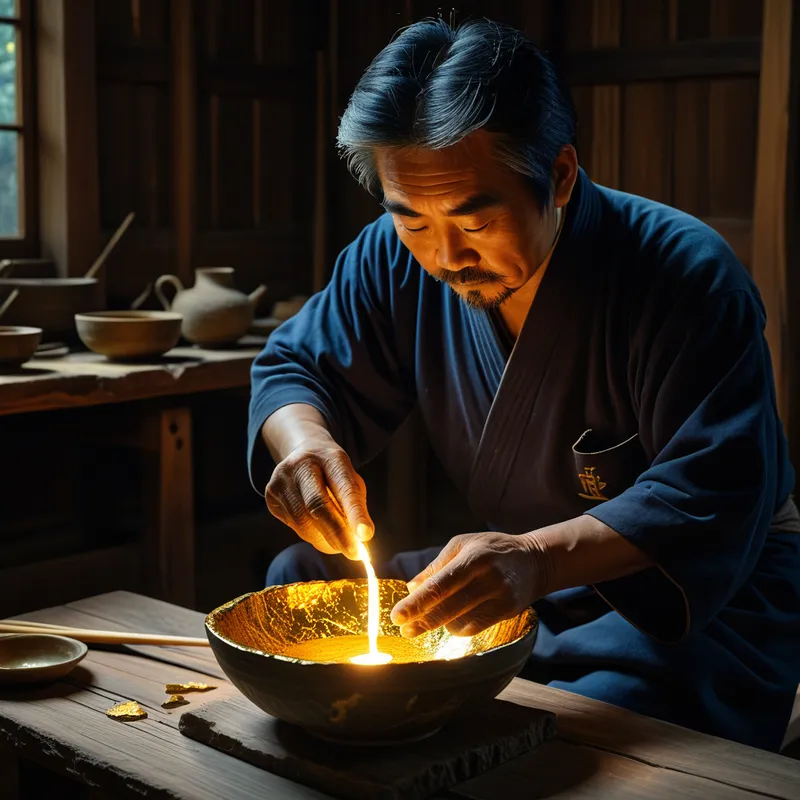
The master gathered the pieces with reverence, as one gathers the bones of an ancestor. A special urushi lacquer, sap of the resilient lacquer tree, was prepared. This was not a glue to hide, but a bond to acknowledge. Piece by piece, the puzzle was reassembled. The cracks were filled not to disappear, but to be emphasized. And then, the final alchemy: into the sticky, dark lines of lacquer, the finest powder of pure gold was carefully dusted, or molten gold was poured.
As the gold set, a miracle occurred. The vessel was reborn. But it was not the same vessel. It was something more. The golden lines traced its history of trauma with luminous honesty. In the lamplight, it did not hide its wounds; it illuminated them. It had been broken, and now it was unbreakable in a new way—not despite its fractures, but because of them. It held its contents not in a perfect void, but in a space defined by golden rivers of repair. Its beauty was no longer the naive beauty of the untouched, but the profound, earned beauty of the survivor. The vessel’s second life had begun, and its value was now beyond measure.

Cultural Origins & Context
The practice of Kintsugi, or 金継ぎ, emerged in the late 15th or early 16th century during Japan’s Muromachi period. While not a myth with gods and heroes in the classical sense, it is a living, material philosophy that has attained mythic status. Its origins are often poetically tied to the story of the Shogun Ashikaga Yoshimasa, who sent a cracked Chinese tea bowl back to China for repair and was disappointed with the ugly metal staples used to mend it. Japanese craftsmen, rising to the challenge, sought a more aesthetic solution, thus birthing the art of golden repair.
This development did not occur in a vacuum. It is deeply rooted in several intersecting Japanese aesthetic and philosophical principles: wabi-sabi, which cherishes the flawed and the ephemeral; mono no aware, a sensitivity to the poignant beauty of passing moments; and mushin. Kintsugi was practiced and perfected by masters of the Japanese tea ceremony, where the repaired vessel, telling a story of survival, became a focal point for contemplation and conversation. It was passed down not through epic poems, but through the silent, meticulous transmission of craft from sensei to apprentice, and through the powerful, wordless dialogue between a handled object and the human who beholds it. Its societal function was to model a radical form of acceptance and transformation, teaching that damage and repair are part of an object’s—and by extension, a life’s—authentic history.
Symbolic Architecture
At its core, Kintsugi is a three-part symbolic manifesto for the soul. First, it symbolizes the acknowledgment of breakage. The break is not denied, smoothed over, or discarded. It is the foundational fact. Psychologically, this represents the conscious integration of trauma, failure, loss, and shadow—the parts of ourselves we wish had never happened.
Second, it represents the patient, attentive repair. The urushi is slow-drying and requires a steady, present hand. This is the work of therapy, introspection, grieving, and healing. It is not a quick fix but a deliberate process of re-assembly, where every piece must be honored and fitted back into the whole.
The gold does not erase the crack; it makes the path of the fracture sacred. Our wounds become not sites of shame, but luminous maps of where we have traveled.
Finally, and most alchemically, it symbolizes transfiguration. The introduction of precious metal transforms the narrative. The flaw becomes a feature; the weakness becomes a unique strength. The vessel’s value increases because of its broken history, not in spite of it. This represents the psychological shift from victim to survivor, from damaged to deepened, where our lived experience—all of it—becomes the source of our unique wisdom, empathy, and character.

The Dreamer's Resonance
When the imagery of Kintsugi appears in modern dreams, it signals a profound somatic and psychological process of re-membering. The dreamer may see themselves as a fractured object being painstakingly glued, or they may be the artisan applying gold to the cracks of another or of the world itself.
Such dreams often surface during or after periods of significant psychological breakdown: the end of a relationship, a career failure, an illness, or a confrontation with a deep-seated trauma. The somatic sensation is often one of pressure and heat—the feeling of the lacquer binding or the gold setting—which mirrors the often uncomfortable but necessary process of neural reintegration. Psychologically, the dream indicates that the unconscious is actively working on a synthesis. It is taking the shattered pieces of identity, the fragmented memories, and the split-off emotions, and is beginning the slow, meticulous work of putting them back into a new, more conscious configuration. The gold in the dream is the dreamer’s own latent value and resilience being activated and applied to the wounds.

Alchemical Translation
The myth of Kintsugi models the individuation process with stunning clarity. Individuation, in Jungian terms, is the journey toward becoming a whole, integrated Self, which necessarily involves confronting and integrating the fragmented and wounded parts of the psyche—the shadow.
The initial, perfect vessel represents the persona—the presented, functional, socially acceptable self. The shattering is the inevitable encounter with life’s realities that breaks this fragile perfection, exposing the shadow and the complexes beneath. The temptation is to discard these pieces, to pretend the break never happened (repression) or to forever identify as broken (victimhood).
The Kintsugi master represents the emerging conscious ego in alliance with the Self, the archetype of wholeness. This inner authority chooses not to discard, but to gather. The urushi is the binding agent of conscious attention and self-compassion—the daily, often messy work of looking at our wounds without flinching. The gold is the transcendent function, the psychic process that arises from the tension of holding opposites (broken/whole, ugly/beautiful, past/present) and produces a new, third thing that is greater than the sum of its parts.
The alchemy is complete not when the scars vanish, but when we can point to them and say, "Here is where I learned to hold light."
The reborn vessel is the individuated Self. It is a functional whole, but its history is visible, integral, and luminous. It carries its past within its present form. For the modern individual, this translates to a life practice: to stop hiding our fractures—our anxieties, our griefs, our failures—and to begin the patient, artistic work of mending them with the gold of our own hard-won awareness. We are not tasked with returning to a naive, pre-broken state. We are tasked with creating a new, more beautiful, more complex, and more valuable form—one whose beauty is defined by its graceful, golden resilience.
Associated Symbols
Explore related symbols from the CaleaDream lexicon:
- Perfect
- Fault
- Patch
- Shattered Vase
- Burnt Toast
- Ripped Trousers
- Frosted Pansies
- Sea Glass
- Shattered Saxophone
- Fractured Bassoon
- Shattered Bowling Pin
- Ceramic Art
- Weathered Pliers
- Vibrating Sander
- Carved Wooden Ottoman
- Frayed Desk Mat
- Scotch Tape
- Sidewalk Cracks
- Cracked Floor Tiles
- Shattered Vases
- Cracked Paint Palette
- Cracked Glass
- Chipped Paint
- Cracked Vase
- Frayed Edge
- Cracked Clay Pot
- Clay Bowl
- Warped Wood Carvings
- Ceramic Shard
- Cracked Pottery
- Fire-Hardened Pottery
- Charred Carving
- Gusset
- Fracture
- Abrasion
- Suture