King Minos' Palace Myth Meaning & Symbolism
A tale of divine hubris, a monstrous birth, and a cunning hero navigating a maze to confront the beast within a king's impossible palace.
The Tale of King Minos’ Palace
Hear now the tale of a palace built on a broken oath, a house of order that birthed chaos, and a king who sought to rule the very gods.
On the sun-drenched isle of Crete, King [Minos](/myths/minos “Myth from Greek culture.”/) reigned. His power was absolute, his navy unmatched, his wealth legendary. To proclaim his divine right, he prayed to [Poseidon](/myths/poseidon “Myth from Greek culture.”/), Lord of the Deep, for a sign. “Send me a bull from your watery herds,” he cried, “and I shall sacrifice it in your honor, proving my piety and your favor!” [The sea](/myths/the-sea “Myth from Greek culture.”/) churned, and from the foam emerged a bull of such staggering majesty it seemed carved from living marble and storm cloud—a creature of pure, divine power.
Minos beheld the bull. Greed, that serpent in the heart of kings, coiled tight. To sacrifice such perfection? Unthinkable. It would be a waste of a treasure. He hid the god-bull in his herds and sent a common beast to the altar, believing [the Earth](/myths/the-earth “Myth from Hindu culture.”/)-Shaker would not notice the deceit. But the gods see all. Poseidon’s wrath was not a [thunderclap](/myths/thunderclap “Myth from Various culture.”/), but a slow, cruel poison. He turned his gift into a curse, inflaming Pasiphaë, the queen, with an unnatural, irresistible passion for the magnificent beast.
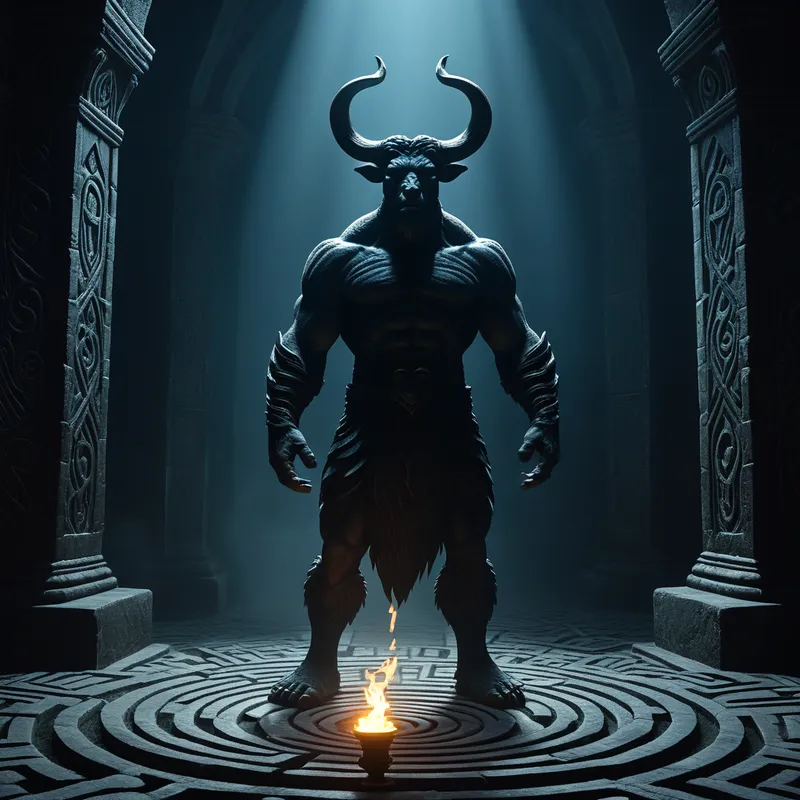
In shame and desperation, the queen sought the aid of the exiled master craftsman, Daedalus. To contain her impossible desire, he built her a hollow wooden cow, a deceptive shell. From this unholy union was born a creature of nightmare: a boy with the head and tail of a bull. They named him Asterion, but [the world](/myths/the-world “Myth from Tarot culture.”/) would know him as [the Minotaur](/myths/the-minotaur “Myth from Greek culture.”/), the “Bull of Minos.”
The palace, once a symbol of enlightened rule, now housed a secret shame. Minos, the ruler who demanded order, faced a chaos of his own making. He could not kill the monster—it was, in its horrific way, of his own royal blood. So he commanded Daedalus once more: “Build me a prison from which nothing can escape. Build me a [Labyrinth](/myths/labyrinth “Myth from Various culture.”/).” And so, beneath the grand courtyards and frescoed halls of the Palace of Knossos, Daedalus constructed his masterpiece of confinement—a twisting, turning, ever-changing maze of stone, a geometric madness with a monstrous heart.
But a beast must feed. To sate the [Minotaur](/myths/minotaur “Myth from Greek culture.”/)’s hunger and to cement his dominance over a rebellious Athens, Minos levied a terrible tribute: every nine years, seven Athenian youths and seven maidens were sent into [the Labyrinth](/myths/the-labyrinth “Myth from Greek culture.”/)’s mouth, lost to the darkness, a feast for the king’s hidden son.
This cycle of horror was broken only by the arrival of a prince in disguise: [Theseus](/myths/theseus “Myth from Greek culture.”/). With the help of Minos’s daughter, Ariadne, who offered him a ball of thread and a sword, he ventured into [the abyss](/myths/the-abyss “Myth from Kabbalistic culture.”/). He tied the thread at the entrance, let it unravel through the meaningless turns, until he stood in the silent, stinking center. There, man faced monster not as king and beast, but as two halves of a shattered whole. [Theseus](/myths/theseus “Myth from Greek culture.”/) slew the Minotaur and, clutching the lifeline of thread, retraced his steps from the belly of the maze back into the light of the world, leaving the palace’s dark secret dead in the dark.
Cultural Origins & Context
This is not merely a monster story. It is a foundational political and cultural myth for the Greek world, specifically for Athens, which told and retold it to define itself against the older, grander Minoan civilization of Crete. The myth comes to us primarily through later Greek sources like Plutarch and the tragic poets, who shaped the raw material of earlier epics and local traditions.
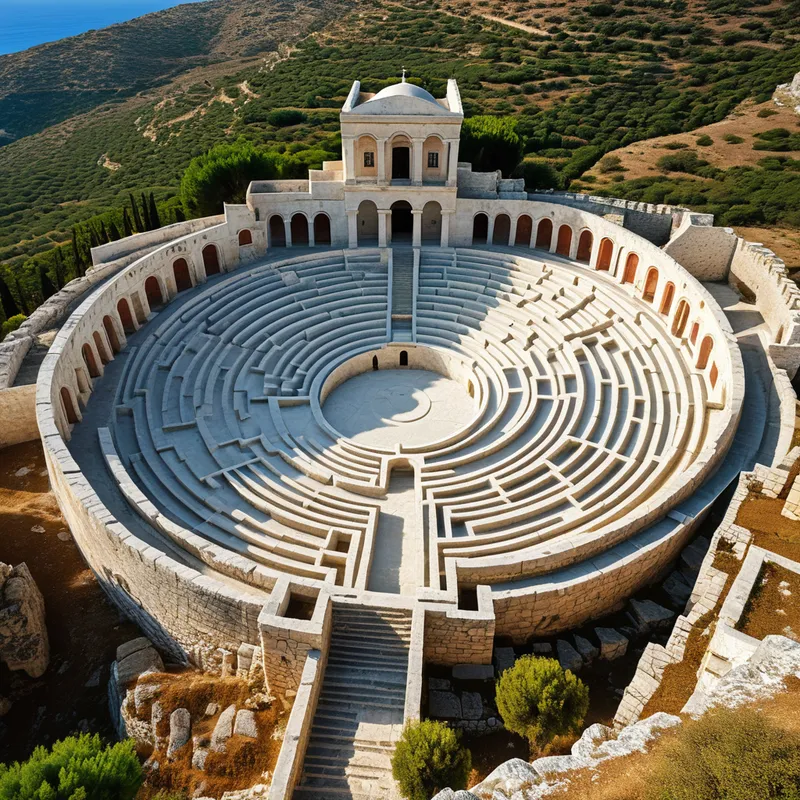
The Palace of Knossos was a real, awe-inspiring Bronze Age complex. To the later, mainland Greeks, its vast, multistoried layout with countless rooms and corridors seemed inherently labyrinthine. The myth served as an etiological tale, explaining the ruins they saw or heard of, transforming a historical center of power into a legendary site of horror. Societally, it functioned as a narrative of [triumph](/myths/triumph “Myth from Roman culture.”/) over a tyrannical, “other” power (Crete), with the clever, civic-minded hero Theseus representing the emerging Athenian ideals of reason and bravery over brute strength and archaic, monstrous kingship. The tribute of youths underscored the cost of subjugation and the glory of liberation.
Symbolic Architecture
The [palace](/symbols/palace “Symbol: A palace symbolizes grandeur, authority, and the pursuit of one’s ambitions or dreams, often embodying a desire for stability and wealth.”/) and its hidden [Labyrinth](/symbols/labyrinth “Symbol: The labyrinth represents a complex journey, symbolizing the intricate path toward self-discovery and understanding one’s life’s direction.”/) form a perfect psychic map. The sunlit halls above represent the conscious ego, the [persona](/symbols/persona “Symbol: The social mask or outward identity one presents to the world, often concealing the true self.”/) of the Ruler—structured, cultured, powerful. But beneath this conscious order lies the unconscious, the [Labyrinth](/symbols/labyrinth “Symbol: The labyrinth represents a complex journey, symbolizing the intricate path toward self-discovery and understanding one’s life’s direction.”/): chaotic, irrational, and easy to get lost in.
The Labyrinth is not a prison for the monster; it is the shape of the psyche that created the monster.
[King](/symbols/king “Symbol: A symbol of ultimate authority, leadership, and societal order, often representing the dreamer’s inner power or external control figures.”/) Minos himself embodies the [shadow](/symbols/shadow “Symbol: The ‘shadow’ embodies the unconscious, repressed aspects of the self and often represents fears or hidden emotions.”/) of the Ruler [archetype](/symbols/archetype “Symbol: A universal, primordial pattern or prototype in the collective unconscious that shapes human experience, behavior, and creative expression.”/): hubris. His sin is not mere greed, but a [betrayal](/symbols/betrayal “Symbol: A profound violation of trust in artistic or musical contexts, often representing broken creative partnerships or artistic integrity compromised.”/) of sacred order ([themis](/myths/themis “Myth from Global/Universal culture.”/)). He breaks a vow to the divine (Poseidon) to aggrandize [the self](/myths/the-self “Myth from Jungian culture.”/). The monstrous [offspring](/symbols/offspring “Symbol: Represents legacy, responsibility, and the future self. Often symbolizes creative projects or personal growth.”/), the [Minotaur](/symbols/minotaur “Symbol: The Minotaur, a creature from Greek mythology, is often interpreted as a symbol of inner turmoil and the struggle between human and beast.”/), is the inevitable [symptom](/symbols/symptom “Symbol: A physical or emotional sign indicating an underlying imbalance, distress, or message from the unconscious mind.”/) of this psychic [crime](/symbols/crime “Symbol: Crime in dreams often symbolizes guilt, inner conflict, or societal rules that are being challenged or broken.”/)—the repressed, bestial, and shameful result of unacknowledged desire and broken [faith](/symbols/faith “Symbol: A profound trust or belief in something beyond empirical proof, often tied to spiritual conviction or deep-seated confidence in people, ideas, or outcomes.”/). It is the [king](/symbols/king “Symbol: A symbol of ultimate authority, leadership, and societal order, often representing the dreamer’s inner power or external control figures.”/)‘s own denied [shadow](/symbols/shadow “Symbol: The ‘shadow’ embodies the unconscious, repressed aspects of the self and often represents fears or hidden emotions.”/), born of his [wife](/symbols/wife “Symbol: The symbol of a ‘wife’ in a dream often represents commitment, partnership, and personal relationships, reflecting one’s desires for intimacy or connection.”/) (the [anima](/symbols/anima “Symbol: The feminine archetype within the male unconscious, representing soul, creativity, and connection to the inner world.”/), or feminine principle, corrupted), demanding to be fed by the sacrifice of his own vitality (the Athenian youths).
Daedalus, the intellect and cunning, is complicit. He builds the deceptive cow and the brilliant [prison](/symbols/prison “Symbol: Prison in dreams typically represents feelings of restriction, confinement, or a lack of freedom in one’s life or mind.”/), showing how [human](/symbols/human “Symbol: The symbol of a human represents individuality, complexity of emotions, and social relationships.”/) ingenuity can be used to enable pathology and contain its symptoms, rather than heal its cause. The [ball](/symbols/ball “Symbol: The ball symbolizes playfulness, joy, and the cyclical nature of life, often representing the search for balance and wholeness.”/) of thread, given by Ariadne (the guiding anima, the clue of love or [intuition](/symbols/intuition “Symbol: The immediate, non-rational understanding of truth or insight, often described as a ‘gut feeling’ or inner knowing that bypasses conscious reasoning.”/)), is the [symbol](/symbols/symbol “Symbol: A symbol can represent an idea, concept, or belief, serving as a powerful tool for communication and understanding.”/) of heuristic—the practical method for navigating the unknowable. It is not a map of the [maze](/symbols/maze “Symbol: A maze represents confusion, complexity, or a search for truth, often reflecting life’s challenges or inner turmoil.”/), but a [trace](/symbols/trace “Symbol: A faint remnant or subtle indication of something that was present, suggesting memory, evidence, or a path to follow.”/) of one’s own [path](/symbols/path “Symbol: The ‘path’ symbolizes a journey, choices, and the direction one’s life is taking, often representing individual growth and exploration.”/), the thread of [consciousness](/symbols/consciousness “Symbol: Consciousness represents the state of awareness and perception, encompassing thoughts, feelings, and experiences.”/) one must lay down to find [the way](/myths/the-way “Myth from Taoist culture.”/) back to oneself.
The Dreamer’s Resonance
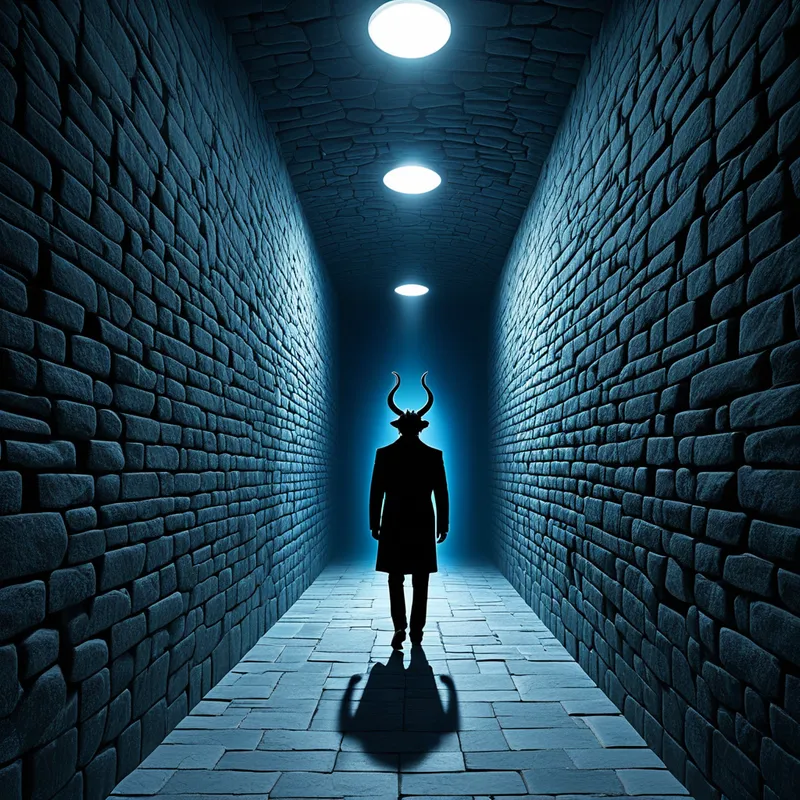
To dream of a labyrinthine palace or an endless, confusing maze is to experience the [psyche](/myths/psyche “Myth from Greek culture.”/)‘s signal that one is in a state of complex, inner confusion. The dream ego is often lost, seeking a center or an exit. This is not a nightmare of pursuit, but one of navigation.
Somatically, this can feel like tension, a knotted feeling in the gut or chest—the body holding the shape of the psychic knot. Psychologically, the dreamer is likely facing a life situation with no clear linear solution: a relational tangle, a career impasse, or a moral dilemma where every turn seems to lead to a dead end. The Minotaur in the modern dream may not be a literal bull-man, but a looming, overwhelming emotion (rage, shame, desire), a person who represents a complex, or a feared aspect of the dreamer’s own power that feels “monstrous” and untamed. The dream is an initiation into the Labyrinth of one’s own psyche, preparing the conscious mind for a necessary, frightening confrontation with what has been walled away.
Alchemical Translation
The myth models the alchemical process of [nigredo](/myths/nigredo “Myth from Alchemical culture.”/)—the blackening, the descent into the chaotic, [prima materia](/myths/prima-materia “Myth from Alchemical culture.”/) of the soul. King Minos’s initial state is one of inflated ego (the glorious palace). His refusal to sacrifice the bull represents [the ego](/myths/the-ego “Myth from Jungian culture.”/)‘s refusal to surrender something prized to a higher principle, blocking the flow of the Self. The creation of the Minotaur is the coagulatio, the concretization of this refusal into a complex—a stuck, autonomous entity in the psyche that devours energy.
Theseus’s journey is the archetypal path of individuation. He volunteers for the descent (conscious engagement with the unconscious). He accepts help (the anima’s thread, representing relatedness and intuition). He does not dismantle the Labyrinth—the structure of the complex remains—but he penetrates to its core.
The triumph is not in destroying the maze, but in traversing it consciously and confronting what it was built to contain.
The slaying of the Minotaur is not a act of violence against the self, but a [separatio](/myths/separatio “Myth from Alchemical culture.”/)—the difficult, often violent-seeming differentiation of consciousness from the identification with the monstrous complex. It is realizing, “This rage, this shame, this hunger is in me, but it is not all of me.” By confronting it, he deprives it of its autonomous, devouring power. The return via the thread is the albedo, the whitening, the reintegration of the insight gained in the depths back into the conscious life. The modern individual’s “Palace of Minos” is any seemingly ordered life structure (career, identity, relationships) beneath which lurks an unaddressed, feeding shadow. The myth calls not for the destruction of the palace, but for the courageous, thread-guided descent to reclaim the energy trapped in the maze, transforming the monster from a master into a memory.
Associated Symbols
Explore related symbols from the CaleaDream lexicon: