King Midas - The Phrygian king Myth Meaning & Symbolism
A king granted a wish turns all he touches to gold, learning that true wealth lies not in metal, but in the touch of life itself.
The Tale of King Midas - The Phrygian king
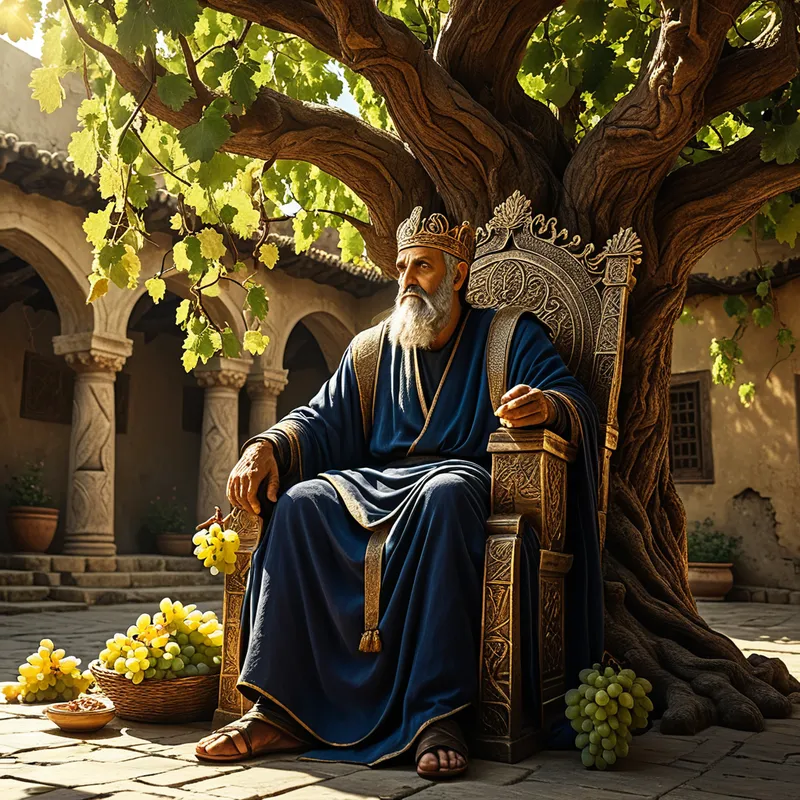
Listen, and hear the tale of [Midas](/myths/midas “Myth from Global/Universal culture.”/), king in the highlands of Phrygia, where [the river](/myths/the-river “Myth from Buddhist culture.”/) Pactolus whispers secrets to the stones. His palace was rich, his storerooms groaned with treasure, yet a hollow wind sighed through the chambers of his heart. His passion was not for his people, nor for the song of the lyre, but for the cold, silent gleam of gold. He would walk in his gardens and see not the blush of [the rose](/myths/the-rose “Myth from Persian culture.”/) or the dance of the vine, but only their potential weight in coin.
Fortune, or perhaps fate, delivered to his court a wandering reveler: [Silenus](/myths/silenus “Myth from Greek culture.”/), old and drunk, lost from the wild train of Dionysus. Midas, recognizing the divine connection, hosted the satyr with lavish feasts for ten days and nights, then returned him safely to his god. Dionysus, grateful and merry with wine, offered the king any boon his heart desired.
Midas did not pause. He did not ask for wisdom or long life. The hunger in his soul spoke first. “Grant that all I touch be turned to gold!” he cried. Dionysus, his smile tinged with a knowing sadness, replied, “So be it.”
At first, it was a miracle. The king trembled with ecstasy. He touched an oak branch—it became a rigid, glittering artifact. A stone from the path—a nugget of pure ore. He ran to his palace, transforming doorposts, tables, and statues into immortal, precious metal. He laughed, a sound like clinking coins. But then came the feast. He raised a cup of wine to his lips, and it hardened into a golden shell, the wine within a solid, undrinkable mass. He reached for bread, and it became a weighty, inedible lump. Hunger and thirst, once simple complaints, became terrifying specters.
The terror climaxed when his young daughter, seeing her father’s distress, ran to embrace him. As her arms wrapped around his neck, her comforting words ceased mid-breath. Her warm, living form stiffened in his grasp; her loving eyes glazed into sightless, metallic orbs. A statue of perfect, heartbreaking gold stood where his child had been. The king’s cry was not of [triumph](/myths/triumph “Myth from Roman culture.”/), but of utter desolation. He had built his own, perfect, lifeless prison.
He tore at his hair, his golden robes, and fled to Dionysus, begging, screaming for the curse to be undone. The god, more merciful than the wish, instructed him to wash in the source of the river Pactolus. Midas plunged in, and as the sacred waters swirled around him, the golden curse flowed from his skin, sinking into the river sands, which legend says have gleamed with gold dust ever since. The king rushed back to his palace, and with a touch now trembling with hope, he restored his daughter from her gilded sleep, the warmth of life returning to her cheeks in the greatest wealth he had ever known.

Cultural Origins & Context
The myth of Midas springs from the rich soil of Anatolian tradition, later woven into the tapestry of Greek mythology by poets like [Homer](/myths/homer “Myth from Greek culture.”/) and Ovid. Historically, a [King Midas](/myths/king-midas “Myth from Greek culture.”/) ruled Phrygia in the late 8th century BCE, a figure of great wealth and power known to Assyrian records. The myth likely evolved as a folk explanation for the actual gold deposits found in the Pactolus River, a crucial source of Lydia’s economic might. Told in symposia and around fires, the story functioned as a profound cultural caution. In a world where commerce and coinage were rising, it served as a societal check against the dehumanizing potential of wealth, reminding a burgeoning mercantile culture that some values—family, sustenance, connection to the divine (through Dionysus)—existed outside the economic exchange and were rendered null by the very touch of greed.
Symbolic Architecture
At its core, the myth is a masterful depiction of a literalized, and therefore catastrophic, psychological state. The “golden touch” is not a blessing but the [symbol](/symbols/symbol “Symbol: A symbol can represent an idea, concept, or belief, serving as a powerful tool for communication and understanding.”/) of a psychic [inflation](/symbols/inflation “Symbol: A dream symbol representing feelings of diminishing value, loss of control, or expansion beyond sustainable limits in one’s life or psyche.”/)—a kingly [consciousness](/symbols/consciousness “Symbol: Consciousness represents the state of awareness and perception, encompassing thoughts, feelings, and experiences.”/) that believes it can transmute the entire world into the substance of its own singular desire.
The wish is the prison. What the ego demands as its ultimate prize is often the very mechanism of its starvation.
Gold, the [metal](/symbols/metal “Symbol: Metal in dreams often signifies strength, transformation, and the qualities of resilience or coldness.”/) of kings and gods, symbolizes the highest value, the sun, immortality. But Midas does not seek its spiritual [aspect](/symbols/aspect “Symbol: A distinct feature, quality, or perspective of something, often representing a partial view of a larger whole.”/); he seeks its [material](/symbols/material “Symbol: Material signifies the tangible aspects of life, often representing physical resources, desires, and the physical world’s influence on our existence.”/), dead form. His touch does not elevate [life](/symbols/life “Symbol: The symbol of ‘Life’ represents a journey of growth, interconnectedness, and existential meaning, encompassing both the joys and challenges that define human experience.”/); it kills it, replacing dynamic, organic [reality](/symbols/reality “Symbol: Reality signifies the state of existence and perception, often reflecting one’s understanding of truth and life experiences.”/) with a [static](/symbols/static “Symbol: Static represents interference, disruption, and the breakdown of clear communication or signal, often evoking feelings of frustration and disconnection.”/), inorganic counterpart. The [food](/symbols/food “Symbol: Food in dreams often symbolizes nourishment, both physical and emotional, representing the fulfillment of basic needs as well as deeper desires for connection or growth.”/) and drink represent basic biological and emotional nourishment, which his [obsession](/symbols/obsession “Symbol: An overwhelming fixation on a person, idea, or object that consumes mental energy and disrupts balance.”/) renders inaccessible. His [daughter](/symbols/daughter “Symbol: In dreams, a daughter symbolizes innocence, potential, and the nurturing aspects of oneself or one’s relationships.”/) represents Eros itself—the [capacity](/symbols/capacity “Symbol: A measure of one’s potential, limits, or ability to contain, process, or achieve something, often reflecting self-assessment or external demands.”/) for [human](/symbols/human “Symbol: The symbol of a human represents individuality, complexity of emotions, and social relationships.”/) [connection](/symbols/connection “Symbol: Connection symbolizes relationships, communication, and bonds among individuals.”/). In turning her to gold, he witnesses the ultimate cost of his inflation: the murder of the [soul](/symbols/soul “Symbol: The soul represents the essence of a person, encompassing their spirit, identity, and connection to the universe.”/)’s [capacity](/symbols/capacity “Symbol: A measure of one’s potential, limits, or ability to contain, process, or achieve something, often reflecting self-assessment or external demands.”/) to love and be loved. The [river](/symbols/river “Symbol: A river often symbolizes the flow of emotions, the passage of time, and life’s journey, reflecting transitions and movement in one’s life.”/) Pactolus represents the cleansing, dissolving power of the unconscious—the divine instruction to descend from his inflated [height](/symbols/height “Symbol: Height often symbolizes ambition, perspective, and the elevation of one’s self-awareness.”/) and immerse himself in the flowing, purifying waters of [nature](/symbols/nature “Symbol: Nature symbolizes growth, connectivity, and the primal forces of existence.”/) and [soul](/symbols/soul “Symbol: The soul represents the essence of a person, encompassing their spirit, identity, and connection to the universe.”/) to be made whole again.
The Dreamer’s Resonance
When this myth stirs in the modern dreamscape, it rarely appears as a king with a crown. It manifests as a somatic and symbolic process. One might dream of their smartphone transforming everything it photographs into cold, digital data, losing the essence of the moment. Another might dream that their words, intended to connect, turn to ash in the air, leaving others as emotionless statues. The core sensation is one of a “toxic touch”—a fear that one’s primary mode of engagement with [the world](/myths/the-world “Myth from Tarot culture.”/) (their ambition, their critical analysis, their need for control) is sterile and destructive.
The dreamer is undergoing a confrontation with a negative inflation. They are being shown by the unconscious that a prized skill, identity, or pursuit has become a Midas curse, isolating them and cutting them off from the nourishing, messy, and vulnerable flow of life. The psychological process is one of horrifying recognition, where [the ego](/myths/the-ego “Myth from Jungian culture.”/)’s solution is revealed to be the core problem. The dream urges a crisis, a desperate reaching out for the “Dionysian” solution—an immersion in what is wild, feeling, and dissolving to the rigid structures of the conscious mind.
Alchemical Translation
The path of Midas is a brutal but precise map of psychic transmutation, a forced journey through the [nigredo](/myths/nigredo “Myth from Alchemical culture.”/) toward redemption. It begins with the unconscious wish: the ego, identified with the Ruler, believes more control (gold) will solve its spiritual poverty. The granting of the wish is the inflation, where this complex takes over the personality.
The alchemical gold is not found in the world, but is produced by the crucible of the soul’s own suffering and insight.
The confrontation with the golden food and daughter is the mortificatio—the necessary death of the inflated attitude. The king must see his child, his own potential for love and relatedness (his anima), frozen and dead by his hand. This is the darkest hour, the utter despair that breaks the ego’s identification with its wish. Only from this utter defeat can the plea for help arise.
The instruction to bathe in the Pactolus is the ablutio—the washing. It is the surrender to a process greater than oneself. He does not undo the touch himself; he submits to the divine (the unconscious Self) and lets the living waters of the [psyche](/myths/psyche “Myth from Greek culture.”/) cleanse him. This is the integration: the gold, his conscious desire for value and permanence, is not destroyed. It is transmuted. It flows out of his inflated ego and into the “sands” of his embodied, instinctual life (the riverbed), where it becomes a natural resource, part of the landscape of his soul rather than its tyrannical ruler. The final touch that restores his daughter is the touch of the redeemed king—no longer seeking to transform the world into his image, but capable of participating in its living, fragile, and truly golden exchange.
Associated Symbols
Explore related symbols from the CaleaDream lexicon: