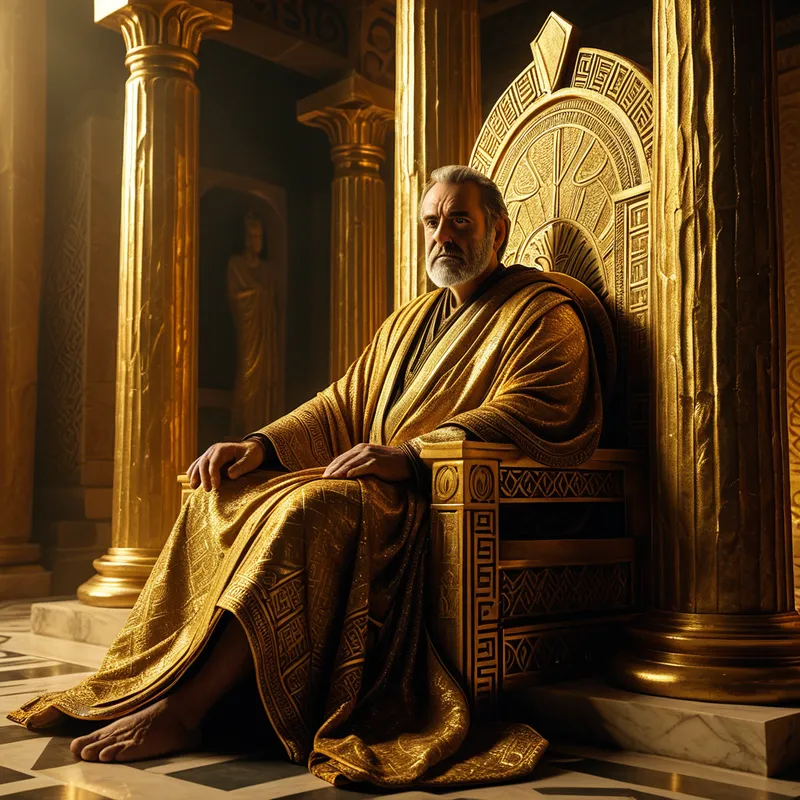
King Midas Myth Meaning & Symbolism
A king's wish for a golden touch becomes a curse, teaching that what glitters can starve the soul and that true wealth lies beyond material transformation.
The Tale of King Midas
In the ancient, rugged highlands of Phrygia, there ruled a king named Midas. His wealth was legendary, his storerooms groaned with treasure, yet a restless hunger gnawed at his soul—a hunger not for more, but for the power of more. His kingdom was a place of rustic beauty, where the river Pactolus sang over stones and the vineyards bore fruit so sweet it tasted of sunlight.
One day, the old, drunken Silenus, tutor to the god Dionysus, stumbled lost into Midas’s royal gardens. Instead of turning him away, Midas recognized the divine connection and hosted the satyr for ten days and nights with feasts and reverence. When Dionysus, frantic with worry for his beloved teacher, arrived, his relief turned to profound gratitude. He looked upon King Midas and said, “Ask of me any boon, and it shall be granted.”
The air in the throne room grew thick with possibility. Midas did not pause. The hunger spoke for him. “Grant that all I touch be turned to gold.”
A shadow passed over Dionysus’s face, a flicker of divine pity. But a god’s word is binding. “It is done,” he said, his voice echoing with unspoken consequence.
The king, trembling with excitement, reached for an oak branch. At his touch, it shimmered and hardened into a perfect, weighty sculpture of gold. He laughed, a sound of pure triumph. He touched a stone, a clay cup, a spear—all transformed into cold, immutable treasure. He raced through his palace, gilding tables, tapestries, and tiles, building a world of dazzling, sterile beauty.
Then, weary and exalted, he called for a feast. As he raised a cup of wine to his lips, it solidified into metal, the liquid gold burning his throat. He reached for bread; it became a metallic lump that shattered his teeth. In horror, he grasped an apple—it turned heavy and inedible in his hand. His beloved daughter, seeing his distress, ran to embrace him. As her arms wrapped around him, her warm, living form stiffened into a statue of priceless, heartbreaking gold.
The king’s cry was not of triumph, but of utter desolation. The Midas Touch was not a gift, but a prison of absolute scarcity. He had built a tomb of gold and sealed himself inside, starving amidst infinite wealth.
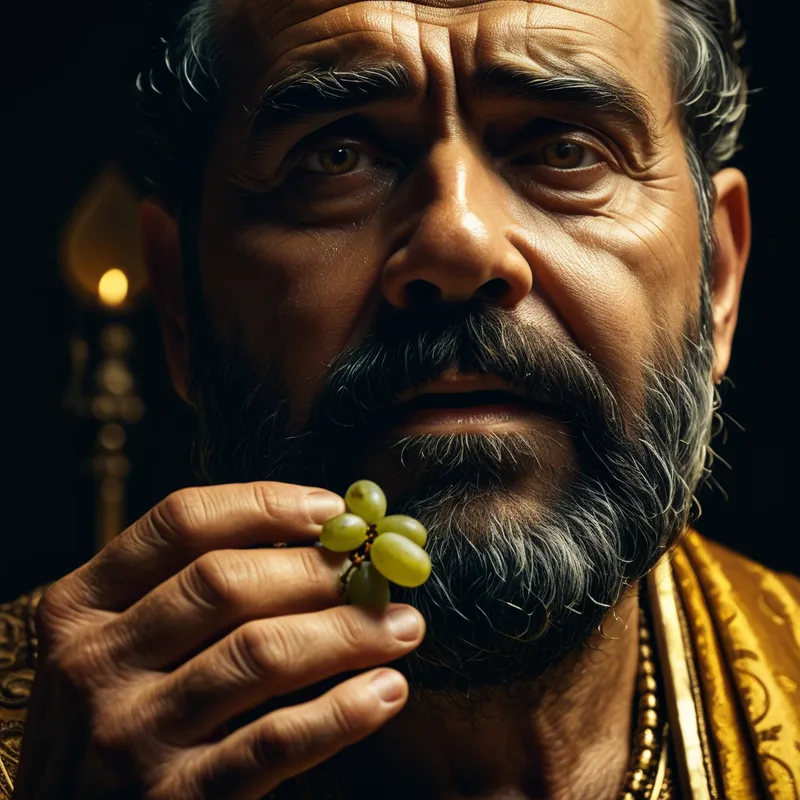
Cultural Origins & Context
The myth of Midas is not a singular, canonical text but a fluid narrative that evolved through oral tradition, most famously crystallized in the Roman poet Ovid's Metamorphoses. Its origins are deeply rooted in the Greek fascination with the boundaries between humanity and divinity, and the peril of overstepping them. Phrygia, to the Greeks, represented a wealthy, semi-barbaric frontier—a perfect setting for a tale about the dangers of untamed desire.
The story functioned as a powerful aetiological myth, explaining why the sands of the river Pactolus were rich with gold dust. But more importantly, it served as a profound cultural caution. In a society that valued sophrosyne (moderation) above almost all else, Midas was the ultimate example of hubris in the realm of material desire. It was a story told to remind the powerful that the gods’ gifts are double-edged, and that true prosperity lies in the fertile, mutable, and perishable world of nature and human connection, not in its static, metallic imitation.
Symbolic Architecture
At its heart, the myth of Midas is an archetypal drama of the psyche’s inflation and subsequent deflation. The golden touch symbolizes a psychic state where a single function—the desire for possession, control, and permanent value—dominates all others. It is the ultimate fantasy of the ego to fix the flowing, living world into a form it can completely own and control.
The wish for the Golden Touch is the death wish of the soul disguised as a pinnacle of success; it seeks to replace relationship with ownership, process with product, and life with monument.
Gold itself is ambivalent. Alchemically, it represents the highest spiritual attainment, the lapis philosophorum. But in Midas’s hands, it becomes a parody of this—spiritual value mistaken for literal material. He confuses the symbol for the substance. The transformation of his food and drink reveals that this inflated desire is anti-life; it cannot metabolize experience. The final, tragic petrification of his daughter is the ultimate revelation: the drive to turn everything to gold kills the anima, the soulful, connecting, and loving principle within one’s own life.
The Dreamer's Resonance
When this myth stirs in the modern unconscious, it often manifests in dreams of sterile triumph. One might dream of receiving a prestigious award that turns to lead in their hands, of a magnificent house that is empty and echoing, or of embracing a loved one who feels cold and distant, like polished stone. Somatic sensations often accompany these dreams: a metallic taste in the mouth, a feeling of bodily stiffness, or profound thirst amidst an abundance of undrinkable, glittering liquid.
These are dreams of psychic inflation. The dreamer is likely in a life phase where a singular drive—for career success, financial security, aesthetic perfection, or intellectual mastery—has begun to usurp the totality of their being. The psyche sounds the alarm, showing that this path, while glittering, leads to emotional and spiritual starvation. The dream is a crisis of value, asking the fundamental question: “What am I truly hungry for?” It points to a process where the ego’s prized “gold” is being revealed as a curse, creating the necessary tension for a revaluation of life.

Alchemical Translation
The path of Midas models a brutal but essential arc of individuation: the nigredo, or blackening, of a one-sided conscious attitude. His initial wish is an unconscious attempt at alchemy—to transmute the base lead of ordinary life into gold. But it is alchemy gone horribly wrong, performed without wisdom or reverence for the living process.
His redemption begins only in the depth of his despair, when he begs Dionysus to take the gift back. This is the crucial moment of humility and surrender, the dissolution of the inflated ego. The god instructs him to wash in the source of the river Pactolus. This is the ablutio—the cleansing. The waters, which represent the unconscious, the flow of life, and emotional cleansing, carry the golden curse from his body into the earth (the river sands), reintegrating the misplaced value back into the natural world.
The healing is not in renouncing gold, but in learning its proper place. The Pactolus holds the gold in its bed; it does not become the gold. We must let our transformative power flow through us, not solidify us.
For the modern individual, the “alchemical translation” is the journey from a Midas-complex—where we try to turn our relationships, our work, our very experiences into fixed, “valuable” assets—to a state of fluidity. It is about touching the world without the need to possess it, to appreciate the rose for its ephemeral fragrance and vulnerable petals, not for its potential as a permanent, metallic trophy. The goal is not to live without desire or ambition, but to desire in a way that nourishes life, allowing what we touch to remain alive, changing, and ultimately, free.
Associated Symbols
Explore related symbols from the CaleaDream lexicon: