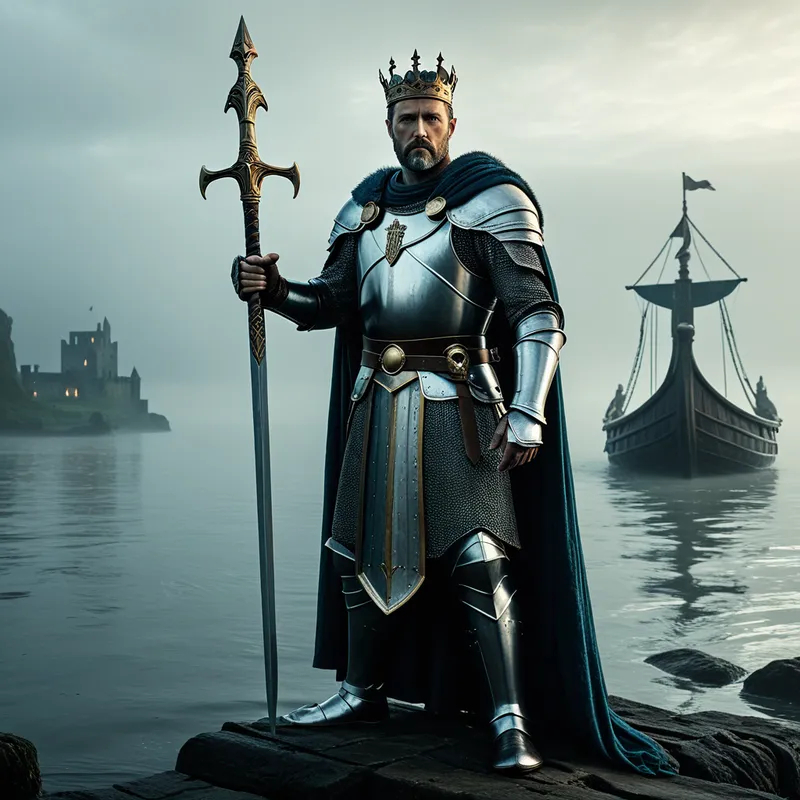
King Arthur Myth Meaning & Symbolism
A wounded land awaits a destined king who draws a sword from stone, founds a noble fellowship, and loses all to a fatal flaw, promising a future return.
The Tale of King Arthur
Listen, and hear the tale of the land’s deep wound and its fleeting healing. In a time when the mist clung low to the hills and the forests whispered of older things, Logres bled. Roman legions were a memory in the stone, and petty kings tore at each other’s throats, their pride a poison in the soil. The people cried out for a True King, one who would wield not just a sword, but sovereignty itself.
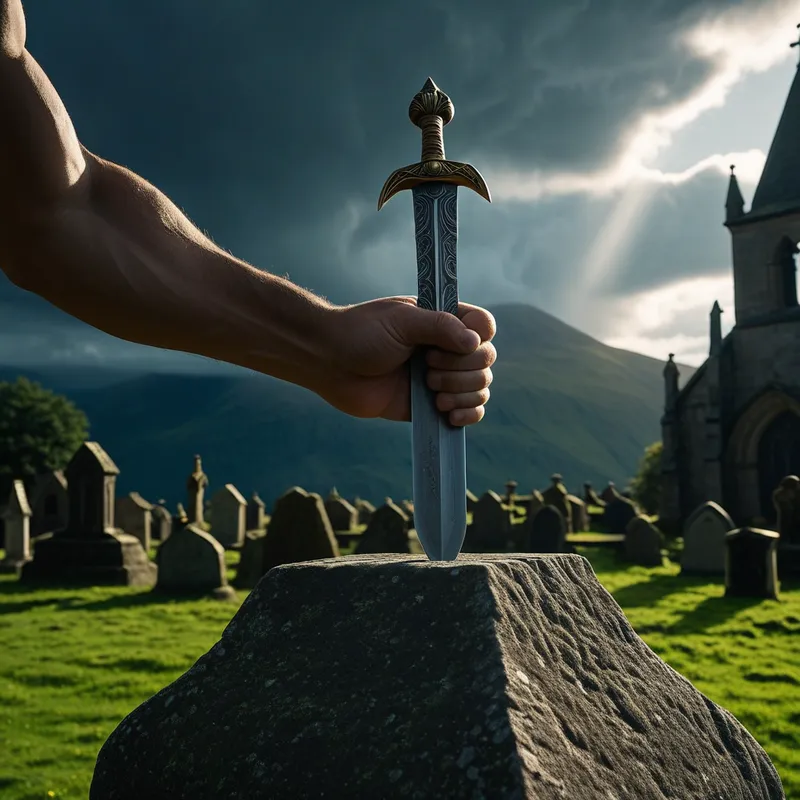
From this chaos, a hope was forged. The great enchanter Merlin, who walked with the breath of dragons and the memory of stones, placed a test upon the world. In the churchyard of London, upon an anvil set in a great stone, he fixed a sword. Letters of gold, cool to the touch, proclaimed: “Whoso pulleth out this sword of this stone and anvil, is rightwise king born of all England.”
Years passed. Lords and knights strained until their veins stood out like cords, but the sword slept, unmovable as the roots of the land. Then came a day of tournament. A boy, Arthur, foster-son to a kind knight, served as squire. His own brother’s sword was forgotten. In desperate need, he saw the glint in the stone. Without thought of kingship, only of duty, he grasped the hilt. It came free as a reed from water, with a sound like a sigh of release.
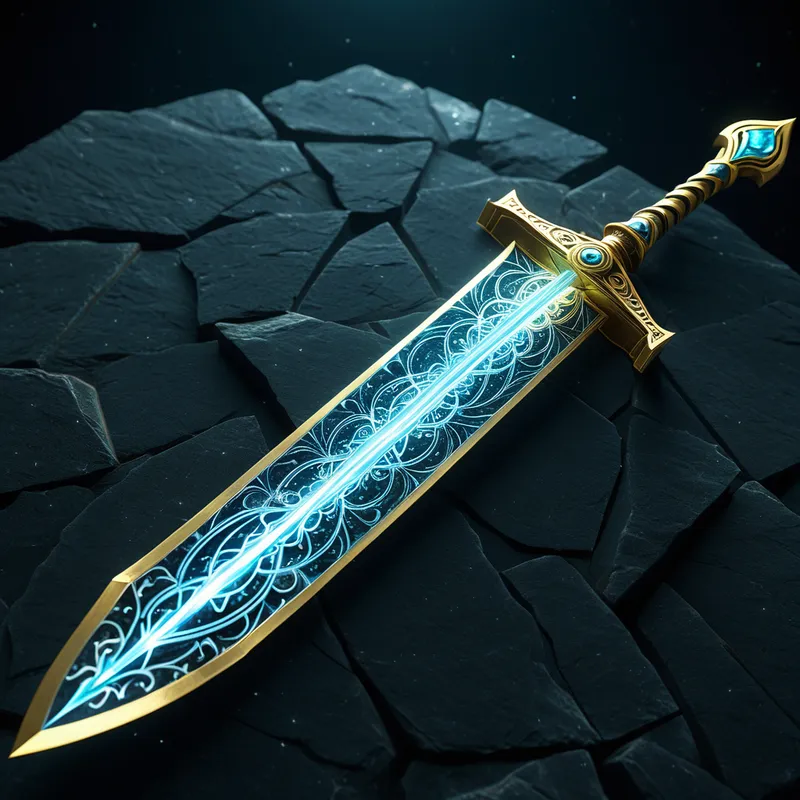
Thus, the hidden son of Uther Pendragon was revealed. Many doubted the boy-king, but Merlin knew the older magic at work. From the Lady of the Lake’s hand, rising from waters that held the moon’s reflection, Arthur received Excalibur, a blade forged in the Otherworld, its scabbard worth ten times the sword for it prevented the loss of blood. With it, he drove back the darkness, uniting the warring tribes.
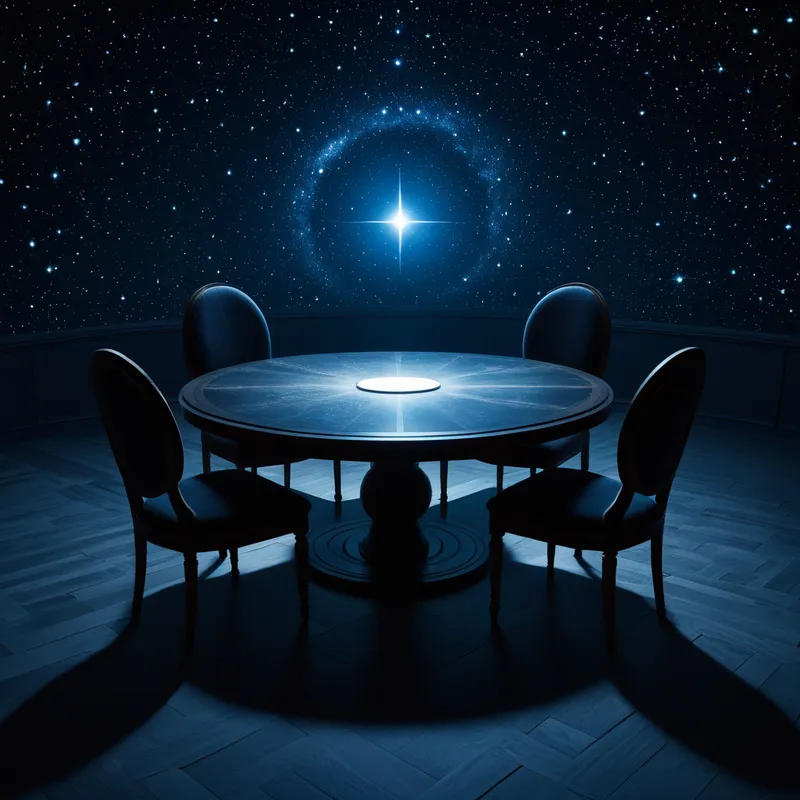
His reign was a golden twilight. At its heart was Camelot and the Round Table, a fellowship of the bravest and noblest, sworn to might in service of right. Their highest quest was for the Holy Grail, a glimpse of which purified the land but fractured the fellowship, for only the purest in heart could behold it fully.
Yet within this splendor coiled the serpent. Arthur’s beloved queen, Guinevere, and his greatest knight, Lancelot, loved not wisely. Their betrayal was the first crack in the world. The final blow came from within Arthur’s own blood: his son, Mordred, conceived in ignorance and raised in bitterness, who seized the throne in his father’s absence.
On the fate-blasted field of Camlann, father and son met. They fought amidst the mud and the dying, and each gave the other a mortal wound. As the last light bled from the sky, Arthur commanded his faithful knight Bedivere to cast Excalibur back into the mere. Reluctant, Bedivere twice hid the sword, but Arthur’s fading spirit knew. On the third cast, a hand rose from the water, caught the hilt, brandished it three times, and drew it beneath.
Then came the black barge from across the misty water. Three queens in mourning veils bore the wounded king away to the isle of Avalon. And it is said by some that he sleeps there still, in the apple-groves under the hill, and will return when the land has need of him. The Once and Future King passed into the mist, and the great winter fell upon Logres.
Cultural Origins & Context
The Arthurian mythos is not a single story but a vast tapestry woven over a millennium, its threads pulled from history, folklore, and pure poetic invention. Its roots are in the post-Roman chaos of 5th and 6th century Britain, a historical “Arthur” likely being a Romano-British dux bellorum (war leader) who won significant battles against Saxon invaders. This faint historical silhouette was clothed in the vibrant robes of Welsh Celtic mythology, absorbing figures like Morgan and the otherworldly island of Avalon.
The story was carried by bards and cyfarwydd (storytellers) in the halls of Welsh princes, a tale of British resistance and lost glory. Its great transformation came with the Norman conquest and the flowering of French chivalric romance. Writers like Chrétien de Troyes in the 12th century introduced the Holy Grail, the courtly love of Lancelot and Guinevere, and the splendor of Camelot. In the 15th century, Sir Thomas Malory’s Le Morte d'Arthur compiled these French and English sources into a monumental, tragic prose epic that became the definitive version for the English-speaking world.
Societally, the myth functioned as a foundational narrative. For the Welsh, it was a national myth of resilience. For the feudal aristocracy of the High Middle Ages, it became a mirror and an ideal, codifying the concepts of chivalry, courtly love, and Christian knightly quest. It provided a model for kingship—the rex quondam rexque futurus (the once and future king)—that balanced martial power with justice, a potent political symbol for monarchs seeking to legitimize their rule.
Symbolic Architecture
At its core, the Arthurian cycle is a profound allegory of the psyche’s struggle for integration, its glorious achievement, and its inevitable fragmentation.
The Sword in the Stone represents the emergence of conscious will and purpose from the unconscious, collective bedrock of life (the stone). It is not taken by force, but received by the one whose nature is aligned with a higher law. Arthur’s act is one of recognition, not conquest.
The true king is not he who seizes power, but he in whom power awakens, answering a call written in the substance of the world itself.
Camelot and the Round Table symbolize the achieved Self—a temporary, harmonious ordering of the psyche’s diverse energies (the knights) around a central, guiding consciousness (Arthur). The quest for the Grail represents the drive toward ultimate spiritual wholeness and connection with the divine, a quest that ultimately transcends and destabilizes the worldly order of the ego.
The tragedy is seeded from the beginning. Mordred is the Shadow, the repressed, unrecognized, and unloved aspect of the king himself, born of an unconscious, incestuous act. The betrayal of Guinevere and Lancelot represents the fracturing of the anima (the soul-image) and the warrior spirit, their passion a force that the ordered consciousness of the King cannot integrate. The fall of Camelot is the necessary deconstruction of a conscious attitude that has become too rigid, too identified with its own perfection, and thus blind to its own hidden flaws.
The Dreamer's Resonance
When the Arthurian pattern stirs in modern dreams, it signals a profound engagement with the archetype of inner sovereignty and its perils. To dream of drawing a sword from a stone or anvil is to experience a moment of destiny-touch, a somatic feeling of one’s latent power and purpose aligning with a deep, structural need in one’s life. It feels less like an achievement and more like a recognition.
Dreams of a round table, especially one that is broken, empty, or occupied by shadowy figures, speak to the dreamer’s internal council—the various sub-personalities, skills, and drives. It asks: Is there a ruling principle? Are the parts in communication, or war? A dream of a wasted, misty land reflects a psychic state of depression or fragmentation, a Logres within that has lost its king.
Most poignantly, to dream of being a wounded king on a boat, or of watching such a figure depart, often accompanies a necessary psychological death. It is the somatic process of relinquishing an old identity, a former “kingdom” of the ego (a career, a relationship, a self-image) that is no longer tenable. The journey to Avalon in the dreamscape is the unconscious initiating a healing retreat, a withdrawal of psychic energy from the outer world to be reconstituted at a deeper level.
Alchemical Translation
The Arthurian myth maps the full alchemical cycle of the individuation process: nigredo (descent and chaos), albedo (purification and ordering), and ultimately the shattered rubedo (the glorious, tragic culmination).
The pre-Arthurian chaos is the nigredo—the dark, confused, and conflicted initial state of the psyche. The drawing of the sword is the first coagulation of a conscious ego from the prima materia. The building of Camelot is the albedo, the creation of a refined, ordered, and seemingly perfect conscious life. The Round Table is the coniunctio, the marriage of opposites within the personality under a single ruling principle.
The Grail is not found at the center of the Table, but beyond it. The ultimate treasure lies outside the ego’s perfect order, in the wilds of the soul.
But this order is fragile because it is not whole. It excludes the shadow (Mordred) and cannot contain the full force of instinct and passion (Lancelot and Guinevere). The quest for the Grail drains energy from the system, revealing that the ego’s kingdom is not the final goal. The fall is the necessary mortificatio—the death of the old king, the deconstruction of the conscious attitude.
The final act is the alchemical transmutation. Arthur does not simply die. Excalibur, the symbol of his conscious power and will, is returned to its source in the unconscious (the Lake). He is taken to Avalon, the place of incubation and healing. This models the psychic process where an exhausted or outmoded complex of identity is dissolved back into the unconscious, not to be destroyed, but to be reworked. The promise of return—the “Future King”—is the hope of the psyche that from this dissolution, a new, more integrated consciousness will be reborn, one that has metabolized its shadow and acknowledged its flaws. The myth teaches that wholeness is not a castle to be built and defended, but a cycle of incarnation, sacrifice, and renewal.
Associated Symbols
Explore related symbols from the CaleaDream lexicon: