
Kinabalu Spirit Myth Meaning & Symbolism
A tale of a mortal who steals fire from the sky gods, leading to a cataclysm that births a sacred mountain and a watchful, eternal spirit.
The Tale of Kinabalu Spirit
In the time before memory, when the earth was young and the sky was a low, heavy blanket of stars, the people lived in a world of perpetual twilight. They shivered in the damp, their bellies empty of cooked food, their nights long and fearful. Above them, in the celestial realm of Kaluwalhatian, the gods lived in radiant splendor, warmed by the sacred fire that danced at the heart of their domain. This fire was not merely flame; it was the essence of knowledge, warmth, and civilization itself, and it was guarded with divine jealousy.
Among the people was a man of uncommon spirit. Some say his name was Kudaman, others that he was unnamed, known only by his deed. He looked upon his suffering kin and his heart burned with a different kind of fire—a fierce, rebellious love. The whispered pleas of the children and the weary sighs of the elders became a drumbeat in his soul. He could not bear the injustice of the cold. So, he resolved to do the unthinkable: he would scale the Sky Ladder and steal a spark of the divine fire.
His journey was a silent hymn of defiance. He climbed through veils of mist where spirits whispered warnings, his hands raw on the slick, living vines. He passed the nests of great Sarimanok, their feathers like polished metal, their eyes holding the wisdom of ages. Finally, he breached the threshold of Kaluwalhatian. There, in a grove of luminous trees, the fire pulsed in a basin of pure crystal. The air hummed with power. With a breath held tight in his chest, he snatched a burning coal with a hollowed gourd, feeling its searing truth through the shell.
The heavens knew the theft instantly. A silence fell, deeper than any night, followed by a roar that shattered the calm. The great sky god, Bathala, or perhaps the fierce guardian Apolaki, erupted in wrath. This was not mere disobedience; it was a rending of the cosmic order. The divine fury manifested as a cataclysm. The Sky Ladder was severed, crashing into the sea. The earth itself convulsed in grief and anger, heaving upwards in a titanic spasm of rock and soil, trying to reach the now-distant sky and reclaim the thief.
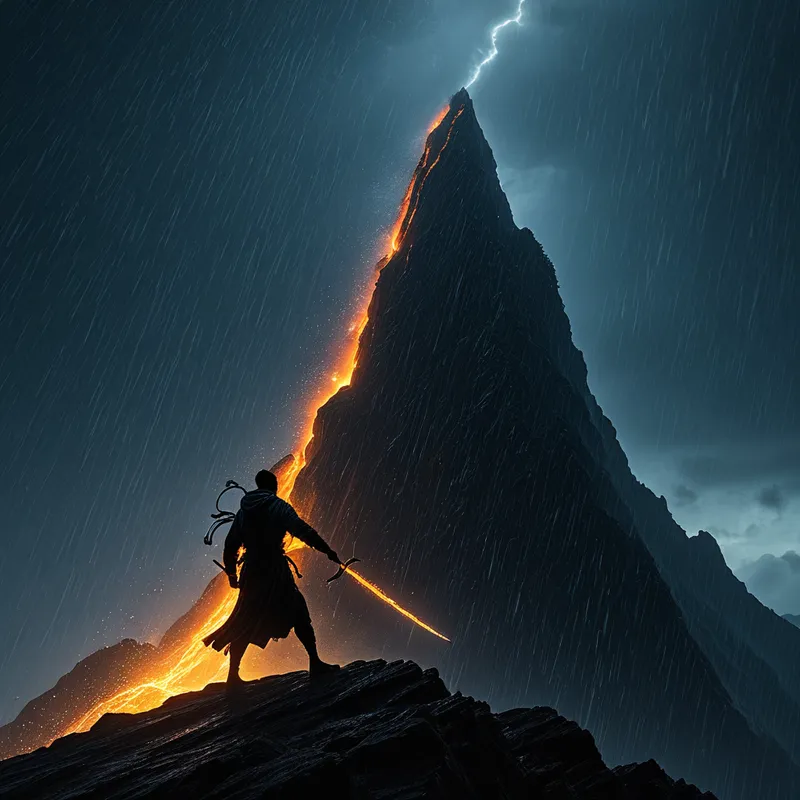
The man, the rebel, was caught in this geologic birth. He did not flee. Clutching his stolen prize, he was engulfed by the rising earth, becoming one with the stone. The mountain grew and grew, a permanent scar and monument, until its peak scraped the underbelly of the clouds. There it stopped, forever separated from the home of the gods. The fire was saved for humanity, but at a cost. The mountain was named Kinabalu, and within its cold, majestic heart, the spirit of the man remained—not as a ghost, but as the living consciousness of the mountain itself. The Kinabalu Spirit was born: a watchful, solemn deity, a bridge no longer of vines but of memory, forever bearing the weight of his transgression and his gift.
Cultural Origins & Context
This myth finds its roots among the indigenous peoples of northern Luzon, particularly those in the Cordillera region, and shares thematic kinship with narratives surrounding the great mountain known to many as Mount Pulag or the concept of a "Navel of the World." It is a story belonging to the oral tradition, told by lallakay and inabel weavers around hearth fires, its rhythms woven into the patterns of blankets and the cadences of chants. Its function was multifaceted: it was an etiological myth explaining the origin of a specific, awe-inspiring geographical feature; a cosmological map detailing the separation of the human and divine realms; and a profound social parable.
The tale served to instill a deep, respectful fear of the mountains, which were both life-givers and perilous domains. It framed the relationship between humanity and the divine as one of necessary tension—gifts come with cost, and progress requires a breach of the old order. The Kinabalu Spirit is not a god to be worshipped with easy praise, but a numen, a presiding presence to be acknowledged with rituals, offerings, and restrained conduct when traversing its slopes. The myth encodes the principle of kapwa, but extends it to the non-human world: one's actions affect the very land, and the land remembers.
Symbolic Architecture
At its core, the myth of the Kinabalu Spirit is a drama of consciousness. The stolen fire represents the Promethean spark of individuation—the moment the ego seizes a piece of the Self’s latent power (knowledge, technology, self-awareness) from the unconscious, collective realm of the gods. This is not a gentle awakening, but a theft, a violent act of differentiation that necessarily provokes a crisis.
The mountain is the solidified conflict between the yearning soul and the established order of heaven. It is the enduring symptom and the eternal monument.
The rebel’s transformation into the mountain spirit symbolizes the fate of the conscious ego that has taken on a burden too great to simply carry. It becomes identified with a complex—here, the "mountain complex" of ambition, isolation, and eternal responsibility. The Kinabalu Spirit is the archetypal image of the psyche that has achieved a great thing but is now frozen in the role of its own achievement, forever guarding the very thing that imprisoned it. The myth beautifully captures the paradoxical nature of such breakthroughs: they elevate and they entomb; they grant light and cast a long, cold shadow.

The Dreamer's Resonance
When this myth stirs in the modern dreamer, it often manifests as dreams of monumental, often solitary, struggle. One might dream of climbing an endless, sheer cliff face, carrying a precious but dangerously hot object. There is a somatic sensation of immense weight and burning pressure in the chest—the "fire in the heart" that feels both like passion and a cardiac burden. The dream landscape is frequently one of sublime, terrifying geology: newborn mountains, chasms opening underfoot, the ground itself feeling alive and judgmental.
Psychologically, this signals a process of integrating a "stolen" or hard-won piece of self-knowledge. The dreamer is in the phase after a rebellious act of self-assertion—perhaps leaving a stifling situation, embracing a forbidden truth, or claiming a creative power. Now, they face the "wrath of the gods": the internalized backlash of old norms, superego judgments, and the terrifying responsibility that comes with their new awareness. The dream is not of the theft, but of its consequence—the formation of a new, permanent, and heavy structure in the psyche. The dreamer is the mountain, learning to bear the weight of their own consciousness.

Alchemical Translation
The alchemical journey modeled here is that of coagulatio—the process where volatile spirit is fixed into solid matter. The fiery, airy ambition of the rebel (sulphur) is confronted by the crushing, limiting reality of consequence (the salt of the earth), resulting in the fixed, enduring state of the mountain spirit (the mercurial essence now trapped in stone). For individuation to move forward, this fixed state must be re-liquefied.
The ultimate goal is not to remain the eternal guardian on the peak, but to discover that the mountain itself is the vessel, and the spirit within can learn to flow through the stone like water through hidden aquifers.
The modern individual must perform the second, more subtle theft: stealing back the spirit from the role. This means differentiating the essential Self from the complex of "the one who achieved X." It involves acknowledging the sacrifice and the isolation (the mountain), but then finding ways to let the Kinabalu Spirit within communicate, not just stand vigil. This is the translation from myth to psyche: from being petrified by one's own deed to becoming a conscious steward of the power one has claimed. The mountain does not disappear, but one learns to inhabit it as a landscape of the soul, rather than as a prison of identity.
Associated Symbols
Explore related symbols from the CaleaDream lexicon:
- Fire — The stolen celestial flame represents forbidden knowledge, the spark of consciousness, and the transformative power that brings both warmth and the risk of divine wrath.
- Mountain — It is the solidified consequence of rebellion, a monument to ambition and sacrifice, and the eternal, isolating burden borne by the awakened spirit.
- Spirit — The eternal consciousness of the rebel, now merged with the mountain, representing a soul fixed in a state of perpetual watchfulness and responsibility.
- Sacrifice — The core transaction of the myth; the rebel sacrifices his mortal form and freedom to secure the divine fire for his people, embodying the high cost of progress.
- Journey — The perilous ascent to the sky world symbolizes the individual's arduous quest to claim a piece of the transcendent for the immanent world.
- Sky — Represents the realm of the gods, the collective unconscious, and the established, distant order that is breached by the act of individual will.
- Stone — The substance of the mountain and the tomb of the rebel, symbolizing permanence, weight, memory, and the fixation of spirit into enduring form.
- Theft — The radical, transgressive act that initiates the entire drama, representing the necessary rebellion against a stagnant or oppressive order to acquire a vital resource.
- Goddess — While not the central figure, the earth that heaves to form the mountain can be seen as a maternal, chaotic force responding to the cosmic imbalance, a goddess of the land enacting a form of terrible birth.
- Shadow — The long, cold cast of the mountain peak embodies the inevitable psychological shadow created by a luminous, heroic act—the isolation, guilt, and eternal burden that accompanies the gift.
- Order — The divine realm's structure, which is disrupted by the theft, representing the pre-conscious, collective state that must be broken for individual consciousness to emerge.
- Rebirth — The transformation of the mortal man into the eternal Kinabalu Spirit is a form of rebirth, a new existence born from a cataclysm, though it is a rebirth into a fixed, archetypal role.