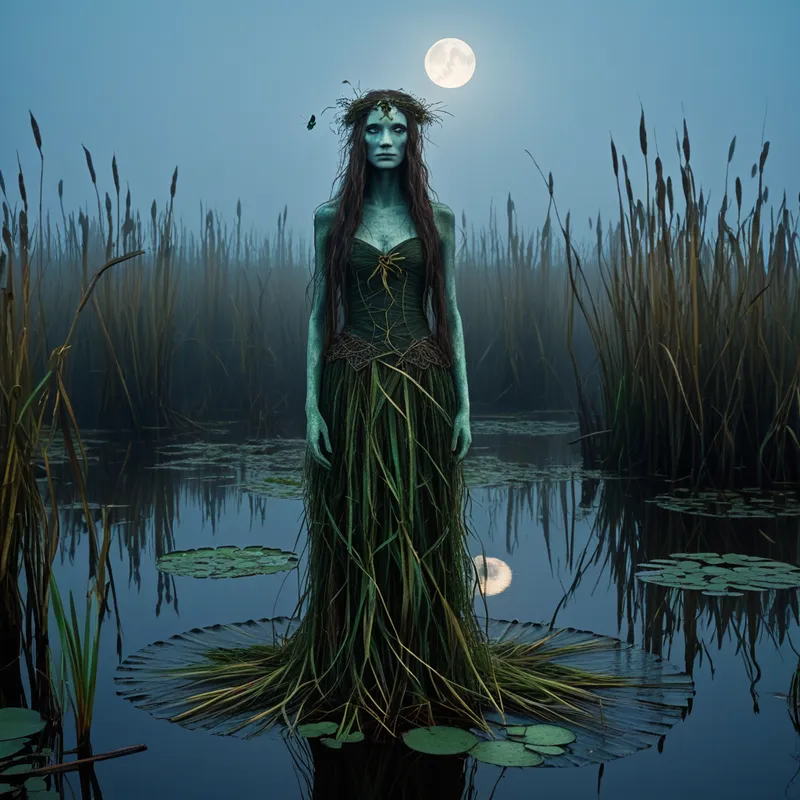
Kikimora of the Swamp Myth Meaning & Symbolism
A tale of a cursed spirit bound to the liminal swamp, embodying the exiled feminine and the psyche's need to reclaim its haunted, forgotten places.
The Tale of Kikimora of the Swamp
Listen, and let the peat-scented mist settle around you. This is not a story of the bright, ordered village, but of the place where the solid earth softens, where paths dissolve, and the water holds the sky captive in its black mirror. This is the tale of the [Kikimora](/myths/kikimora “Myth from Slavic culture.”/) of the Swamp.
She was not born of the swamp, but was given to it. Once, perhaps, she walked in sunlight—a woman of laughter or of silence, a daughter, a wife. But a curse fell, or a great grief was committed, a sin so profound it could not be contained by hearth or home. The community, in its fear, performed the only exile it knew: they led her, bound by whispers and shame, to the edge of the known world where the willows weep into the bog. They left her there, a sacrifice not to a god, but to forgetting. The swamp, that great, patient digestive tract of the earth, took her in. It did not kill her. It transformed her.
Now she dwells in the perpetual twilight beneath the cypress knees and the hanging moss. Her hair is the long, grey-green reeds that trail in the stagnant channels. Her skin holds the pallor of marsh gas and the texture of wet bark. Her eyes are the still, deep pools that show you not your face, but the face you fear you might become. She is the genius loci of the liminal, the lady of the soggy, in-between places where nothing is quite solid, nothing is quite liquid.
She is rarely seen, but always felt. The traveler who strays from the path at dusk will feel the ground grow soft and hungry beneath his boots. He will hear not a scream, but a low, gurgling sob that seems to come from the water itself. The swamp will tighten around him, the familiar landmarks twisting into grotesque parodies. This is her presence. She does not always drag him under. Sometimes, she merely watches, a pale shape glimpsed between the black trunks, reminding him that there are places that belong not to man, but to memory and regret. Her touch is the sudden, cold clutch of roots on an ankle, her voice the pop of a methane bubble breaking the surface—a sound like a lost word finally spoken.
Her story has no heroic slaying, no prince come to break the curse with a kiss. Her resolution is the resolution of the swamp itself: a slow, eternal absorption. The curse is the binding, and the binding is her existence. She is the eternal reminder, the psychic stain on the landscape. The village’s forgotten shame given form, haunting the border they themselves created. To hear her tale is to stand at that border, to feel the chill of the peat-laden air, and to know that some exiles are so complete, they become the geography of the haunted mind.

Cultural Origins & Context
The myth of the Kikimora is a folktale born from the intimate, perilous relationship between Slavic agrarian communities and the vast, unconquerable wilderness that surrounded them. The swamp, or boloto, was a quintessential borderland. It was neither fertile field nor navigable river nor traversable forest. It was a useless, dangerous, and spiritually ambiguous space—a literal no-man’s-land on the edge of the village’s ordered world.
These stories were not the purview of formal priests but of the folk—the narod. They were told by grandmothers by the fire, by woodsmen returning at dusk, serving as both entertainment and profound ecological-psychological instruction. The tale functioned as a cautionary map. It explained the inexplicable: the strange lights (bludički), the disorienting mist, the sudden disappearance of livestock or a foolish child. More importantly, it codified a social law. The Kikimora was often portrayed as a woman cursed for a transgression—adultery, witchcraft, or an unforgivable breach of communal norms. Her exile to the swamp was the community externalizing and geographically containing its own moral failures and unresolved tensions. The myth thus served to reinforce social boundaries by vividly illustrating the fate that lay beyond them, while also acknowledging that the consequences of collective judgment lingered, hauntingly, just out of sight.
Symbolic Architecture
Psychologically, the Kikimora is the archetypal embodiment of the exiled feminine and the repressed content of the personal and collective [shadow](/symbols/shadow “Symbol: The ‘shadow’ embodies the unconscious, repressed aspects of the self and often represents fears or hidden emotions.”/). She is not a [demon](/symbols/demon “Symbol: Demons often symbolize inner fears, repressed emotions, or negative aspects of oneself that the dreamer is struggling to confront.”/) of pure evil, but a [spirit](/symbols/spirit “Symbol: Spirit symbolizes the essence of life, vitality, and the spiritual journey of the individual.”/) of profound sorrow and alienation. The [swamp](/symbols/swamp “Symbol: Represents the subconscious mind, emotions, and the complexities of personal issues.”/) itself is the perfect [symbol](/symbols/symbol “Symbol: A symbol can represent an idea, concept, or belief, serving as a powerful tool for communication and understanding.”/) for the unconscious—a murky, nutrient-rich, fecund, yet perilous [realm](/symbols/realm “Symbol: The symbol of ‘Realm’ often signifies the boundaries of one’s consciousness, experiences, or emotional states, suggesting aspects of reality that are either explored or ignored.”/) where things are preserved, not decomposed; where memories and traumas sink out of [sight](/symbols/sight “Symbol: Sight symbolizes perception, awareness, and insight, representing both physical and inner vision.”/) but remain potent, shaping the [landscape](/symbols/landscape “Symbol: Landscapes in dreams are powerful symbols representing the dreamer’s emotional state, personal journey, and the broader context of life situations.”/) from below.
The swamp does not forget what the village chooses to banish. It is the psyche’s archive of the unbearable.
The Kikimora represents those parts of the self—[vulnerability](/symbols/vulnerability “Symbol: A state of emotional or physical exposure, often involving risk of harm, that reveals authentic self beneath protective layers.”/), wild [emotion](/symbols/emotion “Symbol: Emotion symbolizes our inner feelings and responses to experiences, often guiding our actions and choices.”/), “inconvenient” power, or past [trauma](/symbols/trauma “Symbol: A deeply distressing or disturbing experience that overwhelms the psyche, often manifesting in dreams as unresolved emotional wounds or psychological injury.”/)—that have been cursed by the internalized “[village](/symbols/village “Symbol: Symbolizes community, connection, and a reflection of one’s roots or origins.”/)” of our ego-[consciousness](/symbols/consciousness “Symbol: Consciousness represents the state of awareness and perception, encompassing thoughts, feelings, and experiences.”/) and abandoned at the edge of [awareness](/symbols/awareness “Symbol: Conscious perception of self, surroundings, or internal states. Often signifies awakening, insight, or heightened sensitivity.”/). She is the feeling we refuse to feel, the [memory](/symbols/memory “Symbol: Memory symbolizes the past, lessons learned, and the narratives we construct about our identities.”/) we will not name, the creative [impulse](/symbols/impulse “Symbol: A sudden, powerful urge or drive that arises without conscious deliberation, often linked to primal instincts or emotional surges.”/) we call foolish. Her haunting is not an attack from without, but a summons from within. The disorientation she causes is the ego’s [terror](/symbols/terror “Symbol: An overwhelming, primal fear that paralyzes and signals extreme threat, often linked to survival instincts or deep psychological trauma.”/) when its familiar paths (defenses, narratives) dissolve, forcing a confrontation with the soft, unstable ground of the true self.
Her bound state signifies a psychic complex—an autonomous, [energy](/symbols/energy “Symbol: Energy symbolizes vitality, motivation, and the drive that fuels actions and ambitions.”/)-laden [cluster](/symbols/cluster “Symbol: A dense grouping of similar elements, representing complexity, patterns, or interconnectedness within a larger system.”/) of thoughts and feelings—that is trapped in its own painful [story](/symbols/story “Symbol: The symbol of ‘Story’ represents the narrative woven through our lives, embodying experiences, lessons, and emotions that shape our identities.”/), unable to be integrated or released. She is the “orphaned” part of the [soul](/symbols/soul “Symbol: The soul represents the essence of a person, encompassing their spirit, identity, and connection to the universe.”/), forever mourning its own [exile](/symbols/exile “Symbol: Forced separation from one’s homeland or community, representing loss of belonging, punishment, or profound isolation.”/).

The Dreamer’s Resonance
When the pattern of the Kikimora rises in modern dreams, it signals a profound somatic and psychological process: the emergence of exiled material from the personal shadow. The dreamer may not see a literal swamp spirit, but the landscape will carry her signature.
Dreams of being trapped in slow, sucking mud, of houses with basements flooded with black water, or of finding forgotten, weeping women in attics or behind locked doors are all manifestations of this archetype. The somatic experience is one of dragging weight, of chilled dread, of breath caught in thick air. Psychologically, it is the process of haunting becoming conscious. The ego, the “village” of the waking self, is being visited by what it tried to abandon.
This is not a nightmare for its own sake, but a critical stage in shadow-work. The Kikimora’s appearance is a call to acknowledge the exile. The grief, shame, or rage that has been bogged down in the unconscious is now bubbling to the surface, demanding witness. The dreamer is being invited—or forced—to stand at the edge of their own internal swamp and recognize the spirit they have bound there. The terror is real, but it is the terror of re-connection, of feeling long-numbed pain.

Alchemical Translation
The myth of the Kikimora models the arduous alchemical stage of nigredo—the blackening, the descent into the prime material, the confrontation with the massa confusa. For the modern individual, the “hero’s journey” here is not to slay the spirit, but to dare to be haunted, to consent to the disorientation, and ultimately, to perform an act of sacred reclamation.
The first step is acknowledgment. One must consciously go to the “swamp,” the neglected area of life—a stalled creativity, a frozen grief, a chronic anxiety—and instead of fleeing, stay. Listen for the gurgling sob. This is the dissolution of the old, rigid ego-stance that claimed, “I have no such place within me.”
Individuation often begins not with finding a treasure, but with reclaiming a curse.
The second is dialogue. This is not negotiation, but witnessing. In active imagination or therapeutic process, one might ask the inner Kikimora, “What grief binds you here?” The answer is never the curse itself, but the original wound that preceded it. This is the separatio, distinguishing the authentic pain from the story of monstrosity built around it.
The final, alchemical transmutation is integration through meaning. The Kikimora is not “cured” and turned into a happy village wife. Rather, her essence is transformed. The swampy, fecund energy of the exiled complex is redeemed. The sorrow becomes depth. The wildness becomes authentic expression. The haunting becomes intuition. The orphan is adopted by the wider Self. What was a cursed spirit at the border becomes a guardian of the interior depths, a protector of vulnerability. The individual no longer fears the soft, unstable places within, but learns to build their consciousness including them, finding a strange, wet fertility in what was once only a place of exile and dread.
Associated Symbols
Explore related symbols from the CaleaDream lexicon:
- Swamp — The primary landscape of the myth, representing the liminal, unconscious mind where repressed memories and emotions are preserved in a state of potent, fecund stagnation.
- Swamp Land — The territory ruled by the Kikimora, symbolizing the psychological domain of the exiled complex, a borderland between conscious order and unconscious chaos.
- Water — Specifically stagnant water, embodying trapped emotional energy, unresolved grief, and the mirror-like surface that reflects distorted truths from the depths.
- Mirror — Represented by the still, black pools of the swamp, showing not a true reflection but the shadow-self, the face of the exiled or cursed identity one fears to acknowledge.
- Door — The threshold between the village (ego-consciousness) and the swamp (unconscious), a psychic point of no return where one either exiles a part of the self or chooses to enter the haunted realm.
- Exile — The core action of the myth, symbolizing the psychological process of repression, disowning, and casting out unacceptable parts of the self or community’s experience.
- Shadow — The Kikimora is a personification of the personal and collective shadow, the repository of all that is deemed dark, shameful, or unacceptable by the conscious personality.
- Grief — The fundamental emotion binding the Kikimora, the unresolved sorrow that fuels her haunting presence and calls for witness from the depths of the psyche.
- Wound — The original trauma or transgression that led to the exile, the unhealed psychic injury that festers in the unconscious and generates the complex.
- Ritual — The community’s act of casting the woman into the swamp, representing the unconscious psychological rituals we perform to banish and contain what we cannot integrate.
- Root — The tangled, submerged roots of swamp trees that clutch and bind, symbolizing the deep, archaic, and often hidden connections of a trauma or complex to the foundational structures of the self.
- Dream — The medium through which the modern Kikimora most often appears, as the swamp of the unconscious becomes navigable and the exiled spirit makes its presence known.