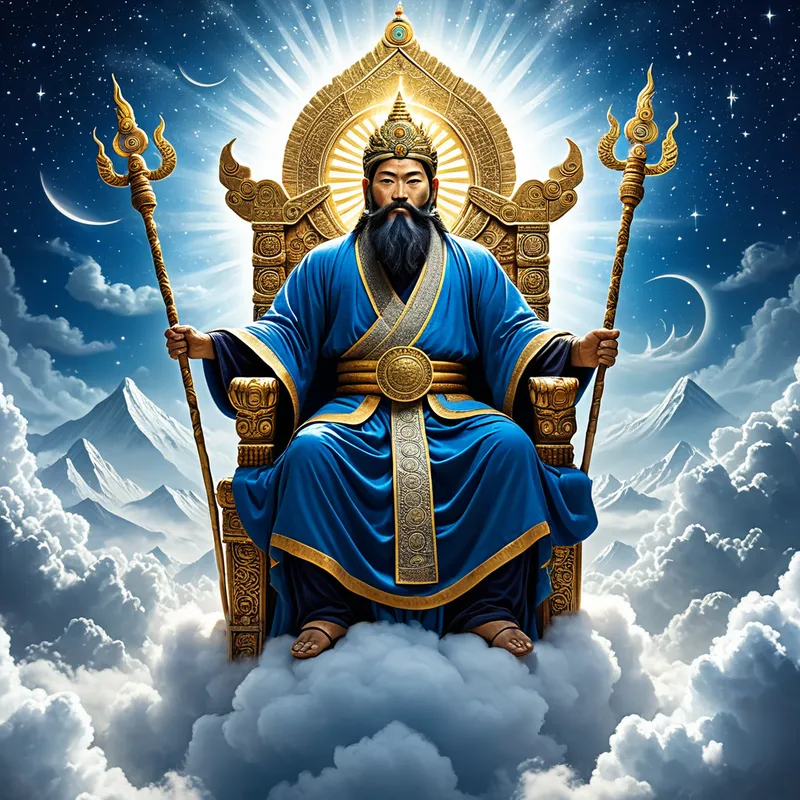
Khormusta Tengri of the Mongol Siberian Myth Meaning & Symbolism
A myth of celestial rebellion and cosmic order, where the supreme sky god Khormusta Tengri establishes the sacred hierarchy of the heavens.
The Tale of Khormusta Tengri of the Mongol Siberian
Listen, and let the wind from the high steppes carry the tale. Before time had a name, and the earth was but a thought in the mind of the Eternal Blue Sky, the heavens were a realm of pure potential—and pure chaos. Countless spirits, the Tengri, swirled in an endless, formless dance. Their voices were the howl of storms and the crackle of lightning, with no law to guide them, no throne to anchor the cosmos.
From this primal tumult arose one whose spirit was not just power, but purpose. His name was Khormusta Tengri. Where others saw only freedom, he perceived the sacred geometry of order. His will was not a shout, but a resonance that began to still the chaos. He did not fight the lesser tengri; he simply was, a mountain in a sea of mist. And the mist began to part.
He ascended, not by conquest, but by an undeniable rightness, to the highest vault of the sky. There, from the ultimate summit, he cast his gaze across the infinite spirit-host. With a voice that was the sound of glaciers moving and stars being fixed in their courses, he spoke the First Law. He divided the chaos into realms. To the West, he appointed fifty-five of the mightiest and most noble spirits. These became the Western Tengri, the benevolent ones, the bringers of light, fortune, and justice. Their number was sacred, a complete and perfect system.
But order begets rebellion. Among the countless spirits not chosen for this western glory, a seething resentment grew. They were the raw, untamed forces of the universe—envy, spite, and boundless ambition given spirit-form. They saw Khormusta’s hierarchy not as a divine gift, but as a chain. In a furious tide, they rose against the celestial court. The sky, so recently ordered, became a battlefield of clashing lights and deafening roars.
Khormusta Tengri did not rise from his throne. He did not summon armies. He simply extended his hand, and in it materialized the unbreakable authority of the cosmos itself. It was not a weapon, but a principle. The rebellion crashed against this principle like a wave against a cliff of diamond. Their chaotic power could not touch the immutable truth of the order he had decreed. One by one, their fury spent, the rebellious spirits were cast down, not into oblivion, but into their own domain—the lower, shadowed realms of existence, where they would rule as the necessary counterbalance, the fifty-five Eastern Tengri.
Silence returned to the high heaven, but it was a new silence—deep, resonant, and structured. Khormusta Tengri, the Supreme Ruler, sat upon his eternal throne at the apex of creation. The fifty-five Western Tengri now moved in a harmonious, celestial bureaucracy, each with a domain, a duty, a place in the great tapestry. The law was established. The cosmos had found its sovereign, and in that sovereignty, found its enduring form.
Cultural Origins & Context
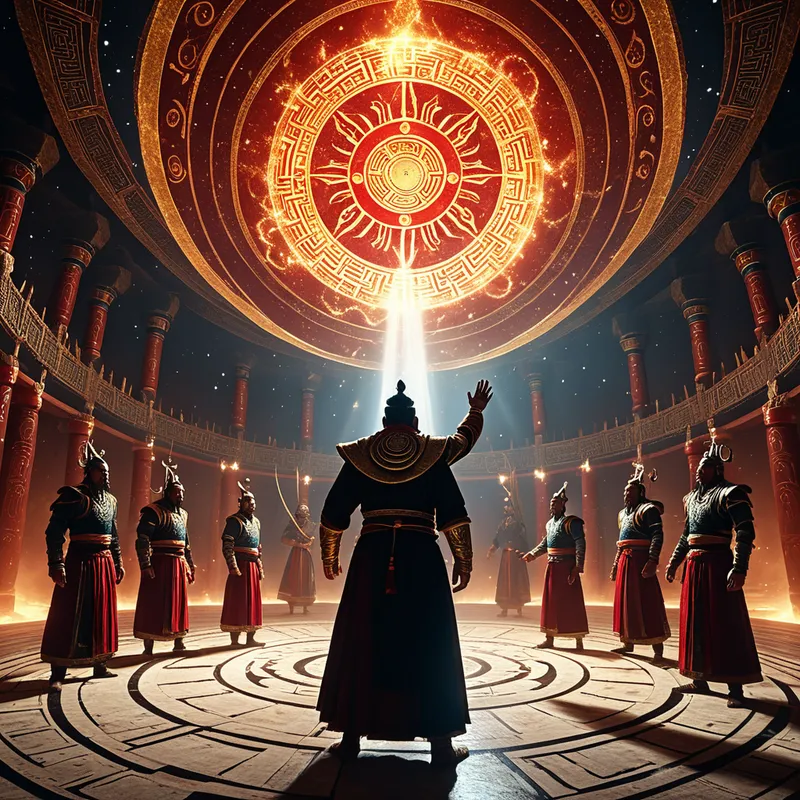
This myth originates from the complex spiritual tapestry of Mongolic and Siberian peoples, particularly preserved in the epic traditions of the Buryats and Altaians. It is a cornerstone of Tengrism, the ancient sky-centric cosmology. Unlike standardized scripture, this story lived in the oral performances of shamans (böö) and epic singers. It was recited during rituals, gatherings, and most importantly, within the monumental oral epic cycles like the Gesar saga, where Khormusta (or Hormusta) often appears as a divine patron.
Its societal function was profound. In the vast, often harsh landscapes of Siberia and the steppe, where human life was at the mercy of immense natural forces, the myth provided a cosmic model for stability. It explained why the world had structure: the weather, the seasons, fortune and misfortune, all were administered by a defined hierarchy of spirits under a supreme authority. It legitimized social and tribal hierarchies by mirroring them in the heavens. The myth was less about worshiping a distant god and more about understanding one’s place within a living, ordered, and intelligible universe.
Symbolic Architecture
At its heart, this is a myth about the emergence of consciousness from the unconscious, of ego from the id. The primal, chaotic heaven represents the undifferentiated psyche—a soup of potentials, drives, and energies without a central organizing principle.
The first act of consciousness is not to create something new, but to perceive the latent order within the chaos.
Khormusta Tengri symbolizes the archetypal Self in its ruling aspect. His ascension is the moment the psyche centers itself, when a core, integrating principle (the Self) emerges to govern the multitude of inner complexes (the tengri). The sacred number fifty-five for the Western Tengri symbolizes a complete, functioning system—the totality of benevolent, conscious functions within the ordered psyche.
The rebellion is crucial. It represents the inevitable shadow reaction to the imposition of order. All those impulses, desires, and energies deemed "unacceptable" or "chaotic" by the newly formed central authority rebel against their exclusion. Khormusta’s victory is not annihilation, but differentiation. By casting them down as the Eastern Tengri, the myth acknowledges that these forces are not destroyed; they are relegated to their own necessary realm, the psychic shadow. A complete psyche requires both the ordered, light-filled "west" and the chaotic, potential-filled "east."
The Dreamer's Resonance
When this myth stirs in the modern soul, it often manifests in dreams of architectural or systemic crisis and resolution. One might dream of a crumbling institution being restored by a calm, authoritative figure, or of a chaotic, overcrowded house where one discovers a locked, pristine room at its center. The somatic experience is often one of tension in the chest or shoulders—the weight of responsibility—giving way to a deep, diaphragmatic breath of relief as order is established.
Psychologically, this dream pattern signals a critical phase of inner consolidation. The dreamer is likely grappling with a life situation that feels overwhelming and fragmented—a career, a relationship, a creative project, or their own internal world in disarray. The rebellion of the Eastern Tengri in the dream may appear as sabotaging thoughts, sudden outbursts of anger, or patterns of self-defeat that rise up just as one tries to "get organized." The dream is mapping the psyche’s struggle to install a competent, benevolent ruling principle (a strong ego in service to the Self) to manage the inner population of drives, fears, and talents.
Alchemical Translation
The individuation process modeled here is that of integration through sovereignty, not elimination. The alchemical goal is not to have only gold (the Western Tengri), but to have the lead (the Eastern Tengri) in its proper place, transmuted into part of a functioning whole.
The true ruler does not conquer the shadow; he assigns it a domain, thereby making the kingdom whole.
The modern individual’s "Khormusta moment" is when they stop trying to banish their chaos—their anger, laziness, fears, or raw instincts—and instead, from a newly centered place of authority (the Self), acknowledge its existence and give it a defined, contained space. This is the creation of inner hierarchy. One might consciously allocate time for unruly creativity, create rituals to honor one’s anger, or simply acknowledge that a part of oneself is rebellious and wild, without letting it drive the chariot.
The sacred number, the precise hierarchy, is akin to developing a personal ethos or code. It is the conscious structuring of one’s values, time, and energy. The triumph is the ability to sit in the center of one’s own being, amidst the swirling storms of internal and external demands, with the unshakable calm of Khormusta on his throne, not because the storms are gone, but because their place in the order of one’s cosmos is understood and respected. One becomes the sovereign of one’s own inner heaven.
Associated Symbols
Explore related symbols from the CaleaDream lexicon:
- Sky — The primary domain and manifestation of Khormusta Tengri, representing the highest consciousness, divine authority, and the vast, ordered structure of the cosmos.
- Order — The core principle established by the myth, symbolizing the necessary hierarchical structure that emerges from chaos to create a functioning psyche and universe.
- Thunder — The voice and commanding power of Khormusta Tengri, representing the awe-inspiring, undeniable proclamation of divine law and psychic authority.
- Rebellion — Embodied by the Eastern Tengri, symbolizing the necessary shadow forces that challenge imposed order, demanding recognition and integration into the whole.
- Hierarchy — The sacred structure of the 55 Western Tengri, representing the differentiated and ranked system of values, instincts, and complexes within an ordered psyche.
- Mountain — A symbol of Khormusta's throne and unshakable authority, representing the stable, central peak of consciousness around which the psychic landscape is organized.
- Light — The radiant, benevolent power of the Western Tengri, representing consciousness, clarity, and the illuminating force of the ruling principle.
- Chaos — The primal state of the heavens before Khormusta's ascension, representing the undifferentiated, potential-rich but formless state of the unconscious.
- Temple — The celestial court itself, symbolizing the psyche as a sacred, structured space where the divine (the Self) resides and administers.
- Crown — The emblem of Khormusta's sovereignty, representing the achieved integration and authority of the Self over the totality of the personality.
- Shadow — The fate of the rebellious spirits, cast down to become the Eastern Tengri, representing the relegated but essential dark and chaotic aspects of the self.
- Spirit — The essential nature of all tengri, representing the myriad autonomous complexes and energies that populate the inner world.