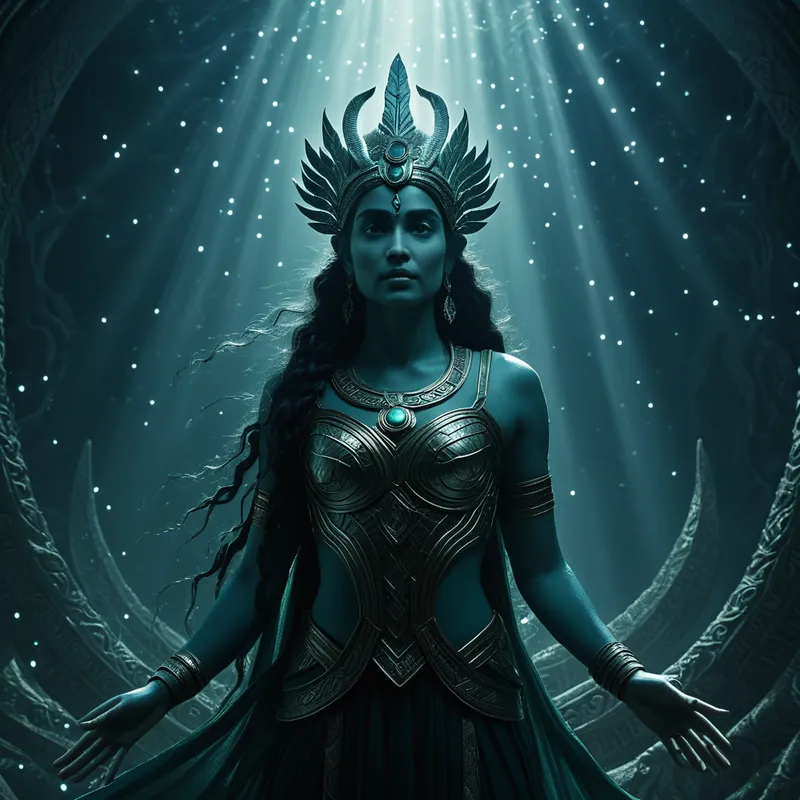
Khidr the Eternal Guide
A mysterious immortal guide in Islamic tradition who appears unexpectedly to offer wisdom, protection, and spiritual direction to seekers.
The Tale of Khidr the Eternal Guide
He appears not in the glare of noon, but in the liminal spaces—at the fork in a desert road, on the shore of a churning sea, in the shade of a forgotten well. His arrival is never announced; it is felt as a shift in the air, a sudden, profound stillness within the storm of one’s own confusion. He is Khidr, “The Green One,” an immortal guide whose very existence is a whisper of divine mercy woven into the fabric of time.
The most renowned telling of his guidance is his journey with the Prophet Musa ([Moses](/myths/moses “Myth from Biblical culture.”/)), a masterclass in the pedagogy of the unseen. Musa, a prophet of clear law and manifest [justice](/myths/justice “Myth from Tarot culture.”/), hears of a servant of God possessing deeper, hidden knowledge. He seeks this servant to learn. God instructs him to carry a salted fish; where the fish vanishes, he will find his teacher. Musa sets out with his attendant, Joshua. They rest by a rock, and the fish, touched by a mysterious spring, leaps to life and escapes into the [water](/myths/water “Myth from Chinese culture.”/). Musa, preoccupied, does not notice its disappearance until much later. Realizing this was the sign, they return to the place of the rock. There, they find Khidr.
Khidr agrees to let Musa accompany him on condition: Musa must not question his actions until given an explanation. What follows is a sequence of bewildering, seemingly immoral acts. Khidr scuttles a poor fisherman’s boat. He kills a young boy. He rebuilds a crumbling wall in a hostile town that refused them hospitality. Each time, Musa’s sense of justice erupts. “Have you done this to drown its passengers?” he cries at the damaged boat. “Have you killed an innocent soul?” he demands after the boy’s [death](/myths/death “Myth from Tarot culture.”/). With each question, Khidr reminds him of their pact, and finally, upon the third question, declares their partnership dissolved.
But before parting, Khidr unveils the hidden wisdom behind each terrifying act. The boat was damaged to save it from a tyrannical king who was seizing all sound vessels; its poverty was its protection. The boy was slain because he would have grown to force his righteous parents into disbelief and ruin; in his place, God granted them a purer, more merciful child. The wall was rebuilt because beneath it lay a treasure belonging to two orphaned boys; by preserving it until they came of age, Khidr secured their legacy from the greedy townsfolk. Musa, who saw only the surface—destruction, murder, reward for the inhospitable—was shown the vast, intricate tapestry of divine care operating beneath the visible world. Khidr’s actions were not violations of justice, but its deeper, more mysterious fulfillment.
This is the essence of Khidr’s guidance. He does not offer comforting platitudes or clear maps. He arrives to rupture the seeker’s certainty, to drill a well into the bedrock of their understanding until it strikes the aquifer of a wisdom that transcends human reason. He is the teacher of ‘ilm al-ladunni—knowledge directly from the divine presence—a knowing that can appear, to the logical mind, as [chaos](/myths/chaos “Myth from Greek culture.”/) or cruelty.
Cultural Origins & Context
Khidr’s roots are ancient and syncretic, flowing into Islamic tradition from a confluence of pre-Islamic Near Eastern and Mesopotamian lore. He is often identified with figures like the Babylonian sage [Utnapishtim](/myths/utnapishtim “Myth from Mesopotamian culture.”/) ([the immortal](/myths/the-immortal “Myth from Taoist culture.”/) survivor of [the flood](/myths/the-flood “Myth from Biblical culture.”/)) and the enigmatic prophet Elijah (Ilyas in the Quran), blending into a composite archetype of the eternal witness. His name, al-Khiḍr, literally means “The Green One,” linking him to the verdancy of life, perpetual renewal, and the fecundity of water—the ultimate source of life in desert cosmologies.
In the Islamic framework, his theological standing is unique. He is not a prophet (nabi) in the legislative sense, but is universally regarded as a wali (a friend or saint of God) endowed with immortality and special divine mandate. His Quranic basis, though not by name, is the “servant of God” in Surah Al-Kahf (18:60-82), the source of the tale with Musa. This scriptural anchor legitimized his figure within Islamic spirituality, allowing him to become a central pillar in Sufi metaphysics. For Sufis, Khidr represents the ever-present spiritual guide (murshid), the inner axis of hidden knowledge accessible to the heart that has been purified of ego. He is the master of the path of spiritual realization (tariqa), appearing in dreams, visions, and inexplicable encounters to those whose souls are ripe for initiation into mysteries beyond formal religious doctrine.
Symbolic Architecture
Khidr is not a [character](/symbols/character “Symbol: Characters in dreams often signify different aspects of the dreamer’s personality or influences in their life.”/) in a [story](/symbols/story “Symbol: The symbol of ‘Story’ represents the narrative woven through our lives, embodying experiences, lessons, and emotions that shape our identities.”/) but a living [symbol](/symbols/symbol “Symbol: A symbol can represent an idea, concept, or belief, serving as a powerful tool for communication and understanding.”/) of the [psyche](/myths/psyche “Myth from Greek culture.”/)’s encounter with the numinous unknown. He personifies the guiding function of the unconscious itself, which often communicates in paradoxes and shatters conscious attitudes to force a more expansive state of being.
He is the embodiment of the coincidentia oppositorum—the coincidence of opposites. In him, destruction is preservation, death is mercy, and reward is given to the unworthy. He holds the tension between divine transcendence (whose ways are inscrutable) and divine immanence (whose care is meticulous).
His immortality signifies the timeless, ever-present quality of archetypal wisdom. It is not that he lives forever in [linear](/symbols/linear “Symbol: Represents order, predictability, and a direct, step-by-step progression. It symbolizes a clear path from cause to effect.”/) time, but that he exists outside of it, in the eternal now of the psyche, available when the [soul](/symbols/soul “Symbol: The soul represents the essence of a person, encompassing their spirit, identity, and connection to the universe.”/)’s need is absolute. His color, green, is the color of the [heart](/symbols/heart “Symbol: The heart symbolizes love, emotion, and the core of one’s existence, representing deep connections with others and self.”/) center in Sufi [psychology](/symbols/psychology “Symbol: Psychology in dreams often represents the exploration of the self, the subconscious mind, and emotional conflicts.”/), symbolizing [compassion](/symbols/compassion “Symbol: A deep feeling of empathy and concern for others’ suffering, often involving a desire to help or alleviate their pain.”/), [regeneration](/symbols/regeneration “Symbol: The process of renewal, restoration, and growth following damage or depletion, often representing emotional healing, transformation, or a fresh start.”/), and the living [knowledge](/symbols/knowledge “Symbol: Knowledge symbolizes learning, understanding, and wisdom, embodying the acquisition of information and enlightenment.”/) that grows like a [vine](/symbols/vine “Symbol: Represents connection, growth, entanglement, or suffocation. Often symbolizes relationships, life force, or binding emotions.”/), connecting [heaven](/symbols/heaven “Symbol: A symbolic journey toward ultimate fulfillment, spiritual transcendence, or connection with the divine, often representing life’s highest aspirations.”/) and [earth](/symbols/earth “Symbol: The symbol of Earth often represents grounding, stability, and the physical realm, embodying a connection to nature and the innate support it provides.”/).
His method is initiatory [trauma](/symbols/trauma “Symbol: A deeply distressing or disturbing experience that overwhelms the psyche, often manifesting in dreams as unresolved emotional wounds or psychological injury.”/). He does not console [the ego](/myths/the-ego “Myth from Jungian culture.”/); he dismantles it. The three questions of Musa represent the breaking points of the rational, moralizing [consciousness](/symbols/consciousness “Symbol: Consciousness represents the state of awareness and perception, encompassing thoughts, feelings, and experiences.”/). To follow Khidr is to consent to a [journey](/symbols/journey “Symbol: A journey in dreams typically signifies adventure, growth, or a significant life transition.”/) where meaning is not given but revealed, often through the painful [dissolution](/symbols/dissolution “Symbol: The process of breaking down, dispersing, or losing form, often representing transformation, release, or the end of a state of being.”/) of what one thought was true.
The Dreamer’s Resonance
To dream of Khidr, or to feel his presence in a moment of profound disorientation, is to stand at a psychic [crossroads](/myths/crossroads “Myth from Celtic culture.”/). He appears when the conscious mind has exhausted its resources, when the maps have failed and the path is lost. In the inner landscape, he is the personification of a critical intervention from the deeper Self.
His arrival signals that the dreamer’s current framework of understanding—their personal “justice” like Musa’s—is too small, too rigid to contain the complexity of their soul’s journey. The guidance he offers is rarely directive. It is more often an act that creates a rupture, a paradox that the dreamer must carry until its meaning ripens within them. He might manifest as a sudden, inexplicable opportunity that seems like a setback, or as a mysterious stranger in a dream whose cryptic words haunt the waking life until their significance dawns months later.
To resonate with Khidr is to develop a tolerance for holy ambiguity. It is to cultivate the faith that the psyche, in its profound wisdom, can orchestrate events and inner encounters that, while painful or confusing in the moment, serve a larger pattern of healing and wholeness that the conscious ego cannot yet perceive.

Alchemical Translation
Psychologically, the encounter with Khidr is the alchemical stage of [nigredo](/myths/nigredo “Myth from Alchemical culture.”/)—the blackening, the dissolution—guided by a mysterious, non-egoic force. The conscious personality (Musa) must submit to the irrational, symbolic processes directed by [the Self](/myths/the-self “Myth from Jungian culture.”/) (Khidr). The boat, the boy, and the wall are not external events but symbolic representations of psychic structures.
The scuttled boat is the necessary deconstruction of a vessel of identity that, while serviceable, would lead to capture by a tyrannical inner complex (the king). The slain child is the merciful “killing” of a potential within the psyche that, though innocent-seeming, would grow to corrupt one’s core values. The rebuilt wall is the unsolicited protection of a nascent, orphaned treasure of the Self until the ego is mature enough to integrate it.
The process is one of sacrificium intellectus—the sacrifice of the intellect’s demand for immediate, logical clarity. The gold produced is not certainty, but a participatory wisdom, a knowing that comes from having endured the mystery. One integrates Khidr not by becoming immortal, but by internalizing his perspective: developing an inner witness that can perceive the hidden blessings in apparent curses, and the larger pattern in fragmented events. The seeker learns to see with the “eye of the heart.”
Associated Symbols
Explore related symbols from the CaleaDream lexicon:
- Water — The primary element of Khidr, symbolizing the source of life, hidden knowledge, and the fluid, unpredictable flow of divine providence that restores and transforms.
- Guide — The archetypal function Khidr embodies: the non-egoic force that appears at critical junctures to lead the soul through unknown terrain toward wholeness.
- Mystery — The essential atmosphere of Khidr’s being and teachings; he represents that which cannot be grasped by reason but must be encountered and endured.
- Eternal — His condition of timelessness, representing the perennial availability of archetypal wisdom outside the constraints of linear history and mortal lifespan.
- Door — [The threshold](/myths/the-threshold “Myth from Folklore culture.”/) upon which Khidr stands; his appearance itself is a door opening from the mundane to the sacred, from known understanding to hidden reality.
- Fish — The symbol of the lost and resurrected life that leads to the encounter with the guide; a sign of the soul’s vitality breaking free from the salt of固化.
- Shadow — The aspect of Khidr’s actions that seem destructive or immoral, forcing a confrontation with the hidden, often difficult, wisdom of the unconscious.
- Journey — The fundamental context of his guidance; he is met not in static doctrine but in the dynamic, often disorienting, movement of the soul’s quest.
- Key — The paradoxical wisdom he imparts, which unlocks a deeper level of understanding but often by first locking the door on previous certainties.
- River — The flowing, ever-changing course of life and spirit along which Khidr travels, and the medium through which the miraculous fish makes its escape.