
Khepri Myth Meaning & Symbolism
The scarab god who rolls the sun across the sky, embodying the eternal cycle of death, rebirth, and the psyche's power of self-creation.
The Tale of Khepri
Before the first bird sings, in the hour when the world holds its breath, the great blackness of the Duat begins to stir. The waters of Nun grow restless. A silence, thick and expectant, blankets the land of the Two Banks. It is the hour of the knife-edge, the moment between death and life.
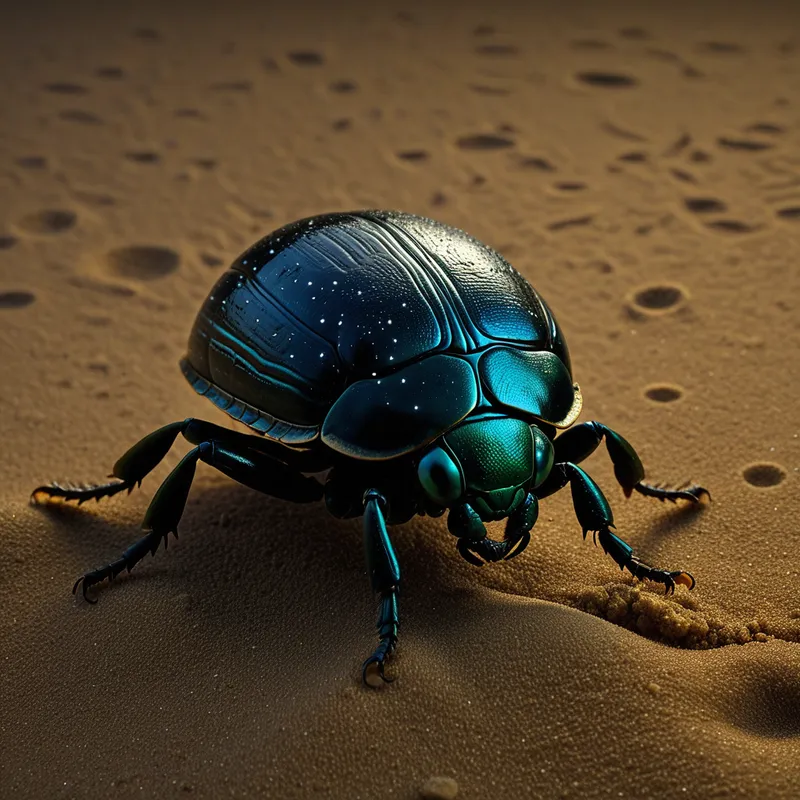
From the deepest chamber of the night, a form begins to move. Not with the stride of a man or the flight of a bird, but with a patient, relentless push. It is Khepri, the Self-Created One. His body is the hard, polished carapace of the scarab, a living jewel of obsidian and lapis. His six legs dig into the sands of the unseen world, muscles of stone and will. And before him, he rolls his great burden: the sun.
Not the blazing, triumphant orb of noon, but the Khepri-sun, a sphere of molten potential, swaddled in the cloth of dawn. It is heavy with the memories of yesterday’s descent, cool to the touch, its light a secret held within. The journey is immense, uphill through the treacherous, serpent-filled corridors of the Duat. Apep, the serpent of chaos, coils in the shadows, waiting to strike, to swallow the light forever.
But Khepri does not fight with spear or spell. His struggle is one of ceaseless, forward motion. He presses his head against the cool curve of the sun-disk. He pushes. The sphere turns, grinding against the sands of eternity. With each rotation, a faint warmth begins to emanate from within. The golden shell begins to thin, to glow from its core. The journey is the transformation; the pushing is the kindling.
As he nears the eastern mountain, Manu, the strain is greatest. The world above is still pitch. Then, the first crack appears—not in the sun, but in the fabric of the sky. A sliver of silver. Khepri gathers the last of his self-born strength, heaves, and rolls the sun up and over the final threshold.
The sphere, now incandescent, bursts from the horizon. It is no longer the burden of Khepri, but the radiant Ra, soaring into the sky on wings of fire. Khepri, his work complete, seems to vanish, his essence absorbed into the new day’s light. He has not died. He has become the action that made the dawn. And as Ra journeys across the sky, Khepri is already forming again in the deepening twilight, preparing to roll the sun once more through the belly of night, an eternal cycle of will and becoming.
Cultural Origins & Context
The myth of Khepri is not a narrative preserved on long papyrus scrolls, but one written in the daily observation of nature and etched into the very amulets worn by every Egyptian, from pharaoh to farmer. It emerged from the black, fertile soil of the Nile, where the people witnessed the humble scarab beetle (Scarabaeus sacer) performing its inexplicable marvel: shaping balls of dung, rolling them across the ground, and burying them, from which new life would later emerge. This observable, earthly miracle became the perfect metaphor for the cosmos' greatest mystery: the rebirth of the sun.
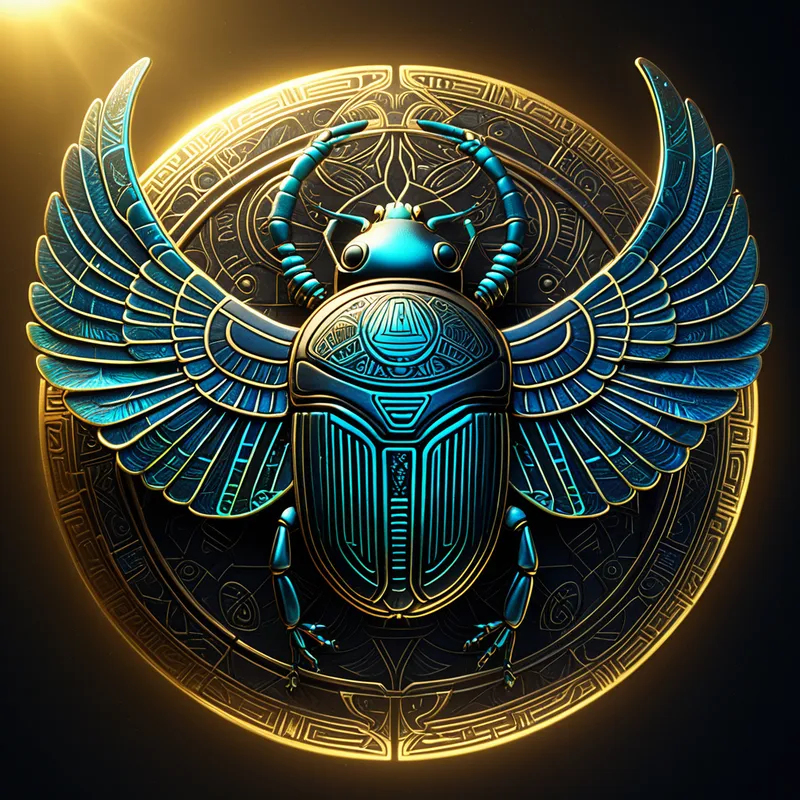
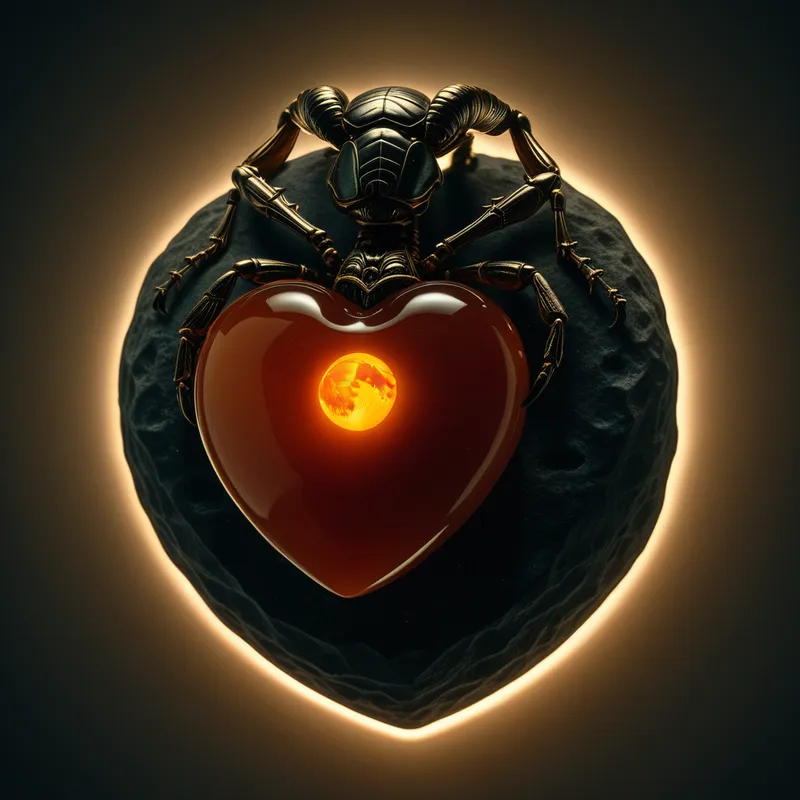
The myth was passed down not by bards in halls, but by priests in temple rituals and artisans in their workshops. It was a functional, living theology. The name "Khepri" itself comes from the Egyptian verb kheper, meaning "to come into being," "to change," or "to transform." His image was ubiquitous—carved onto heart scarabs placed on mummies to ensure resurrection, painted in tomb ceilings mapping the sun’s nightly journey, and invoked in daily solar hymns. Khepri represented the moment of transformation, the critical pivot from potential to manifestation, making him a god of fundamental, existential creativity accessible to all.
Symbolic Architecture
At its core, Khepri symbolizes the principle of autogenesis—self-creation from within. Unlike other creator gods who speak or fashion the world from external matter, Khepri is the act of his own becoming. The scarab rolling the sun is not a servant to a separate power; the pushing creates the pusher. This is a profound psychological truth.
The true dawn is not an event that happens to us, but an action we must initiate from the substance of our own darkness.
The sun-disk is the latent Self, the total, integrated psyche that lies dormant and cool in our personal Duat—the unconscious. The arduous, often solitary push through the night represents the ego’s necessary, persistent effort to bring this wholeness to consciousness. The enemy, Apep, is the inertia of chaos, the resistance within us that fears transformation and seeks to maintain the stagnant, familiar darkness. Khepri’s victory is not one of annihilation, but of steadfast, rolling motion; we overcome inner chaos not by destroying it, but by consistently moving our focused consciousness forward.
The Dreamer's Resonance
When the pattern of Khepri stirs in the modern dreamer, it often manifests as dreams of immense, solitary effort. You may dream of pushing a heavy, spherical object (a boulder, a globe, a giant egg) up a hill or through a narrow tunnel. There is a palpable sense of weight, resistance, and profound responsibility—you must move this thing. There is no one to help. The sphere may feel inert, cold, or frustratingly dormant.
Somatically, this can correlate with feelings of pressure in the chest or solar plexus, a sense of being "on the verge" of a breakthrough that requires one final, exhausting push. Psychologically, this is the process of integrating a major content from the unconscious—a new insight, a creative project, or a necessary life change—into the light of day. The dream is the psyche’s enactment of the Khepri principle: you are both the laboring beetle and the nascent sun within the ball. The effort is the birthing.
Alchemical Translation
The alchemical journey of individuation mirrors Khepri’s nocturnal voyage precisely. It begins in the nigredo—the blackening, the chaotic, fertile "dung" of the unconscious, the Nun. Here, the raw, unformed material of the psyche (the sun-disk) is gathered. The work, the opus, is the long, dark solutio and coagulatio: the dissolving of old ego structures and the re-forming of a new consciousness through relentless, often repetitive, effort.
Individuation is not a destination reached, but a dawn rolled into being each day through the will to become.
Khepri models the stage where the individual must become their own creator. We must press our awareness against the cool, hard shell of our potential and push. Each rotation—each attempt at understanding, each act of courage, each moment of creating order from inner chaos—warms the sphere from within. The triumph is not in reaching a state of perfect, static enlightenment (the blazing, distant Ra), but in the daily, gritty commitment to the rolling itself. The modern individual’s "eastern horizon" is the moment a repressed truth surfaces, a creative idea finds form, or a long-held pattern finally shifts. In that moment, you are Khepri, and the new day of a broader consciousness is your creation. And as with the god, the work is never finished, for the sun must be rolled again tomorrow, in an everlasting cycle of death and self-made rebirth.
Associated Symbols
Explore related symbols from the CaleaDream lexicon: