Kelpie Myth Meaning & Symbolism
A shape-shifting water spirit of Scottish lochs, the Kelpie lures the unwary to a watery grave, embodying the perilous allure of the untamed unconscious.
The Tale of Kelpie
Listen, and let the mist of the loch gather at the edge of your hearing. In the gloaming, when the world between worlds grows thin, he waits. Not in the crashing waves of the sea, but in the deep, still, peat-dark waters of the inland loch—a place of perfect reflection that shows only the sky, hiding the cold depths beneath.
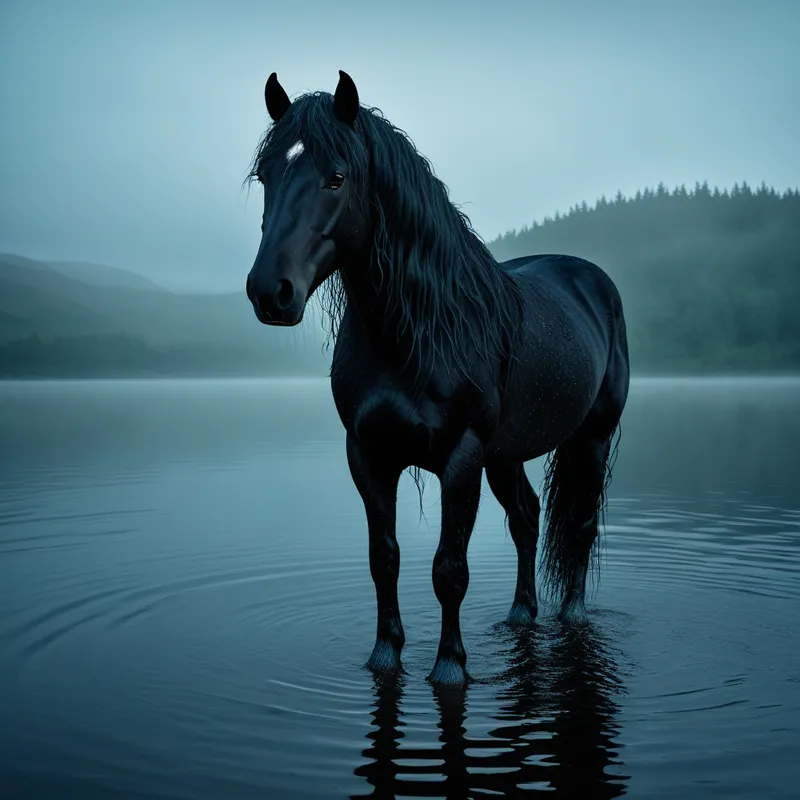
He is a horse of impossible beauty. His coat is the black of a starless midnight, slick and shining as if freshly risen from the deep. His mane falls in thick, wet ropes, tangled with strands of green duckweed and the pale blooms of water lilies. His eyes hold the chill green of the deepest pool, intelligent and ancient. He stands placid in the shallows, a saddled and bridled steed of peerless strength, offering silent salvation to the weary traveler caught by the rising storm or the failing light.
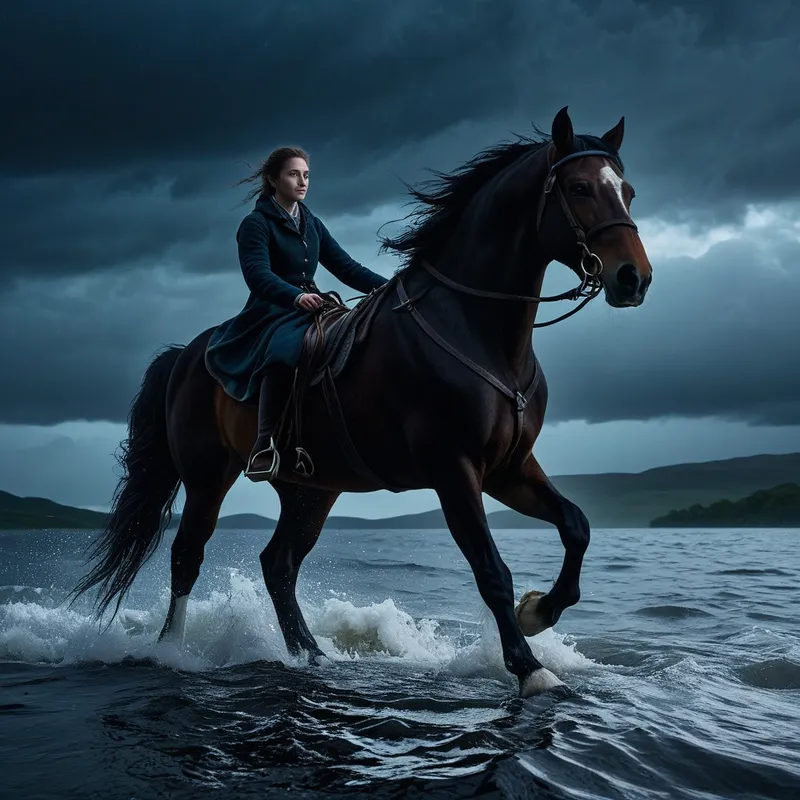
A young man, separated from his kin, stumbles upon the lochside path as the last light bleeds from the sky. The wind howls, and the first cold drops of rain sting his skin. Desperation claws at him. And then he sees it—the magnificent horse, standing as if sent by the gods themselves. Relief floods him. Here is his passage home, a creature of such obvious power and calm.
He approaches, murmuring soft words. The horse bows its great head, the bridle cool and heavy in the traveler’s hand. The moment his fingers close on the leather, or his weight settles into the saddle, the world changes. The gentle beast transforms. The leather of the bridle becomes a cold, living part of the creature’s skin, adhesive and unbreakable. The horse’s hide grows clammy and impossibly strong, its form swelling with the terrible power of the deep.
With a sound like a drowning scream, the Kelpie rears and plunges into the black water. The traveler is dragged into the freezing embrace of the loch, his breath stolen, his struggles useless against the supernatural strength. The Kelpie dives to its hidden, watery hall, where the bones of the unwary gleam in the perpetual dark. The offering is accepted; the hunger of the deep is fed, for a time. Only at dawn might a lone, sodden boot wash upon the stony shore, a silent testament to the pact made in desperation at the water’s edge.
Cultural Origins & Context
The Kelpie is a creature of specific geography, rooted in the folklore of Scotland and Ireland (where it shares kinship with the Each-Uisge, an even more vicious lake-horse). This was not a myth of grand, national identity, but a local story, told by hearths and in barns, passed from parent to child along specific loch-sides and riverbanks. It was an oral tradition, a “counsel tale” from a people whose lives were intimately tied to—and threatened by—the capricious power of fresh water.
Its primary tellers were the communities themselves: farmers, fishermen, and travelers. The myth served a profoundly practical, societal function. In an era before safety barriers and weather warnings, the Kelpie was the story that kept children from playing too near the treacherous, steep-banked lochs. It was the reason a wise traveler would eye a saddled horse standing alone by the water with deep suspicion. It personified the very real dangers of drowning, sudden storms, and hidden currents, transforming a statistical risk into a tangible, intelligent predator. The Kelpie was ecology translated into narrative, a mythic enforcement of respect for an environment that could provide sustenance and life, or snatch it away in an instant.
Symbolic Architecture
The Kelpie is not merely a monster. It is a perfect symbolic vessel for the raw, untamed, and potentially annihilating aspects of the unconscious. The loch itself is a classic symbol of the unconscious mind—a reflective surface hiding unknown depths. The Kelpie is the denizen of that depth, the shape-shifting content that rises to the surface to meet us.
The lure of the unconscious is always dressed in the garments of our conscious needs. It offers a solution that binds us to the problem.
Its primary form, the beautiful black horse, is deeply symbolic. The horse universally represents raw instinct, power, libido, and the untamed force of nature. Its beauty is the seductive face of our own repressed instincts—our wild passions, our deep-seated angers, our primal fears. It appears saddled and bridled, a cruel joke offering the illusion of control. This speaks to the ego’s arrogance, believing it can harness and direct the primordial forces of the psyche for its own convenience. The moment of adhesion, when the rider is stuck fast, symbolizes the point of possession, when an unconscious complex (like a sudden rage, a debilitating fear, or an addictive pattern) fully captures the conscious personality. The plunge into the watery depths is the experience of being overwhelmed, dragged into a state of depression, mania, or psychic dissolution.
The Kelpie’s shape-shifting ability—sometimes also appearing as a handsome man or a shaggy pony—underscores the deceptive nature of the unconscious. It always presents itself in a form the conscious mind is willing to accept, often as a savior or a solution, masking its ultimately assimilative nature.
The Dreamer's Resonance
When the pattern of the Kelpie arises in modern dreams, it signals a critical encounter with a binding, deceptive complex from the personal or collective unconscious. The dreamer is not simply facing a fear; they are being tempted by a seemingly perfect solution that carries a hidden, catastrophic cost.
Somatically, one might dream of touching something cold and adhesive, or feeling an irresistible pull toward a body of water. Psychologically, the dream scenario often involves accepting a offer that seems too good to be true: taking a job that promises everything but feels subtly “sticky,” entering a relationship that offers salvation but demands the dissolution of the self, or embracing an ideology that provides absolute answers but removes personal agency. The feeling upon waking is often one of dread, claustrophobia, or the chilling realization of a trap being sprung. The dream is a profound warning from the psyche: the path of least resistance, the offered “bridle” of easy control over powerful forces, is a path to being controlled by them.
Alchemical Translation
The individuation process, the alchemical work of becoming whole, requires a conscious relationship with these Kelpie-like forces. The myth does not offer a simple slaying of the monster; it maps the perilous stage of nigredo, where one is dragged into the dark waters of the unconscious. The triumph is not in avoiding the loch, but in surviving the plunge and returning transformed.
To master the instinct, one must first be mastered by it, to know its full weight and power. The true bridle is forged in the drowning.
The alchemical translation begins with the recognition of the “beautiful horse”—the acknowledgment of a powerful, instinctual force within (creativity, anger, sexuality, grief) that the ego has tried to ignore or superficially “saddle.” The conscious mind must then willingly engage with this force, knowing the risk of possession. The catastrophic “dragging under” is reframed as a necessary descent, a dark night of the soul where the ego’s illusion of control is dissolved in the cold waters of reality.
The survivor of this process—the one who manages to break free, often told in variant tales through a clever trick like cutting off a finger or speaking a holy name—does not return with the Kelpie slain. They return having stolen its power. They have integrated the raw instinct, not as a rider controlling a beast, but as a human who now understands the nature of the beast within. The Kelpie’s strength becomes their own resilience; its connection to the deep becomes their own depth of feeling and intuition. The mythical artifact of power, the Kelpie’s bridle, symbolizes this hard-won integration: a means to guide the instinctual force, a pact of respect rather than an attempt at domination, forged in the very waters that sought to consume them.
Associated Symbols
Explore related symbols from the CaleaDream lexicon: