Keelut Evil Earth Spirit Myth Meaning & Symbolism
A myth of a hairless, dog-like spirit that emerges from the frozen earth, embodying the terror of being pursued by one's own buried darkness.
The Tale of Keelut Evil Earth Spirit
Listen, and feel the cold seep into your bones. Not the clean cold of fresh snow, but the deep, ancient cold that lives in the stone heart of the earth. This is the land where the sun abandons the sky for months, where the wind has teeth, and where the silence is so complete it becomes a sound of its own. Here, survival is a prayer whispered with every step. And here, in the vast, white loneliness, the most dangerous things are those that leave no trace.
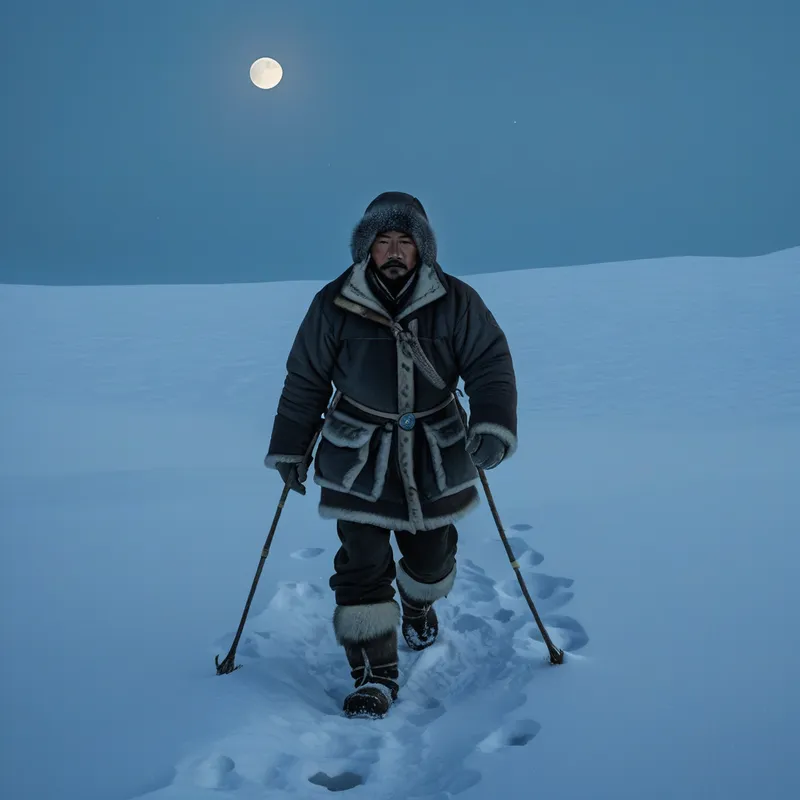
It begins with a traveler. Perhaps a hunter, following the ghostly path of a caribou. Perhaps a child, sent to fetch ice for water. The journey is long, the way familiar, but a prickle rises on the neck—a sense of being watched from the empty expanse. He turns. Nothing. Only the endless tundra, the sighing wind. He walks on, faster now. The feeling grows, a weight upon the soul. He looks back again. And there, in the unbroken snow where only his own footsteps should be, he sees them: a second set of prints, dog-like, padding directly in the hollows of his boots.
His blood turns to ice. He knows this sign. It is the mark of the Keelut.
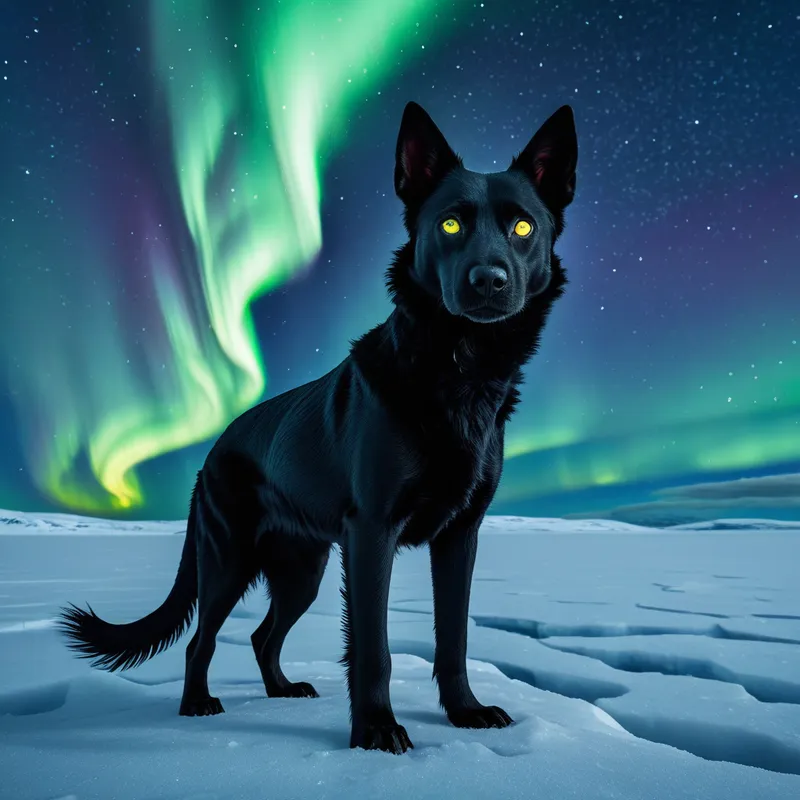
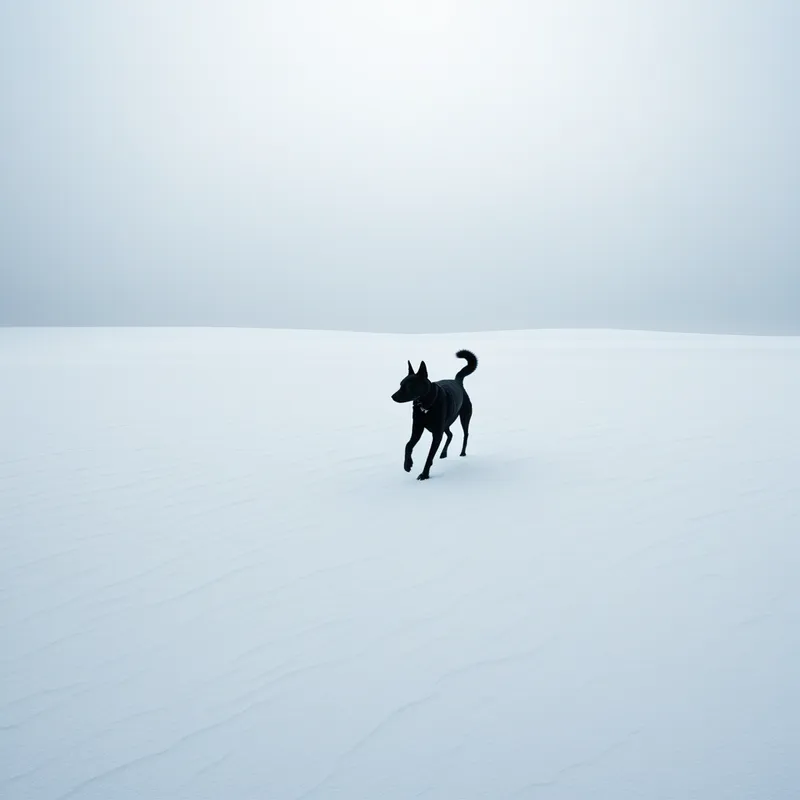
He runs. The wind steals his breath. The cold claws at his lungs. Behind him, the pursuit is silent, relentless. He dares a glance over his shoulder, and in the gathering gloom, he sees it. A dog, but wrong. Its skin is bare, hairless, and black as a hole in the world. Its eyes are coals, glowing with a hungry intelligence. It does not bark. It does not pant. It simply follows, matching him stride for stride, a shadow given flesh and malice, born from the very ground he treads.
The sanctuary of the village is a world away. The familiar landmarks blur in the twilight. The Keelut is a manifestation of the land itself turning against him, a piece of the dark earth that has risen to claim him. His fate hinges on endurance, on reaching the circle of firelight and human voices before the spirit’s patience ends. For when it finally closes the distance, it does not attack like a wolf. It is a spirit of corruption, of soul-chilling terror. To be touched by it is to have the vital warmth, the inua of life, sucked into the frozen earth from whence it came.
The tale ends at the threshold. Either the runner collapses at the door of the snow-house, his family pulling him in to safety as the hairless thing melts back into the shadows, or… the prints stop, and a new, deeper silence falls upon the snow.
Cultural Origins & Context
This myth springs from the Inuit relationship with an environment that is both provider and profound threat. The stories of the Keelut were not mere entertainment; they were vital navigational charts for the psyche and society, told by elders around the seal-oil lamp during the long winter nights. The teller was often a grandparent or a respected hunter, their voice low and serious, making the shadows dance on the walls of the qarmaq.
Its primary function was pedagogical and prophylactic. For children, it emphasized the danger of wandering alone, of straying from the known path. For all, it codified a specific and profound fear: the terror of the unseen follower, the enemy that mirrors your own movement perfectly. In a culture where tracking and reading signs in the snow meant life or death, a creature that left no sign of its own was the ultimate violation of natural law. The Keelut myth enforced community cohesion, respect for the unknown aspects of the land, and the critical importance of vigilance. It was a story that taught you to listen to the primal fear in your gut, for that fear was often the first and only warning.
Symbolic Architecture
The Keelut is a masterful symbol of the personal Shadow. It is not a random monster, but one intrinsically tied to the individual it pursues. Its defining action—walking in the hunter’s footprints—is the core of its symbolism. It represents that which we have repressed, denied, or split off from our conscious identity, yet which follows us with absolute fidelity.
The Shadow does not walk beside us; it walks within us, step-for-step, a perfect, hidden echo of our own journey.
Its hairlessness makes it vulnerable, raw, and obscene—it has no protective pelt, no socially acceptable "covering." This reflects the nature of repressed content: it is often perceived as ugly, shameful, or too vulnerable to expose. Its black color signifies its hidden, unknown nature. It emerges from the Earth, from below, the classic direction of the unconscious. The Keelut does not exist until it is perceived; it is conjured by the traveler’s lonely journey and his own mounting fear. It is the psychic embodiment of the "terror of the hinterland," the part of the self that feels alien and predatory when we venture into uncharted internal territory.

The Dreamer's Resonance
When this mythic pattern stirs in the modern Dream, it rarely appears as a literal hairless dog. Its essence manifests as the feeling of being silently pursued by something intimately connected to oneself. The dreamer may be fleeing through endless corridors, across barren landscapes, or through familiar neighborhoods that have become alien. The pursuer is unseen but felt—a looming presence, a known threat just out of sight.
Somatically, the dreamer often wakes with a racing heart, a cold sweat, or a feeling of dread clinging to the edges of consciousness. Psychologically, this signals a moment when repressed psychic material—a shame, a guilt, a rage, a denied talent or desire—has gained sufficient energy to begin its campaign for recognition. The Keelut in the dream is not trying to destroy the dreamer, but to catch up. It seeks integration. The terror is the ego’s resistance to this reunion, its perception of the repressed content as annihilating. The dream is a snapshot of the psyche in motion, where the distance between the conscious self and its shadow is closing.
Alchemical Translation
The individuation process modeled by the Keelut myth is not one of heroic slaying, but of endurance, awareness, and ultimate integration through confrontation. The hero’s Journey here is an inward marathon.
The first alchemical stage is Nigredo, the blackening. This is the moment the traveler sees the second set of prints—the shocking, undeniable awareness that he is not alone in his own psyche. The "evil" of the spirit is the ego’s projection onto what it does not understand. The running is the old consciousness trying to outpace a truth that is, in fact, part of its own foundation.
The goal is not to outrun the shadow, but to turn and face it, thereby discovering it is not a separate monster, but the lost, hairless companion of one's own soul.
The culmination, the Coniunctio or sacred marriage, occurs at the threshold. Success is reaching the Hearth—the symbol of the integrated Self, the center of warmth and consciousness. To bring the knowledge of the pursuit to the hearth is to bring the shadow to the light of awareness. The Keelut does not enter; it dissolves, because its energy is transmuted. The individual who survives this psychic ordeal is not the same as the one who began the journey. He carries the cold knowledge of his own darkness, and in doing so, he is no longer naively controlled by it. He becomes more grounded, more whole, having made peace with the dark Earth of his own being.
Associated Symbols
Explore related symbols from the CaleaDream lexicon:
- Earth — The source and domain of the Keelut, representing the unconscious, the grounded reality of the psyche, and the dark, fertile soil from which shadow material emerges.
- Shadow — The direct psychological counterpart to the Keelut, the repressed and unseen aspects of the self that follow the individual with relentless fidelity.
- Fear — The primary emotion evoked by the Keelut, serving as both the warning signal of the shadow's approach and the initial barrier to its integration.
- Journey — The solitary path across the tundra mirrors the internal journey of individuation, where one must traverse the barren landscapes of the psyche to reach wholeness.
- Hearth — The sanctuary and goal, symbolizing the integrated Self, consciousness, warmth, and community where the shadow's terror can be dissolved.
- Spirit — The Keelut's essential nature as a non-corporeal entity of malice, representing psychic energy that has taken on an autonomous, personified form.
- Wound — The potential consequence of the Keelut's touch, symbolizing the psychic injury of unintegrated trauma or the soul-loss feared from confronting the shadow.
- Door — The critical threshold between the frozen wilderness and the hearth, representing the moment of choice between conscious integration and being consumed by the unconscious.
- Tracking — The act of reading the prints in the snow is inverted in this myth, representing the ego's attempt to understand a pursuer that leaves no independent trace.
- Dream — The modern realm where the Keelut pattern most actively manifests, as a nocturnal pursuit by one's own unconscious content.
- Death — The ultimate threat of the Keelut, symbolizing the psychic death of the ego if it is overwhelmed by the shadow, or the death of an old, naive identity.
- Grounded Spirit — The paradoxical goal: to become a spirit (consciousness) that is fully grounded in, and accepting of, the dark earth of one's own complete nature.