Kay Pacha Uku Pacha Hanan Pacha Myth Meaning & Symbolism
The Incan cosmology of three interwoven worlds—the upper, middle, and inner realms—reveals a map for navigating consciousness, shadow, and spiritual ascent.
The Tale of Kay Pacha Uku Pacha Hanan Pacha
Listen. Before the first Inti painted the sky with dawn, the world was not one, but three. They were not separate lands, but three breaths held in the same chest, three notes in the same song, waiting for the rhythm that would bind them.
Above, in the shimmering, boundless blue, was Hanan Pacha. Here, the great condor, Apu Kuntur, spread wings that caught the light of unborn stars. Here resided Viracocha, after his work was done, and Illapa, who cracked the sky with his sling. It was a realm of pure potential, of radiant order and celestial fire, where rivers were made of light and mountains floated like clouds. But it was silent, a magnificent, frozen hymn.
Below, in the deep, moist dark where sound is born, was Uku Pacha. This was the belly of the Pachamama, a labyrinth of roots, rivers of dark water, and sleeping serpents. Here, the ancestors rested, not as dust, but as fertile potential, as seeds wrapped in the soft, dark soil. It was a realm of gathering, of gestation, of all that was not yet formed. It hummed with a low, patient frequency, the pulse of the unborn. But it was directionless, a churning, creative chaos.
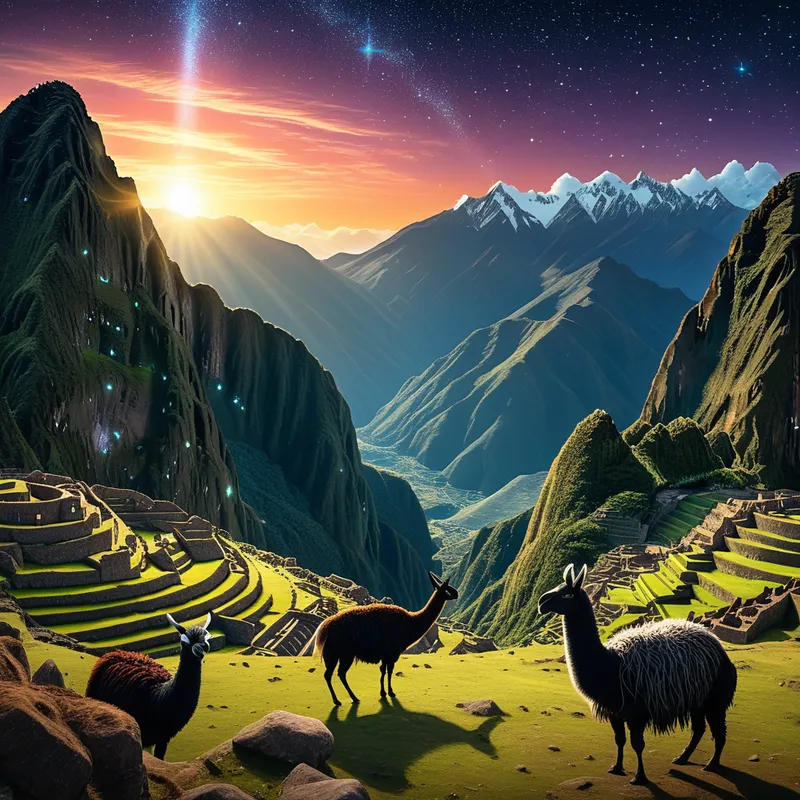
And between them, thin as a blade of ichu grass, was Kay Pacha. This was the "here-and-now," a world of fierce beauty and terrible fragility. It was the steep slopes of the Andes, the terraced fields of maize, the laughter of children, and the bite of the wind. It was the realm of the living, but it was adrift, a fragile raft tossed between the silent, perfect heavens and the murmuring, fertile depths. The people of Kay Pacha looked up and felt small; they looked into the springs and caves and felt a deep, ancestral pull. They were torn, belonging fully to neither world, and thus were incomplete.
The conflict was not of war, but of isolation. Hanan Pacha shone, but its light did not warm the seeds. Uku Pacha nourished, but its potential could not reach the sun. Kay Pacha lived, but it lived without meaning, without connection to the source of its life or the destination of its spirit. The worlds were like three great llamas, tethered too far apart, unable to share their warmth.
The resolution came not from a hero, but from a principle: yanantin, sacred reciprocity. Pachamama herself, whose body was Uku Pacha and whose surface was Kay Pacha, stretched her roots deeper and raised her peaks higher. The mountains, the Apus, became the living pillars. Their snow-capped peaks pierced Hanan Pacha, drawing down the rain of Illapa. Their roots plunged into Uku Pacha, drawing up the waters of life. The condor would descend to drink from mountain lakes, carrying messages. The serpent would ascend through sacred springs, bringing fertility.
And the people of Kay Pacha learned the rituals. They built ushnus, altars that were conduits. They offered the fruits of Kay Pacha back to Pachamama (Uku Pacha) and raised their prayers on smoke to Inti (Hanan Pacha). They became the connectors, the living axis where the three breaths met and became one sustaining cycle. The world was no longer three, but one being in three expressions, a sacred trinity in eternal, reciprocal flow.
Cultural Origins & Context
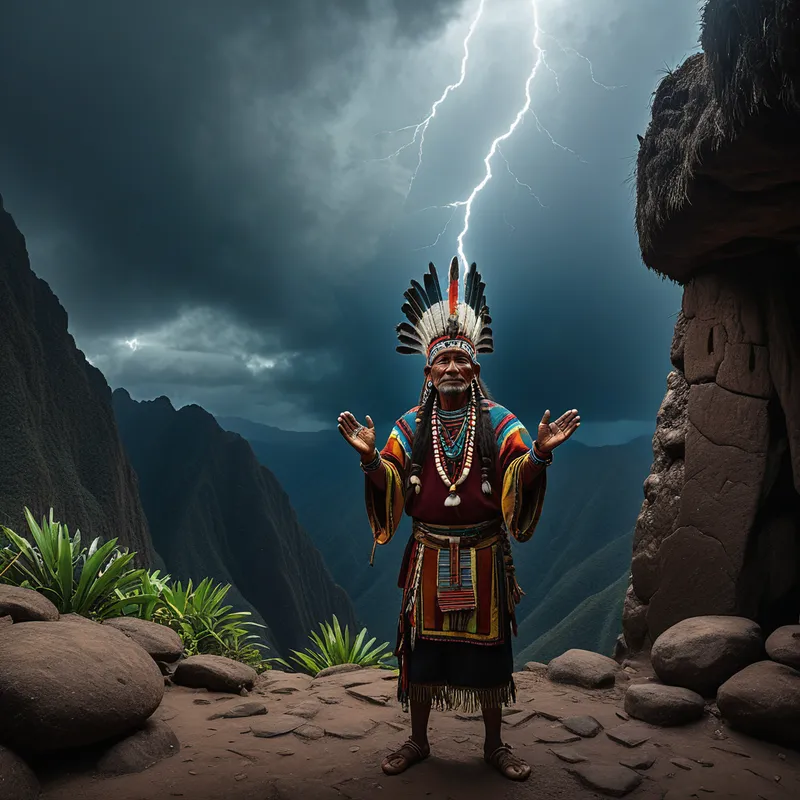
This cosmology was the foundational architecture of the Inca worldview, known as Tawantinsuyu, the "Land of the Four Quarters." It was not merely a myth to be told, but a lived, experiential reality encoded into the very landscape and social order. The myth was passed down orally by the amautas (wise philosophers) and haravicus (poet-singers), and enacted by the paqos (shaman-priests). Its societal function was immense: it explained the natural order (why mountains touch the sky, why springs emerge from the earth), justified the theocratic rule of the Sapa Inca (as the mediator between Hanan Pacha and Kay Pacha), and prescribed the ethics of ayni (reciprocal exchange) that governed everything from agriculture to community labor. The myth was the map that showed every individual their place and purpose within a vast, animate, and interconnected cosmos.
Symbolic Architecture
The three Pachas are not places, but states of being, layers of consciousness interwoven into a single reality.
Hanan Pacha symbolizes the superconscious—the realm of ideals, spirit, higher principles, and ultimate order. It is the father principle, the realm of the sun: luminous, directive, and sometimes distant. Psychologically, it represents our aspirations, our connection to the numinous, and the guiding archetypes of the Self.
Uku Pacha symbolizes the subconscious and the unconscious—the realm of instinct, memory, the ancestral past, the shadow, and unformed potential. It is the mother principle, the womb and the tomb: fertile, chaotic, nourishing, and terrifying. It holds our repressed material, our creative seeds, and the psychic "soil" from which our conscious life grows.
Kay Pacha is the ego-consciousness—the "I" that experiences the present moment. It is the realm of action, choice, suffering, and joy. It is the crucible where the influences of Hanan (spirit) and Uku (instinct/shadow) meet and must be reconciled.
The true self is not born in any one world, but in the conscious act of bridging them. We are the mountain, not the peak, the root, or the slope alone, but the entire vertical axis of being.
The myth's core teaching is that health—of an individual or a society—depends on maintaining conscious, respectful communication between these three levels. To ignore Hanan Pacha is to live without meaning or direction. To ignore Uku Pacha is to become rootless, denying one's shadow and history, leading to psychic eruption. To become stuck solely in Kay Pacha is to live a flat, literal, and disconnected existence.
The Dreamer's Resonance
When this mythic pattern stirs in the modern dreamer, it often manifests as dreams of verticality and mediation. You may dream of climbing a treacherous mountain (aspiring to Hanan Pacha), only to find a cave at the summit leading deep within (confronting Uku Pacha). You may dream of being in a familiar house (Kay Pacha) and discovering a hidden basement full of forgotten belongings or a sealed attic containing old letters (encounters with the personal Uku Pacha and Hanan Pacha).
Somatically, this process can feel like a tension between the head and the gut, a feeling of being "torn" between a lofty ideal and a base impulse. Psychologically, it is the process of acknowledging that you are not a monolithic "I," but a field of interaction. A dream of falling into a deep pit (Uku Pacha) may coincide with a period of depression or introversion, a necessary descent to gather lost parts of the self. A dream of flying or reaching a brilliant summit (Hanan Pacha) may follow a breakthrough or inspire a new life vision. The dream-ego in Kay Pacha is learning to be the paqo, the mediator who can hold the tension and translate between the depths and the heights.

Alchemical Translation
The individuation process, the journey toward psychic wholeness, is mirrored perfectly in the task of the myth: to consciously integrate the three worlds. The initial state is one of identification solely with Kay Pacha—the ego believes it is the entirety of the self. The first alchemical operation is the descent into Uku Pacha: confronting the shadow, engaging with personal and collective trauma, and retrieving the "Incan gold" of repressed vitality and creativity. This is the nigredo, the blackening, a necessary dissolution of the ego's illusions.
The second operation is the ascent toward Hanan Pacha: not an escape, but an effort to connect conscious life with a guiding symbolic or spiritual principle. This is the albedo, the whitening, where insights from below are refined by the light of understanding from above.
The alchemical vessel is Kay Pacha itself—your lived, embodied experience. The great work is to stand firmly in this world while consciously conducting energy between the inner depths and the higher call.
The final goal is not to live in heaven or the underworld, but to transform Kay Pacha into a true ushnu—a sacred altar where the energies of all three realms are acknowledged, honored, and synthesized. The individual becomes the living axis mundi. Your daily life, with all its mundane tasks and relationships, becomes the ritual ground where spirit is embodied and instinct is spiritualized. You achieve a state of yanantin within yourself, a sacred reciprocity where every thought, feeling, and action is in dialogue with both your deepest roots and your highest stars.
Associated Symbols
Explore related symbols from the CaleaDream lexicon:
- Mountain — The living axis mundi that physically and symbolically connects all three Pachas, representing the individual's journey of integration and ascent.
- Cave — The entrance to Uku Pacha, symbolizing descent into the unconscious, confrontation with the shadow, and the womb of rebirth.
- Serpent — The primal creature of Uku Pacha, representing subterranean wisdom, cyclical time, instinctual energy, and the healing force that can ascend.
- Condor — The majestic bird of Hanan Pacha, symbolizing the higher perspective, spiritual aspiration, and the ability to carry messages between realms.
- Bridge — The mediating principle and the role of the conscious self (Kay Pacha) in creating connection between the upper and lower worlds.
- Root — The anchoring connection to Uku Pacha, representing ancestry, the personal and collective unconscious, and the hidden sources of nourishment.
- Star — The pure, distant light of Hanan Pacha, symbolizing guiding ideals, destiny, and the transcendent aspects of the Self.
- Water — The flowing element that circulates between all three worlds as rain, river, and spring, representing the fluidity of consciousness and emotional truth.
- Stone — The foundational substance of Kay Pacha and the sacred ushnu, symbolizing the enduring presence of the earthly realm and the altar of conscious experience.
- Ritual — The conscious action performed in Kay Pacha to maintain reciprocity with the other worlds, modeling the daily practice of psychic integration.
- Shadow — The psychological counterpart to Uku Pacha, containing all that is repressed, unknown, and yet essential for wholeness.
- Journey — The core narrative of moving between and integrating the three realms, which maps directly onto the path of individuation.