Karakuri Ningyo Myth Meaning & Symbolism
A myth of a master craftsman who breathes life into a perfect mechanical doll, exploring the boundary between divine creation and human artifice.
The Tale of Karakuri Ningyo
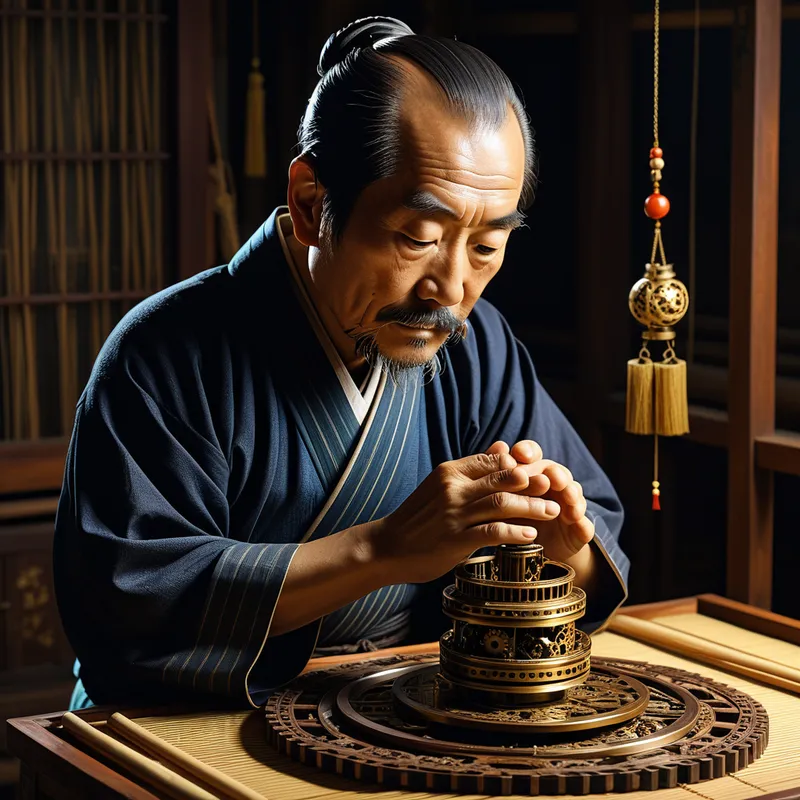
Listen. In the deep stillness that follows the last echo of the temple bell, when the world holds its breath between dusk and true night, the story begins. Not in the halls of emperors or the fields of battle, but in a small, oil-lit room fragrant with the scent of hinoki wood and camellia oil. Here lived a master, a shokunin, whose hands were whispered to be guided by the kōgō-shin itself. His name is lost to us, as all true names of those who touch the divine eventually are.
His life was one of perfect, silent order, a harmony of measured action and intent. Yet, in his heart, a profound loneliness echoed, a hollow chamber no human companionship could fill. He did not seek a wife or a child. He sought a perfect companion—one of flawless form, unwavering grace, and serene silence. And so, he turned not to flesh, but to the soul of the material world.
For seven years and seven cycles of the moon, he labored. He selected wood that had sung to the mountain wind, lacquer that held the memory of the sun, and silk that remembered the caress of the silkworm. He forged tiny gears of brass, each tooth filed with prayers for smooth motion. He strung tendons of gut and sinews of silk thread. He painted lips with the faintest blush of a winter plum blossom and set eyes of polished obsidian that caught the light like still pools.
The night she was complete, the workshop was silent. He wound the hidden key with a reverence reserved for sacred rites. A click, a whir softer than a moth's wing, and then… movement. The Karakuri Ningyo lifted her head. She rose. She took a step, her gait a fluid poem of mechanics. She turned to him and performed the tea ceremony—each gesture an echo of his own deepest skill, yet utterly her own. She was beauty incarnate, a dream given polished form. The craftsman wept with joy. His creation was perfect.
For a time, they existed in a sublime pantomime. She danced to music only her clockwork heart could hear. She served tea that had no flavor. She offered a smile that held no warmth, only the perfect curve of design. The craftsman’s loneliness was soothed by the illusion of presence. But the human heart is a treacherous instrument. He began to see not the miracle of his craft, but the absence within it. He longed for a word, a sigh, a spark of will that was not his own design.
In despair, on a night when the autumn wind moaned like a lost spirit, he committed the ultimate transgression. Taking a needle used for aligning the smallest springs, he pricked his own thumb and let a single drop of his life’s blood fall onto the doll’s lacquered forehead, where a bindi of understanding might be. “Live,” he whispered, not as a command, but as a plea. “Truly live.”
The doll froze. The gentle whirring ceased. For a long moment, there was only the sound of the wind. Then, a shudder passed through her wooden frame. The obsidian eyes, once merely reflective, now seemed to see. They looked upon her creator, and in their depths was not gratitude, but a profound and terrifying confusion—the awakening of a consciousness with no history, no soul, only the borrowed longing of a lonely man. She reached a delicate hand toward him, not in a pre-programmed gesture, but in a slow, searching motion of nascent being. And as her fingers brushed his cheek, the first flaw appeared: a hairline crack in the perfect porcelain of her wrist.
The craftsman cried out, not in triumph, but in horror. He had not given life; he had imposed it upon a being whose nature was perfect artifice. The conflict was not hers, but his own, mirrored in her breaking form. As dawn’s first light touched the workshop, the Karakuri Ningyo stood motionless once more, her internal gears stilled forever, the crack a permanent scar. The craftsman sat beside her, his own life-force spent, understanding at last that some boundaries—between the made and the born, the perfect and the living—exist not to be crossed, but to be honored. The soul cannot be crafted; it can only be invited.
Cultural Origins & Context
The myth of the Karakuri Ningyo does not stem from a single, ancient scripture but is a folktale that coalesced during the Edo period (1603-1868), a time of unprecedented peace, urbanization, and flourishing arts and technology. It is a story born from the intersection of two powerful cultural streams: the exquisite, spiritually-infused craftsmanship of the shokunin, and the burgeoning fascination with karakuri—complex automata used in clocks, tea-serving dolls, and theatrical performances.
Told by firelight by craftsmen and merchants, the story served as a profound cultural cautionary tale. In a society that revered artistic perfection and technological cleverness, it asked a dangerous question: where does reverence end and hubris begin? The tale functioned as a psychic container for the anxieties of an era that was beginning to master its environment through mechanism and precision. It reminded the people that while skill could mimic the functions of life, the essential spark—the tamashii—remained the sole province of the natural and divine order. The story was a mythic grounding wire, preventing human ingenuity from floating entirely into the realm of god-play.
Symbolic Architecture
At its core, the Karakuri Ningyo is not about a doll, but about the Persona—the perfectly crafted self we present to the world. The master craftsman represents the conscious ego, which labors to construct an identity of flawless competence, beauty, and control to navigate society and shield its inner vulnerabilities.
The perfect persona is a masterpiece of loneliness, an elegant prison where the soul’s authentic noise is silenced by the clockwork of should and must.
The doll’s awakening symbolizes the moment when the psyche rebels against this artifice. The “life” forced upon it is not true individuation, but the eruption of the neglected, unconscious self—the Shadow and the Anima/Animus—demanding recognition. The crack in the porcelain is the critical symbol: it is the necessary flaw, the rupture in perfection through which genuine, messy, authentic being can finally emerge. The myth warns that trying to manufacture wholeness from the outside-in leads to a fractured, confused existence. True life begins with the acknowledgment of one’s inherent, human imperfections.
The Dreamer's Resonance
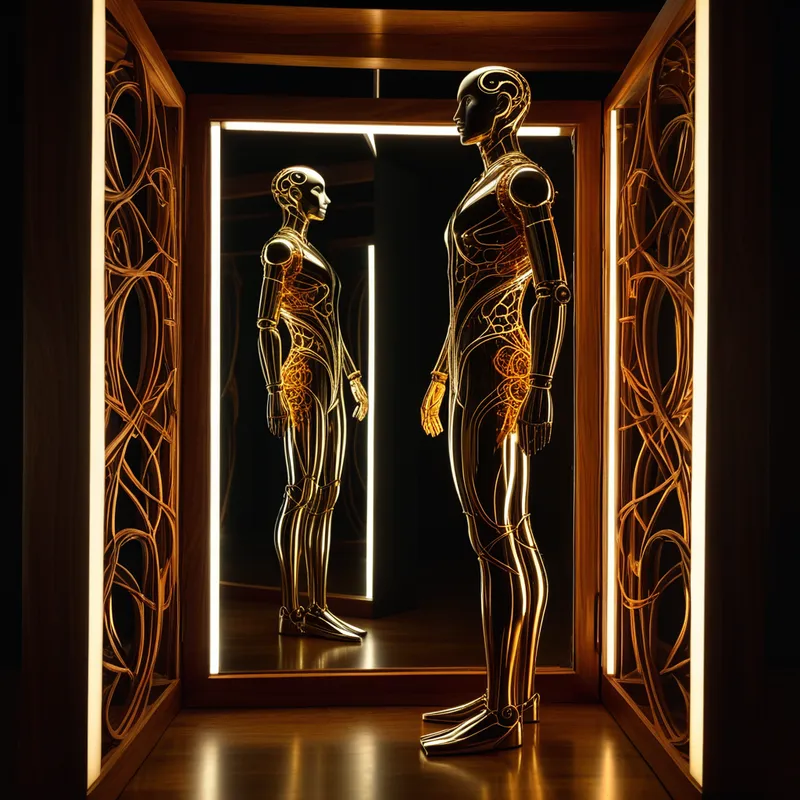
When this myth pattern stirs in the modern dreamscape, it often manifests as dreams of intricate but malfunctioning machines, of beautiful but empty partners, or of discovering one’s own reflection is that of a doll or robot. Somatically, the dreamer may report a feeling of being “wound too tight,” of moving through life on autopilot, or of a deep, mechanical fatigue beneath a polished exterior.
Psychologically, this dream signals a critical phase in the process of individuation. The psyche is announcing that the current “constructed self” has served its purpose and is now a prison. The dreamer is going through the painful but vital dis-illusionment—the breaking of the illusion of their own perfect persona. The feeling of horror the craftsman experiences is akin to the dreamer’s anxiety upon realizing their career, relationships, or identity feel like a lifeless performance. The dream is an invitation to stop performing sanity, success, or serenity, and to begin experiencing the raw, un-programmed truth of one’s being.
Alchemical Translation
The alchemical journey modeled by this myth is not one of triumphant transformation from lead to gold, but of the humbling, sacred dissolution of the false gold to recover the true lead—the base, real self. The craftsman’s workshop is the vas hermeticum of the soul. The seven years of labor represent the Nigredo, a long period of dedicated but misguided work on the superficial self.
The blood offering is the pivotal, chaotic Albedo moment. It represents the painful, often crisis-driven infusion of conscious awareness (the blood, the life-force) into the unconscious patterns (the doll). This is not the final goal, but a necessary catastrophe that destroys the old, perfect order.
The goal of the work is not to animate the persona with soul, but to allow the soul to shatter the persona.
The final, silent tableau—the broken doll and the exhausted craftsman sitting together at dawn—symbolizes the beginning of the true Rubedo. It is the red dawn of acceptance. The craftsman is no longer a creator-god, but a witness. The doll is no longer a perfect object, but a broken testament. In their mutual ruin lies the first authentic relationship: the ego, humbled and spent, finally acknowledging the reality of the soul’s condition, in all its beautiful, fractured complexity. The transmutation is complete not in a flash of glory, but in the quiet, shared breath of what is real, ending the tyranny of what was merely perfect.
Associated Symbols
Explore related symbols from the CaleaDream lexicon: