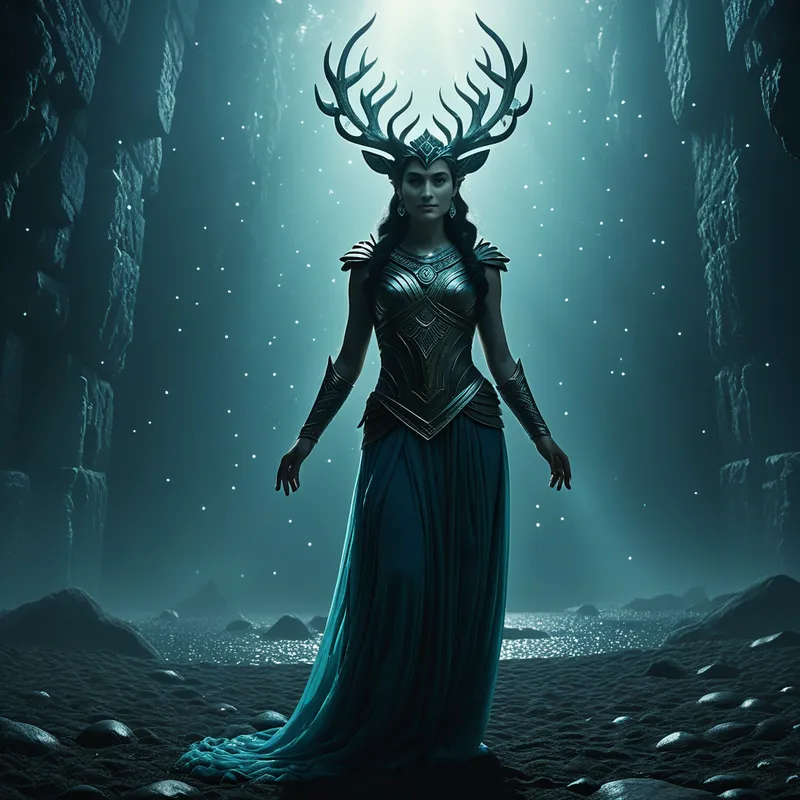
Kappa Water Spirit
Mischievous Japanese water spirits known for drowning victims but bound by strict etiquette; their head bowl holds life-giving water and vulnerability.
The Tale of Kappa Water Spirit
In the liminal hour when dusk settles on the riverbank, a ripple parts the still water’s surface. It is not a fish, nor a diving bird. A small, greenish hand, webbed between the fingers, breaks the plane, followed by the crown of a strangely dish-like head. The kappa emerges. It stands perhaps as tall as a child, its skin slick as a frog’s, smelling of river mud and deep water. In the hollow atop its skull rests a saucer of clear, vital water.
This is no mere monster, but a creature of profound contradiction. By day, it is a trickster, a puller of pranks that dance on the edge of calamity. It might sneak into a village to steal cucumbers—a food it prizes above all—or to peek up the kimono of an unsuspecting washerwoman. Its laughter is a wet, gurgling sound. Yet its mischief has a darker current. It is a dweller in the deep pools where children swim, a lover of sumo wrestling who challenges passersby with a grip of iron. To lose is to be dragged into the murky depths, one’s life essence—the shirikodama, a mythical ball of soul said to reside in the anus—extracted and consumed.
But the kappa is also a being of strict, almost obsessive, etiquette. It is bound by rules deeper than the river’s bed. It cannot refuse a challenge, and it must return a bow in kind. Herein lies the secret known to the wise. If you encounter a kappa, bow deeply. The creature’s compulsion to reciprocate will force it to tip forward. The water in the bowl on its head will spill out onto the earth. At this, the kappa is undone. It loses its strength, its very vitality seeping into the dry ground. It becomes helpless, a prisoner of its own formality, and may beg for its life, offering knowledge of medicine or the secret of setting bones in exchange for the return of its water.
To refill the bowl is to restore the kappa, who will then bound back into its aquatic realm, perhaps with a grudging promise of future favor, or a vow to leave the local villagers in peace. The creature that moments before was a figure of terror is rendered pathetic, then restored, all through the observance of a custom. It is a drama of power inverted by propriety, where survival hinges not on strength, but on knowing the hidden rule.
Cultural Origins & Context
The kappa belongs to the vast and fluid category of Japanese spirits known as yōkai. Its origins are deeply rooted in the animistic heart of Shinto, where every river, rock, and tree possesses a spirit, a kami. The kappa is the kami of a specific place—the deep pool, the treacherous bend in the river, the irrigation ditch. It personifies the dual nature of water itself: life-giving and perilous. Water irrigates the rice paddies, ensuring community survival, but it also drowns the unwary and floods the homestead.
Historically, the kappa myth served a vital sociological function. It was a story told to children, a warning spirit that guarded them from the very real dangers of unsupervised swimming. The tale enforced caution around waterways. But its complexity transcends simple admonition. The kappa also embodies the necessary, yet fraught, relationship between human settlements and the natural world. Farmers would make offerings of cucumbers (a food associated with the kappa) at the water’s edge to appease the spirit and ensure it did not sabotage their irrigation or harm their livestock. This practice reflects a worldview of negotiation with nature, acknowledging its capricious power and seeking a fragile accord through ritual and respect.
Symbolic Architecture
The kappa is a perfect symbolic vessel, its anatomy a map of its psychological and spiritual meaning. Its amphibious nature places it on the threshold between worlds—water and land, wild and cultivated, unconscious and conscious. The dish on its head, holding the life-sustaining water, is its most potent feature. This is not merely a physical vulnerability; it is the symbolic locus of its spirit, its concentrated essence. The water is its connection to its source, its power, and its soul. To spill it is to sever that connection, rendering the potent spirit inert.
The kappa’s bowl is the cup of its identity. The water within is the spirit’s contract with its element; to lose it is to experience a psychic dehydration, a dissolution of the self.
Its compulsive bowing reveals a psyche bound by internal law. The kappa is not free; it is a slave to its own code. This mirrors the human condition, where the very structures that give us identity and strength—our morals, our etiquette, our pride—can also become our points of greatest vulnerability, the rituals by which we can be disarmed. The extraction of the shirikodama is a profound image of soul-loss, of a vital, perhaps instinctual, core being stolen by a chaotic, trickster force from the depths of one’s own being.
The Dreamer's Resonance
To dream of a kappa, or to feel its presence in the psyche, is to encounter the trickster aspect of the unconscious. This is not the grand, transformative trickster of some mythologies, but a more localized, petty, yet insistent force. It represents those parts of ourselves that are slippery, difficult to pin down, prone to embarrassing pranks and sudden, overwhelming pulls into emotional depths. It is the compulsive thought, the addictive behavior, the childish impulse that surfaces at inopportune moments to sabotage our dignity.
Yet the kappa also carries the wisdom of the depths. Its weakness—the bow—is also the key to engaging with it. In psychological terms, to “bow” is to acknowledge this shadow aspect with respect, to meet its chaotic energy not with brute suppression, but with conscious ritual. When we formally recognize our own mischievous, destructive, or fearful impulses, we often find they lose their overwhelming power. Their “water” spills out; their compulsive energy dissipates, and they can be re-integrated in a more manageable form. The kappa thus teaches that the path to dealing with our inner demons is not always through battle, but sometimes through etiquette—a conscious, respectful engagement that disarms them.
Alchemical Translation
The encounter with the kappa is an alchemical process of solve et coagula—to dissolve and to coagulate. The initial state is one of latent danger, a potent, undifferentiated spirit of nature (the unconscious) lurking at the edge of awareness. The human who meets it represents the conscious ego. The bow, the act of conscious engagement according to a hidden rule (self-knowledge), is the agent that dissolves the kappa’s threatening form. It reduces the powerful, autonomous complex to a state of helplessness, separating its “water” (its vital spirit) from its “body” (its behavioral pattern).
This moment of helplessness is the nigredo, the blackening, the necessary humiliation and defeat of the complex. Only from this state can a new agreement be forged.
The final act—pouring water back into the bowl—is the coagula. It is not an exorcism, but a restoration under new terms. The kappa’s energy is not destroyed; it is re-hydrated, brought back to life, but now bound by a promise, a conscious pact. The terrifying spirit of the deep pool becomes a potential source of healing knowledge. Psychologically, this is the integration of a shadow aspect: the compulsive trickster energy, once faced and disarmed, can be redirected. It becomes a source of creativity, of medicinal insight (healing), or of protection for the very domain it once threatened.
Associated Symbols
Explore related symbols from the CaleaDream lexicon:
- River — The kappa’s primary domain, representing the flow of life, the boundary between worlds, and the ever-present potential for both nourishment and drowning.
- Trickster — The archetypal embodiment of chaos, mischief, and rule-breaking, challenging order and revealing hidden truths through disruptive play.
- Cup — A direct analogue to the kappa’s head bowl, a vessel that holds the essence of spirit, life, or sacrament, and whose contents are precious and vulnerable.
- Shadow — The unconscious part of the personality containing repressed weaknesses and instincts, often perceived as a dark, threatening figure that must be confronted.
- Ritual — The prescribed formal behavior, like the bow, that mediates between the human and spirit worlds, transforming chaotic encounters into structured exchanges.
- Water — The fundamental element of the kappa, symbolizing the unconscious, emotion, intuition, and the fluid, shape-shifting nature of the psyche.
- Yokai Spirits — The broader class of Japanese phenomena-spirits to which the kappa belongs, representing the animated, often ambiguous, soul of the natural and domestic world.
- Bridge — Symbolizing the connection between conscious and unconscious, human and spirit, safety and danger, much like the riverbank where encounters with the kappa occur.
- Fear — The primary emotion the kappa evokes, but a fear that, when faced with proper knowledge, becomes a gateway to negotiation and potential wisdom.
- Healing — The knowledge often offered by a subdued kappa, representing the gifts that can emerge from successfully engaging and integrating a troubling aspect of the self or the world.