Kanzashi Myth Meaning & Symbolism
A celestial artisan shatters her divine hairpin, scattering its pieces to Earth, where they become the first flowers, trees, and flowing waters.
The Tale of Kanzashi
In the time before time, when the Plain of High Heaven was silent and the world below was a formless, shifting brine, there existed a loneliness so profound it echoed between the realms. The primordial deities had withdrawn, and the land of Ashihara-no-Nakatsukuni lay barren, a canvas of mud and rock awaiting its first stroke of color.
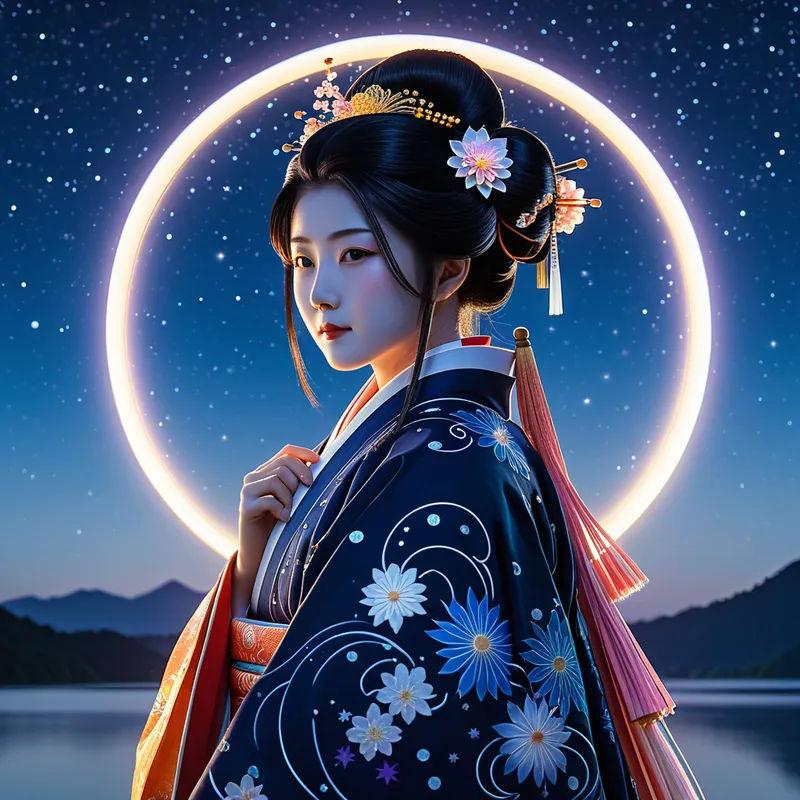
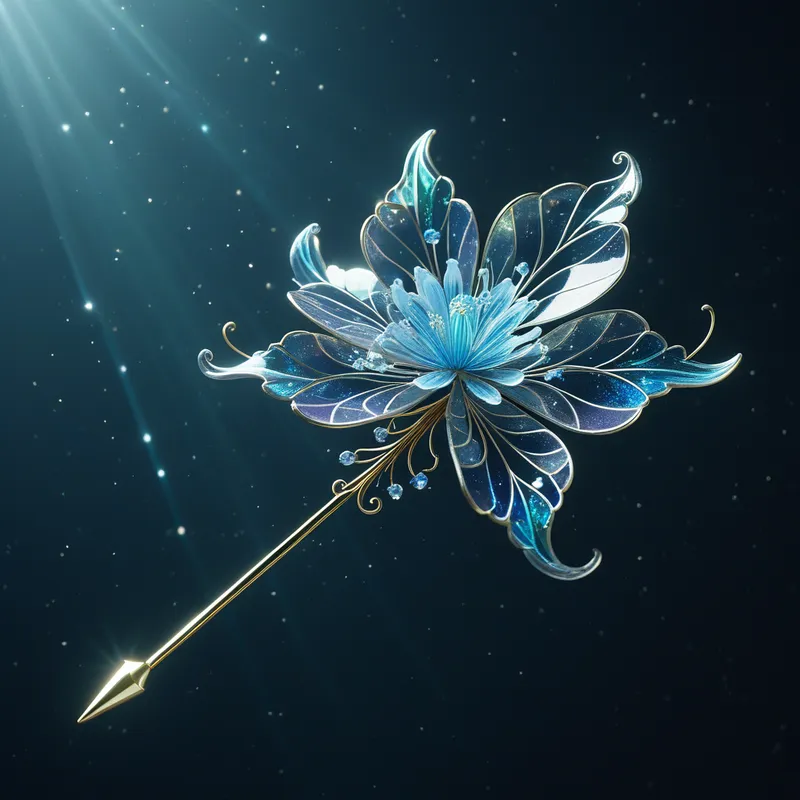
Among the celestial beings who gazed upon this desolation was Ame-no-Uzume. Yet, in this distant age, her famed laughter was still unborn. She was an artisan of the ineffable, a weaver of potential. In her twilight-black hair, she wore a single kanzashi, but this was no mere adornment. Forged from the breath of Izanagi and the tears of Izanami, it was a needle of concentrated becoming. Its head was a blossom of captured starlight; its pin, a shaft of polished void. It held the patterns of things that were not yet, humming with a silent, yearning song.
Each day, Ame-no-Uzume would stand at the bridge between heaven and earth, her heart aching in rhythm with the silent world below. The kami whispered of a great work, but the substance—the beauty, the life—was missing. The mud had no memory of green; the rock held no dream of bloom. One fateful dawn, as the first hint of peach-colored light touched the edge of the sky, the song within the kanzashi swelled to an unbearable pitch. It was not a sound, but a pull—a gravitational tug towards the barrenness.
With a understanding that pierced her like the pin itself, Ame-no-Uzume knew the law of creation: for something to be given, something of equal substance must be offered. The kanzashi was perfect, complete, and whole in the celestial realm. To seed the earthly realm, it could not remain so.
Without a word, she drew the pin from her hair. The heavens dimmed for a moment, holding their breath. Then, with a resolve as gentle and final as a falling petal, she pressed the tip of the celestial hairpin against the bridge of heaven and snapped it in two.
A silent explosion of potential erupted. Not a shattering of glass, but a bursting of a seedpod. The pieces did not fall as debris; they spiraled downward like luminous pollen, like tears of solidified dawn. Where the star-blossom head fractured, its fragments touched the mud and became the first camellias, peonies, and chrysanthemums—each flower a note of the kanzashi’s silent song given form. The shards of the long pin, piercing the rock, became the sacred cryptomeria and maple trees, their roots drinking the memory of the void. The finest dust of its creation, catching the new light, became the morning mist rising from the first clear streams and waterfalls, which themselves were born from the flow of the artisan’s released breath.
And Ame-no-Uzume? She stood, her hair now loose, feeling the weight of the offering. But as she watched the world below awaken in a riot of color and form, a sound welled up within her—a pure, spontaneous cascade of joy. It was the first laughter. It rolled across the newborn fields, shaking dew from petals, and it called the sun forth from its cave. The sacrifice was complete. The tool of potential was gone, but in its breaking, the world was made.
Cultural Origins & Context
While the core figures of kami like Ame-no-Uzume are central to the foundational texts of Kojiki and Nihon Shoki, this specific narrative of the Kanzashi is a mukashibanashi—a "tale of long ago"—that lives in the oral tradition, particularly linked to ancient craft guilds and seasonal festivals. It is not a myth of state foundation, but a folk explanation for the origin of beauty itself. Storytellers, often elders or traveling etoki priests, would recount it during spring Hanami or autumn moon-viewing ceremonies, connecting the fleeting beauty before the people to a divine, sacrificial origin.
Its societal function was multifaceted. For artisans—potters, weavers, lacquerware makers—it sanctified the act of transforming raw, "barren" material into an object of beauty, framing their work as a continuation of the primordial creative act. For society, it embedded a profound aesthetic and spiritual principle: true beauty (mono no aware) is not merely decorative, but is born from a sacred fracture, a willing descent from perfection into particularity. The myth served as a cultural container for the understanding that creation is inherently an act of courageous imperfection.
Symbolic Architecture
The myth’s power lies in its elegant symbolic economy. The Kanzashi is the symbol of latent, unified potential. It is the unmanifested idea, the perfect blueprint held safely in the realm of thought (Heaven). It is psychic wholeness before engagement with the world.
The act of creation is not an addition, but a sacred subtraction. Wholeness must be broken for its parts to live.
Ame-no-Uzume represents the conscious ego or the creative spirit that must mediate between the ideal (Heaven) and the real (Earth). Her moment of decision is the critical juncture of all creativity and individuation: the choice to risk the perfect, internal form for the sake of messy, external manifestation. The breaking is not a destruction, but a distribution of soul.
The barren Earth symbolizes the unconscious, the shadow, and the raw material of lived experience—initially inert and unmourished. The transformation of the fragments into flora and water represents the process of sublimation, where psychic energy is redirected from a contained, personal form (the hairpin as personal adornment) into a generative, life-giving force that nourishes the collective world.
The Dreamer's Resonance
When this myth stirs in the modern unconscious, it often surfaces in dreams of fragile, beautiful objects breaking—a precious vase, a piece of jewelry, a crystalline structure. The dreamer may experience this not with horror, but with a poignant, awe-filled sadness. Somatic sensations might include a feeling of release in the chest, a loosening of the hair or scalp, or the sensation of something scattering from one’s hands.
Psychologically, this dream pattern signals a profound process of creative sacrifice. The psyche is preparing to break apart a long-held, perhaps idealized, self-image, a perfect plan, or a treasured but outgrown identity (the celestial hairpin). The dream is an assurance that this breaking is not an end, but the necessary precondition for seeding new life. The dreamer is at the threshold where holding on to internal, perfect potential becomes a greater poverty than allowing it to fragment into fertile, if vulnerable, reality. It is the soul’s way of rehearsing the courage to be imperfect, to trade containment for contribution.

Alchemical Translation
The alchemical journey modeled here is the individuation process in its essential creative phase: the solve et coagula (dissolve and coagulate). The initial state is the nigredo—the barren, formless Earth, synonymous with a life feeling sterile, devoid of meaning or beauty.
Ame-no-Uzume’s role is that of the mediating consciousness. The kanzashi represents the prima materia—the precious, hidden psychic content that feels too perfect to touch. The alchemical operation is the separatio and projectio.
Individuation requires the shattering of the personal ornament to feed the impersonal garden. We do not become whole by gathering more to ourselves, but by distributing what we already are into the world.
The modern individual undergoes this when they take a deeply held, private talent or insight—a song unsung, a business idea, a vulnerable truth, a artistic vision—and "break" it by offering it to the world. This feels like a sacrifice, a loss of perfection and control. The fragmented pieces—rejected drafts, misunderstood presentations, partial successes—are the seeds. The resulting "flowers and streams"—the connections made, the beauty perceived by others, the unexpected new growth that springs from the attempt—are the rubedo, the reddening, the achieved creation. The myth teaches that our most profound contributions are born not from what we keep perfectly intact, but from what we are willing to gracefully break and scatter. The laughter of Ame-no-Uzume that follows is the joy of liberation, the proof that the creator is not diminished by the act of creation, but is fulfilled by it.
Associated Symbols
Explore related symbols from the CaleaDream lexicon: