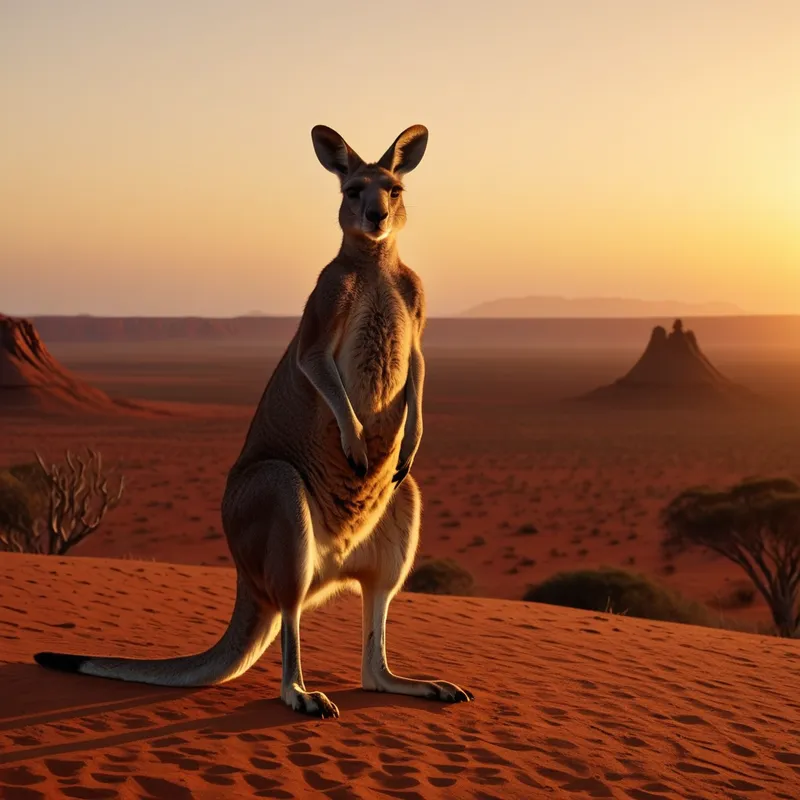
Kangaroo Dreaming Myth Meaning & Symbolism
A foundational myth where the First Kangaroo's sacrifice creates the landscape, establishes sacred law, and births the rhythm of life for all beings.
The Tale of Kangaroo Dreaming
In the time before time, when the world was soft and unformed, the Ancestors walked. The earth was a flat, dry plain, silent and thirsty. Among the first of these great beings was Marlu, the First Kangaroo. He was immense, his fur the colour of the red earth at sunset, his eyes holding the depth of the night sky. He moved with a powerful, bounding grace, but his heart was heavy with a knowing. The land was empty, and the Law was not yet sung into the stone.
Marlu journeyed for countless cycles, his great feet pressing into the soft crust of the world. He travelled from the place of the cold south wind to the edge where the salt water begins, searching. He searched not for food or rest, but for the sacred site—the place where the song of the land needed to begin. The silence was a weight upon him. The other nascent creatures—the emu, the lizard, the honey ant—watched his passage, sensing a great change stirring in the dust he kicked up.
One day, under a sun that burned like a white-hot stone, Marlu came to a vast, featureless basin. Exhaustion, deeper than mere tiredness, seeped into his bones. It was the exhaustion of potential unfulfilled. He stood still, and in that stillness, he heard it: a faint, dry whisper from the earth itself, a plea for life. He knew then what was required by the Law that existed before him. The land needed not just a traveler, but a sacrifice.
With a final, mighty bound, Marlu leapt high, casting a vast shadow. As he descended, he did not land to spring again. Instead, he let his full weight settle onto the barren ground. A great sigh escaped him, not of defeat, but of purpose. As his body made contact, a miraculous transformation began. Where his body touched the earth, the ground softened, grew damp, and then broke open. Clear, cool water began to flow, carving channels in the red earth—the first creeks and waterholes. His backbone sank into the land, rising as the first rocky ridge. His fur became the spinifex grass, waving in the new wind. His watching eyes became two deep, still pools, reflecting the sky.
From his essence, the first mob of kangaroos sprang forth, imbued with his rhythm and his law. The water he released flowed out, creating Iwari, the pathways of life. The land was no longer silent; it sang with the sound of water, the rustle of grass, and the thump of living feet. Marlu was gone, yet he was everywhere. He had become the country itself, and his journey was now etched forever in the landscape for all who knew how to see.
Cultural Origins & Context
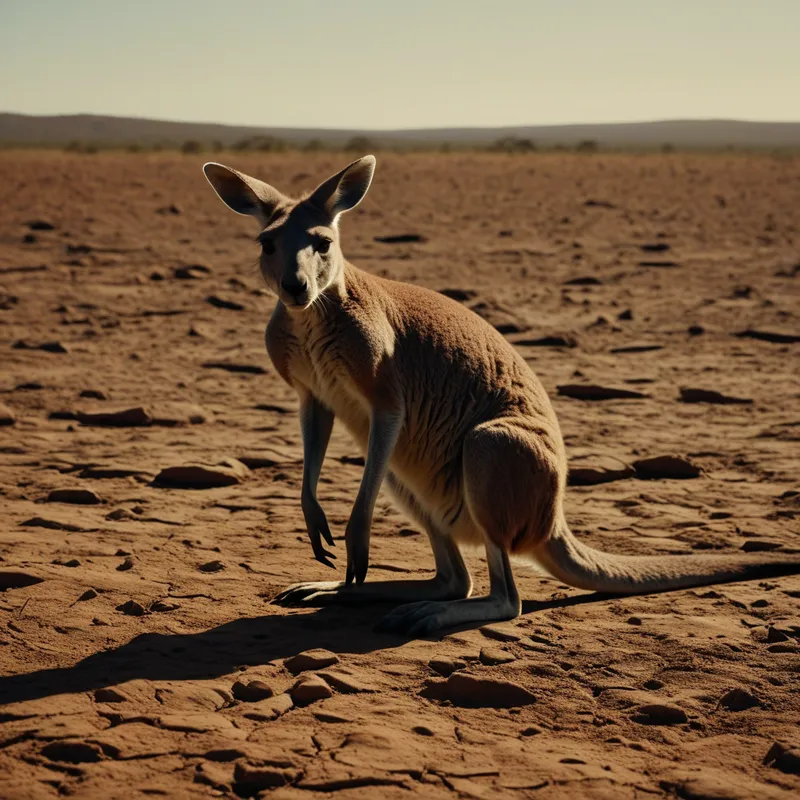
The narratives of The Dreaming or Tjukurrpa are not mere "myths" in a historical sense; they are the living, ontological bedrock of Aboriginal Australian cultures. The story of Kangaroo Dreaming belongs to specific language groups, particularly across the arid and semi-arid regions of Central Australia, where the kangaroo is a vital source of life and a profound spiritual relative.
This story was and is passed down through intricate oral traditions—a fusion of song, dance, art, and ceremony. Elders, as custodians of this knowledge, would recount the journey of Marlu during initiations and gatherings, often while walking the very songlines his journey created. Its function was multifaceted: it was a geological and geographical map explaining the formation of waterholes and ranges; a legal constitution outlining the responsibilities of kinship with the kangaroo species and the land; and a spiritual manual teaching the principle of sacred exchange—that life comes from life, and sustenance requires respect and reciprocity. The myth established the "Law" for how humans must interact with the kangaroo, ensuring its survival and theirs.
Symbolic Architecture
At its core, the myth of Kangaroo Dreaming is a profound allegory for the principle of generative sacrifice and the incarnation of law into tangible reality. Marlu is the archetypal first being who voluntarily undergoes a metamorphosis from a singular, mobile entity into the dispersed, animating spirit of an entire ecosystem.
The greatest act of creation is not movement, but the conscious choice to become the ground from which all else may spring.
Symbolically, the kangaroo embodies potent dualities: immense power paired with gentle vigilance; nomadic travel culminating in permanent settlement; individual identity dissolving into collective sustenance. His journey represents the necessary "walkabout" of the spirit or the culture—a period of searching that must ultimately lead to a point of rooted commitment. The water that flows from his sacrifice is the symbol of life, knowledge, and emotional sustenance released into the world through acts of self-giving. His transformation into the landscape illustrates the Aboriginal concept that the land is not inert, but a literal embodiment of ancestral consciousness and story. Every hill and watercourse is a clause in the living law.
The Dreamer's Resonance
When the pattern of Kangaroo Dreaming stirs in the modern psyche, it often signals a profound somatic and psychological crossroads. To dream of a kangaroo, especially one that is monumental, weary, or in the act of a significant leap or descent, may indicate the dreamer is carrying a heavy but purposeful burden. This is not the burden of anxiety, but of potential—a talent, a responsibility, a deep knowing, or a creative vision that seeks manifestation.
The somatic sensation might be one of deep fatigue in the legs or back, a literal feeling of "carrying the weight." Psychologically, the dreamer may be in a prolonged phase of seeking or running, searching for the right place, the right moment, or the right form to release their gift into the world. The dream is a nudge from the depths, suggesting that the end of the journey is not another leap, but a deliberate, grounding sacrifice—the choice to invest one's essence into a project, a relationship, or a community, thereby creating a sustainable source of "water" for oneself and others. It calls for moving from potential to actuality.
Alchemical Translation
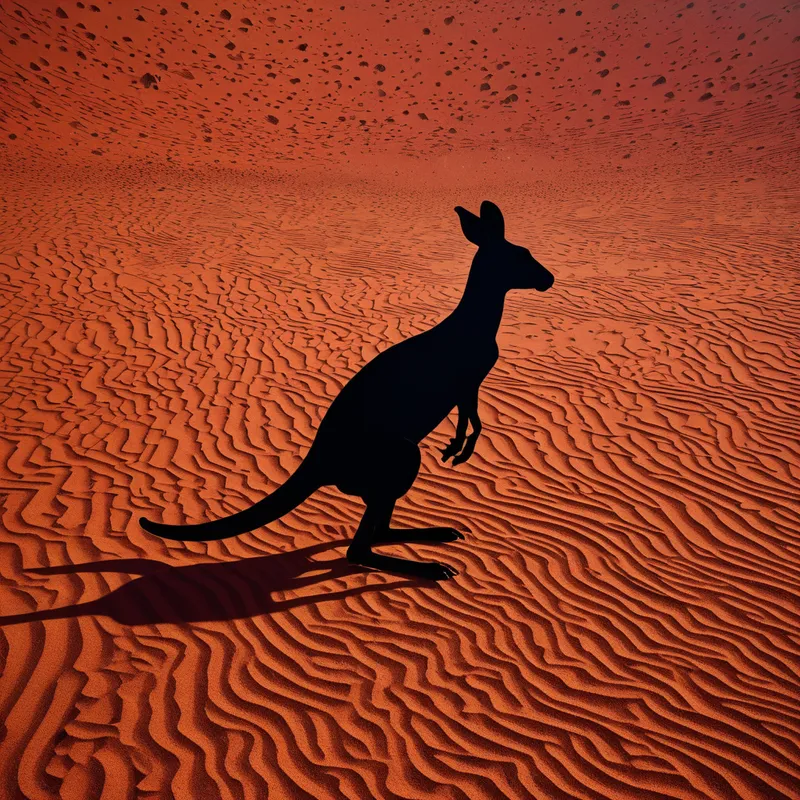
In the alchemical vessel of individuation—the process of becoming one’s whole, integrated self—the Kangaroo Dreaming models the critical stage of mortificatio and solutio: the dying of the old, itinerant form and the dissolving of the ego into a greater pattern. The modern individual often journeys through life accumulating experiences, identities, and knowledge (the boundless travel of Marlu). Yet, wholeness demands a sacrificial pause.
Individuation requires the hero to sacrifice his mobility to become the mountain, trading the freedom of the seeker for the responsibility of the source.
The "alchemical translation" of this myth is the conscious decision to stop seeking externally and to instead become the resource. This might mean an artist finally grounding their style and teaching it, a leader embodying their values so fully they become institutional, or a healer settling to create a sanctuary. It is the transformation of personal journey into lasting legacy. The ego-centric "I" that journeys alone is sacrificed, and in its place arises a "Self" that is geographically and psychically embedded—a self that has become part of the landscape of one's own life and the lives of others, creating permanent wells of meaning, law, and sustenance. The rhythm of the hop becomes the heartbeat of the land itself.
Associated Symbols
Explore related symbols from the CaleaDream lexicon: