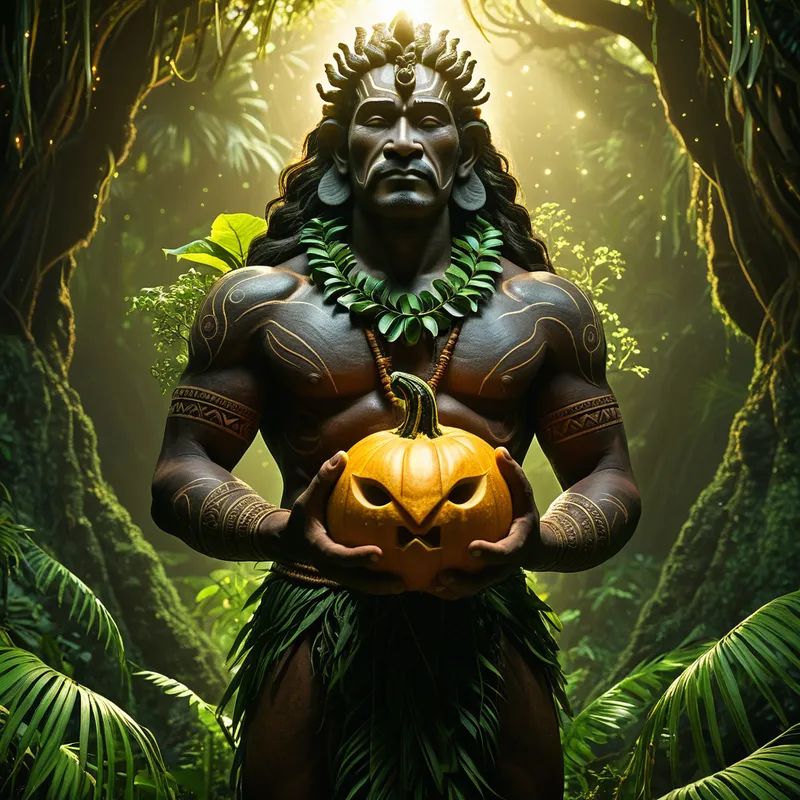
Kane the Creator Myth Meaning & Symbolism
The story of Kane, the Hawaiian creator god who shaped the world from primal darkness and breathed life into humanity, establishing cosmic and moral order.
The Tale of Kane the Creator
In the beginning, there was Pō. A deep, silent, endless night. No wind stirred, no wave broke, no eye saw. It was the great slumber before the dream. And from within this profound darkness, a presence awoke. Not from something, but from the potential of nothing itself. This was Kāne.
He was not born; he emerged. A consciousness becoming aware of its own power in the womb of eternity. With him came his kin: Kū, of fierce form and unyielding strength, and Lono, whose essence was the whisper of growth and the promise of clouds. Together, they were the first trinity, swimming in the black waters of Pō.
But Kāne was the dreamer, the architect. He looked into the void and saw not emptiness, but a canvas. He spoke, and his word was not a sound, but a vibration that parted the dark. "Let there be separation," his will declared. And so, the waters above were parted from the waters below. A sliver of light, the first Wākea (sky father), was lifted from the chaos. What remained below became Papa (earth mother), solid and waiting.
Yet, the world was barren, a silent sculpture of rock and sea. Kāne descended. With his hands, he carved the great valleys of Kauaʻi and the soaring cliffs of Molokaʻi. He struck the earth, and fresh water sprang forth, the blood of the land. He called to Lono, and rains came to fill the streams. He called to Kū, and the great forests of Hawaiʻi thrust upward, their roots gripping Papa.
Still, the silence was profound. No voice answered the rustle of the leaves or the crash of the surf. Kāne went to the red earth of Kūkaniloko. He gathered the dark, rich clay, and with immense care, he fashioned a form in his own image. He shaped the head, the limbs, the curve of the back—a man. Then, from a different place, he shaped a woman. He laid them side by side on the sacred ground.
This was the pivotal moment. Creation was sculpted, but not alive. Kāne, the life-giver, knelt beside his clay children. He leaned close, and from his own divine essence, he breathed out—a long, gentle, powerful exhalation. His ha, the breath of life, flowed into the nostrils of the first man, Kū-Honua, and the first woman, Ke-ʻOla-kū-Honua. Their chests rose. Their eyes opened, seeing the world, seeing their creator, for the very first time. The silence was broken by the sound of their own breath, echoing the ha of Kāne. The world now had witnesses. It was complete.
Cultural Origins & Context
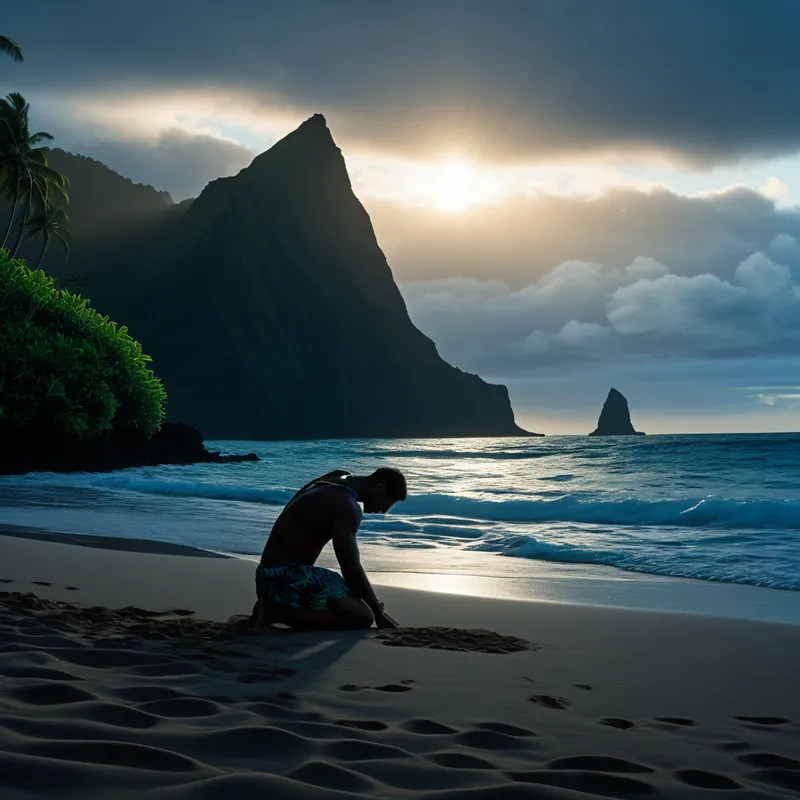
The myth of Kāne is not a single, standardized scripture, but a living tradition woven through the moʻokūʻauhau (genealogical chants) and kaʻao (historical tales) of the kānaka maoli. It was preserved and transmitted by the kāhuna, particularly those of the kahuna nui of Kāne. These stories were not mere entertainment; they were the cosmological map and moral constitution of society.
Chanted during sacred ceremonies, such as the consecration of a heiau (temple) or the birth of a high-ranking aliʻi (chief), the myth established the divine origin of life, land, and social order. It explained humanity's privileged yet responsible place in the universe: shaped from sacred earth and animated by divine breath. This connected all life—human, plant, animal—to Kāne, fostering a relationship of profound reverence, or kapu</abīr>, for the natural world. The myth was the foundational story that justified stewardship, defined life as inherently sacred (ola), and linked the authority of the chiefs directly back to the creator.
Symbolic Architecture
The myth of Kāne is a profound allegory for the emergence of consciousness from the unconscious and the imposition of life-giving order onto formless potential.
Creation is not an act of making something from nothing, but of recognizing the latent forms within the void and breathing the spark of awareness into them.
Pō represents the primordial unconscious, the undifferentiated state of psyche before ego-consciousness (Wākea) arises. Kāne’s emergence is the first stirring of the Self, the central archetype of order and wholeness. The separation of sky and earth is the fundamental psychic differentiation—the birth of duality (light/dark, above/below, male/female) necessary for any conscious experience.
The act of fashioning humans from earth signifies that our physical and instinctual nature (Papa) is the raw material of our being. But the crucial element is the ha—the divine breath. This is the infusion of spirit, consciousness, and soul. It symbolizes that true life, true humanity, exists at the intersection of the earthly and the divine, the formed and the animating principle. We are not just clay; we are inspired clay.
The Dreamer's Resonance
When the pattern of Kāne’s myth stirs in the modern dreamer, it often signals a profound creative or existential crisis poised for resolution. One might dream of being in a vast, empty, dark space (the Pō of the psyche), feeling a potent but undefined pressure. This can correlate to a period of depression, stagnation, or the "dark night of the soul," where old structures have dissolved but nothing new has formed.
Dreams of molding shapes from clay or dirt, or of finding a hidden spring or source of pure water, speak to the stage of re-connecting with one’s fundamental, instinctual nature—the Papa within. The somatic sensation is often one of grounding, of hands working with elemental materials.
The most critical dream motif is the breath. Dreaming of being unable to breathe, or conversely, of taking a first, deep, liberating breath of incredibly pure air, directly mirrors Kāne’s animating act. This signifies the psychological process of inspiration—literally, "in-spiriting." It is the moment when insight, vitality, or a new sense of purpose (ha) is integrated into a long-prepared but lifeless structure of the personality. The dreamer is receiving their own divine breath, moving from potential to animated life.
Alchemical Translation
The journey of Kāne models the individuation process—the psychic transmutation of the individual into their whole, authentic Self. It begins in the nigredo, the blackening: the chaotic, undifferentiated state of Pō. This is a necessary dissolution, a return to the psychic womb where all potentials exist.
The emergence of Kāne, Kū, and Lono represents the first differentiation of archetypal forces within the psyche: the creative impulse (Kāne), the will and structure (Kū), and the connecting, nourishing principle (Lono). The modern individual must recognize and differentiate these inner powers.
The alchemical work is not to create a soul, but to discover the divine breath that has always been waiting to animate the form you have spent a lifetime sculpting.
Shaping the world and the human figures is the long, arduous work of albedo and citrinitas—building the ego, developing skills, forming relationships, crafting a life. But this can become a barren achievement, a "perfect" life that lacks soul. The final, transcendent stage, rubedo, is the infusion of the ha. This is the moment of enlightenment where one realizes that the purpose of all the striving and forming was to build a vessel worthy of being filled by the spirit. The struggle culminates not in a victory, but in a reception—allowing the Self to breathe life into the personality. The individual becomes a conscious participant in their own creation, a living bridge between earth and heaven, finally whole.
Associated Symbols
Explore related symbols from the CaleaDream lexicon:
- Creator — The central archetype embodied by Kāne, representing the primal urge to bring form, order, and conscious life out of chaos and potential.
- Breath — Directly corresponds to Kāne's ha, the divine exhalation that transforms inert matter into a living soul, symbolizing inspiration, spirit, and the essence of life itself.
- Earth — The raw material, Papa, from which the first humans and the islands are formed, representing the physical body, instinct, and the foundational ground of being.
- Water — The primal element Kāne separates and from which he draws life-giving springs, symbolizing the unconscious, emotion, and the fluid potential from which all forms emerge.
- Light — The first separation from Pō, representing consciousness, awareness, and the illuminating power of the creative mind (Wākea).
- Tree — The forests called forth by Kāne and Kū, representing growth, life, connection between earth and sky, and the organic structure of the created world.
- Sky — Wākea, the separated expanse, representing the father principle, consciousness, and the realm of spirit and higher order.
- Stone — The foundational substance of the islands, and the sacred ground of Kūkaniloko, representing permanence, the anchor of creation, and the temple of the earth.
- Temple — The entire created world as a heiau for life, and the human body as a sacred vessel, representing a consecrated space where the divine and earthly meet.
- Order — The ultimate achievement of Kāne's work, the transformation of Pō into a harmonious, living cosmos governed by natural and moral law.
- Life — The final gift of Kāne's breath, the state of ola, encompassing physical vitality, spiritual presence, and the sacred interconnectedness of all created things.
- Seed — The latent potential within Pō that Kāne recognizes and nurtures, representing the unmanifest destiny and creative possibility within the unconscious.