Kamo no Chōmei's Ten-Foot-Square Hut Myth Meaning & Symbolism
A 13th-century recluse builds a tiny hut in the mountains, finding profound freedom in radical simplicity amidst a world of fire, famine, and flux.
The Tale of Kamo no Chōmei's Ten-Foot-Square Hut
Listen. The capital is burning. Again. The great conflagration of Angen sweeps through the night, a dragon of wind and flame consuming palaces and hovels alike. The sky weeps embers. In the chaos, a man of the court, Kamo no Chōmei, watches the world he knows turn to ash and smoke. He hears the cries, smells the char, feels the terrible heat of impermanence on his skin.
This is but the first of the great whirlwinds. Famine follows, a silent, gray specter that stalks the land until the roads are littered with the dead. Then, the earth itself groans and splits in the great earthquake of Genryaku, toppling pagodas like child’s blocks. The capital is a broken body, and the soul of the age is one of profound mujō.
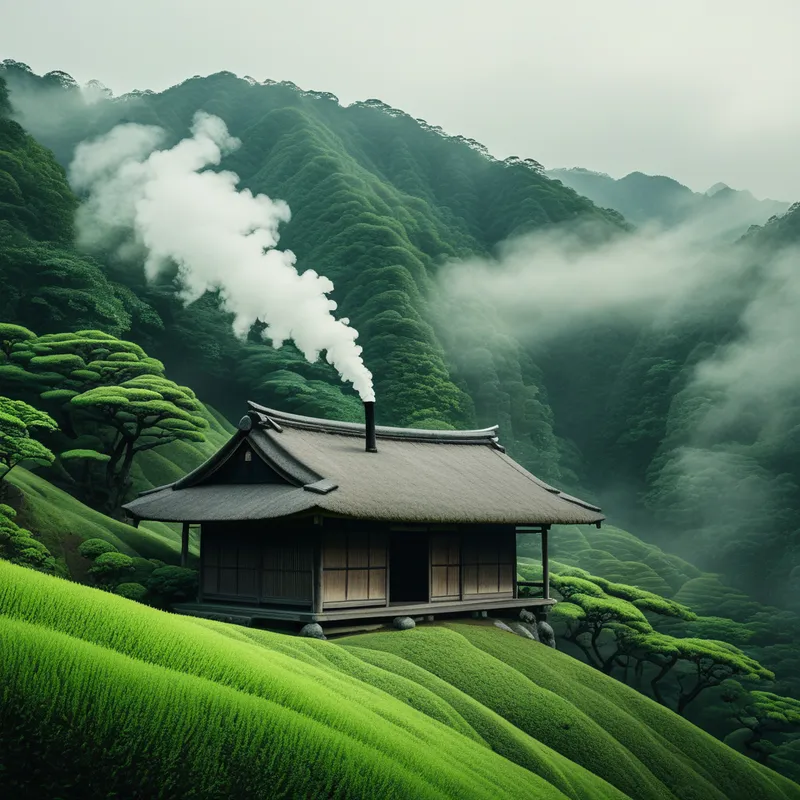
Chōmei, his heart heavy with the transience of all things, turns his back. He leaves the smoldering ruins of status and sorrow. He walks into the mountains of Hino, following the song of a stream. There, on a narrow shelf of land, he builds. Not a palace, not a temple, but a hut. A ten-foot-square hut. The pillars are slender, the roof thatched with brush, the walls papered simply. He fits a shelf for the Three Teachings and a portrait of Amida Buddha. In one corner, a place for his koto; in another, a basket of waka verses.
Here, the symphony of the world simplifies. The conflict of society fades, replaced by the rising action of the seasons: the cry of the monkey, the blush of autumn leaves, the deep silence of snow. His companions are the moon and his own thoughts. The resolution is not an answer, but a deepening question, a settling into the rhythm of the stream outside his door. He finds not escape, but a different kind of engagement—with the essential, the immediate, the true shape of a single life within the vast, turning wheel.
Cultural Origins & Context
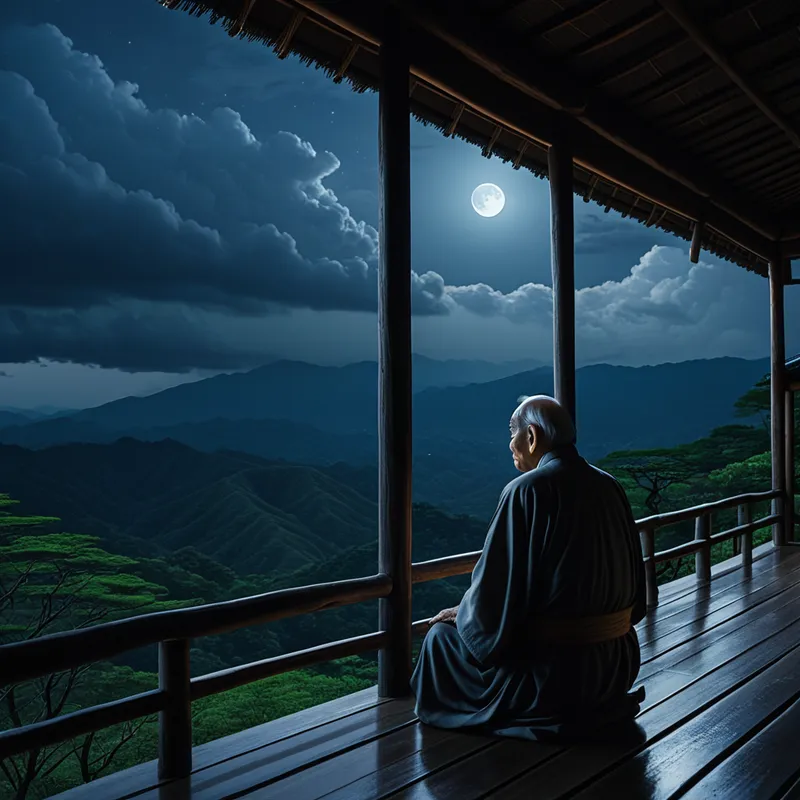
This is not a myth of gods, but a myth of the human spirit, recorded in the early 13th century during the tumultuous transition from the Heian to the Kamakura period. The work, Hōjōki, is a zuihitsu—"following the brush"—a form that allows for poetic meandering between observation, memory, and philosophy. Kamo no Chōmei, a minor aristocrat and accomplished poet, witnessed the collapse of the elegant, insular Heian world into an age of war, natural disaster, and social upheaval.
Hōjōki was his response, passed down not by bards but by scribes and scholars, becoming a cornerstone of Japanese literary and spiritual thought. Its societal function was multifaceted: it was a poignant record of historical catastrophe, a meditation on Buddhist doctrine accessible to the literate elite, and a powerful model of personal response to collective trauma. It presented renunciation not as a failure, but as a viable, even noble, path to integrity when the outer world becomes a realm of suffering (samsara). It gave cultural permission to seek meaning not in building anew, but in paring down to the core.
Symbolic Architecture
The hut is not merely a shelter; it is a complete symbolic universe. Its ten-foot square is the measured boundary of the self, a conscious limitation that creates infinite internal space. It is an anti-palace, rejecting the sprawling, burdensome ego-structure of social life for a defined, manageable domain of the soul.
The hut is the psyche's container, the temenos where the chaotic flood of worldly events is distilled into the clear water of conscious experience.
Each element is psychically charged. The thatched roof symbolizes a return to organic, elemental protection. The paper walls represent permeability—the self is not a fortress, but a sensitive membrane through which the beauty and melancholy of the world can be felt, without being destroyed by it. The nearby stream is the constant flow of time and consciousness, its sound a perpetual reminder of change. Chōmei’s few possessions—the Buddhist texts, the musical instrument, the poetry—map the tripartite needs of the mature psyche: spiritual guidance (The Three Jewels), emotional expression (music), and intellectual/creative integration (poetry). The hut, therefore, is the architecture of a balanced, intentional self, constructed in deliberate opposition to the unconscious, compulsive building of the persona in society.
The Dreamer's Resonance
When this myth appears in modern dreams, it rarely manifests as a literal Japanese hut. Instead, one dreams of finding a secret, perfectly small room in a chaotic house, of boarding up windows to create a peaceful cocoon, or of building a minimalist shelter in the midst of a raging storm or sprawling, alien city. These are dreams of psychological retraction and consolidation.
The somatic process is one of contraction preceding renewal. The dreamer is often overwhelmed—by the demands of the persona, by the "fires and famines" of modern life (stress, loss, information overload). The psyche, in its wisdom, initiates a retreat. To dream of the Ten-Foot-Square Hut is to experience the self enforcing a boundary, saying, "This far, and no further." It is the soul's immune response to psychic inflation or dissolution. The process feels like pulling in one's limbs, coming to center, and focusing all energy on maintaining a core integrity. It is not a dream of agoraphobic fear, but of essential self-preservation. The dreamer is undergoing a necessary enantiodromia, where the conscious attitude of expansion and acquisition flips into its unconscious opposite: the urge for simplicity, silence, and essence.

Alchemical Translation
The myth models the alchemical stage of nigredo followed by albedo. The fires, famines, and earthquakes represent the nigredo—the burning away of all that the individual once believed was solid and permanent: social status, material security, even cultural certainty. This is a brutal, involuntary dissolution.
Chōmei’s journey to the mountains and his conscious act of building the hut is the beginning of albedo. It is the active, willed participation in the purificatory process. He takes the prima materia of his ruined life and, through the ars combinatoria of radical choice, transmutes it into a vessel for the spirit.
The individuation process requires not just the expansion of consciousness, but, at critical junctures, its deliberate and sacred limitation. We must choose our ten-foot square.
For the modern individual, the alchemical translation is this: psychic transmutation does not always mean adding more—more insight, more relationships, more achievement. Often, the crucial work is subtractive. It is the courageous, sorrowful, yet ultimately liberating act of defining what is truly essential to the Self and letting the rest, no matter how glittering, burn away or be swept downstream. The triumph is not in conquering the world, but in constructing a conscious, authentic dwelling place for the soul within it. The hut becomes the lapis philosophorum—not a stone, but a space, where the conflict between inner and outer is reconciled in a chosen, harmonious simplicity. The individual becomes, like Chōmei, both the hermit and the sage, inhabiting the humble, profound square where the infinite can be glimpsed through the finite frame.
Associated Symbols
Explore related symbols from the CaleaDream lexicon: