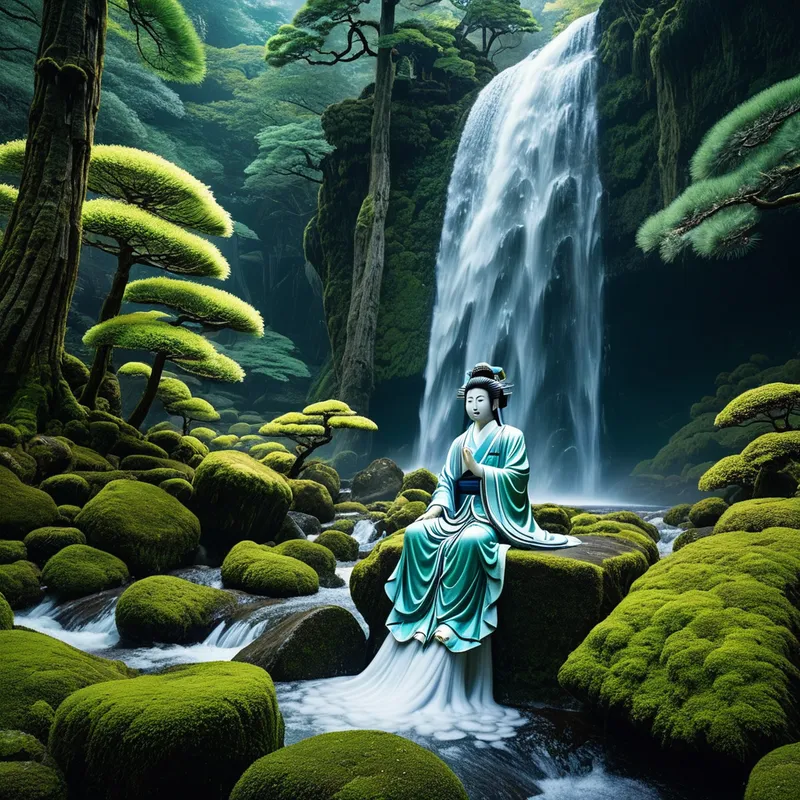
Kami of Streams Myth Meaning & Symbolism
A myth of a divine spirit who becomes a stream, offering purification and life, embodying the sacred flow of consciousness and the cost of transformation.
The Tale of Kami of Streams
Listen, and let the sound of water carry you back. Before the first shrine was raised, when the world was thick with the breath of spirits, there lived a kami of the high mountains. This was no distant, celestial god, but a being of profound presence, a consciousness woven into the mist that clung to the cedars and the cool, damp earth of the primordial forest. It knew the secret language of roots and the slow turning of stone.
Yet, a heaviness grew in the land below. The people in the valley, though they lived, were clouded. Sickness of body and weariness of spirit clung to them like a persistent fog. Their hearts were parched, not for water, but for clarity. Their rituals were empty echoes, their lives a trudging through spiritual dust. The kami, from its lofty perch, felt this thirst as a sharp ache in its own essence. It heard not with ears, but with the very fabric of the land, the silent, desperate cry rising from the valley—a cry for cleansing, for a return to flow.
A resolve, quiet and deep as bedrock, formed within the kami. It would not send a message or a sign. It would become the answer. From the sacred rock where it dwelt, the kami began a slow, deliberate descent. It did not walk, but unfolded. Its form, once gathered like morning dew on a spider’s web, began to soften, to yield. With a sigh that stirred the pine needles, it surrendered its defined presence. Its consciousness poured forth, not as a flood, but as a seepage of pure intent, finding the path of least resistance down the mountain’s ancient face.
It met resistance—a defiant slab of granite, a dense tangle of roots. Here, the myth holds its breath. This was the conflict: not against a monster, but against the very nature of form itself. To become the cure, the kami had to cease being what it was. It had to allow itself to be carved, to be channeled, to be divided. With a patience that humbles epochs, it persisted, not by force, but by persistent, gentle offering. It gave itself to the cracks, to the crevices, singing a silent song of erosion and emergence.
And then, the resolution. From the mountain’s base, a new sound was born. Not the wind in the boughs, but the chuckle of water over stone. A stream, clear and cold as melted starlight, emerged into the sunlight of the valley. It was the kami, now wholly transformed. It wound its way through the dry land, and where it flowed, a miracle followed. The sick who washed in its waters found fever broken; the weary who drank from it felt a lightness return to their souls. The stream did not speak, yet it communicated in the language of pure, life-giving flow. It became the artery of the community, a constant, sacred reminder that to cleanse, to heal, and to sustain often requires a profound and total self-giving. The kami did not rule from the peak; it served from the valley, having become the very essence of its own gift.
Cultural Origins & Context
This tale lives in the heart of Shinto, the "way of the kami." It is not a single, canonical myth from texts like the Kojiki or Nihon Shoki, but rather a composite, folk expression of a fundamental Shinto principle. It was passed down not by court scribes, but by villagers, farmers, and mountain ascetics—anyone who lived intimately with a local stream and felt its peculiar, animating presence.
Every pure, life-giving water source in Japan has the potential to be seen as the body of a suijin (water kami). The myth of the Kami of Streams gives narrative form to this perception. Its societal function was multifaceted: it explained the origin of a vital resource, it instilled a deep, religious respect for that resource (forbidding pollution), and it modeled a cosmology where the divine is not transcendent and judging, but immanent and nurturing. The stream-kami is a local deity, tied to a specific place, reflecting the profoundly animistic and community-oriented nature of early Shinto practice. To tell this story was to reinforce the sacred contract between the people and the land that sustained them.
Symbolic Architecture
At its core, this myth is a profound allegory of consciousness itself. The kami on the mountain represents a state of potential, of unified but isolated awareness. The valley’s sickness symbolizes the fragmented, polluted, or stagnant state of the human psyche—what in depth psychology we might call a complex or a state of neurosis.
The stream is consciousness in motion, the flowing awareness that connects the heights of spirit with the depths of embodied life.
The kami’s transformation is the ultimate act of empathy; it must become the medium of connection. The water symbolizes the unconscious in its life-giving, purifying aspect—the individuation process that washes away the rigid ego and allows for a more fluid, adaptive self. The resistance of rock and root are the innate defenses of the psyche, the patterns and traumas that resist the flow of change. The myth teaches that healing is not an act of conquest, but of graceful, persistent descent and self-surrender into a new form.
The Dreamer's Resonance
When this myth pattern surfaces in modern dreams, it often signals a profound somatic and psychological process of emotional or spiritual release. To dream of a pure, unexpected stream emerging in a barren or urban landscape points to the awakening of a nourishing, cleansing current from within the dreamer’s own unconscious. The body may be processing stored grief, anxiety, or toxicity, and the psyche is offering the image of its natural cleansing mechanism.
Conversely, dreaming of a blocked, polluted, or dried-up stream is a direct manifestation of what Carl Jung called a "blocked libido"—not merely sexual, but the general life energy that has become stagnant. The dream is a diagnostic image, showing where the flow of one’s vitality, creativity, or feeling has been dammed up by unresolved conflict, unexpressed emotion, or life choices that are out of alignment with the soul’s deeper currents.
Alchemical Translation
The alchemical journey mirrored here is not of turning lead to gold, but of turning stone into water—of transmuting the static, hardened aspects of the self into a dynamic, life-sustaining force. For the modern individual, the "mountain" is the isolated ego, perhaps successful or intellectualized, but disconnected from the fertile valleys of community, emotion, and the body.
The sacrifice is the willingness to dissolve the old, defended identity to serve a purpose greater than self-preservation.
The "valley’s sickness" is our modern malaise—the burnout, the existential dryness, the feeling of being spiritually parched amidst material plenty. The alchemical operation is one of solutio (dissolution), a crucial and terrifying stage where fixed forms must liquefy. We are asked to let our certainties erode, to allow our tears to flow, to become vulnerable and permeable. By consciously engaging with this process—through therapy, art, meditation, or service—we undertake the kami’s journey. We cease trying to control our healing from a detached height and instead become the healing process itself. We allow our consciousness to flow into the wounded, dry places within and around us. In doing so, we are no longer a person beside the stream of life, but have, in our most essential self, become a part of its sacred, cleansing, and eternally giving current.
Associated Symbols
Explore related symbols from the CaleaDream lexicon: