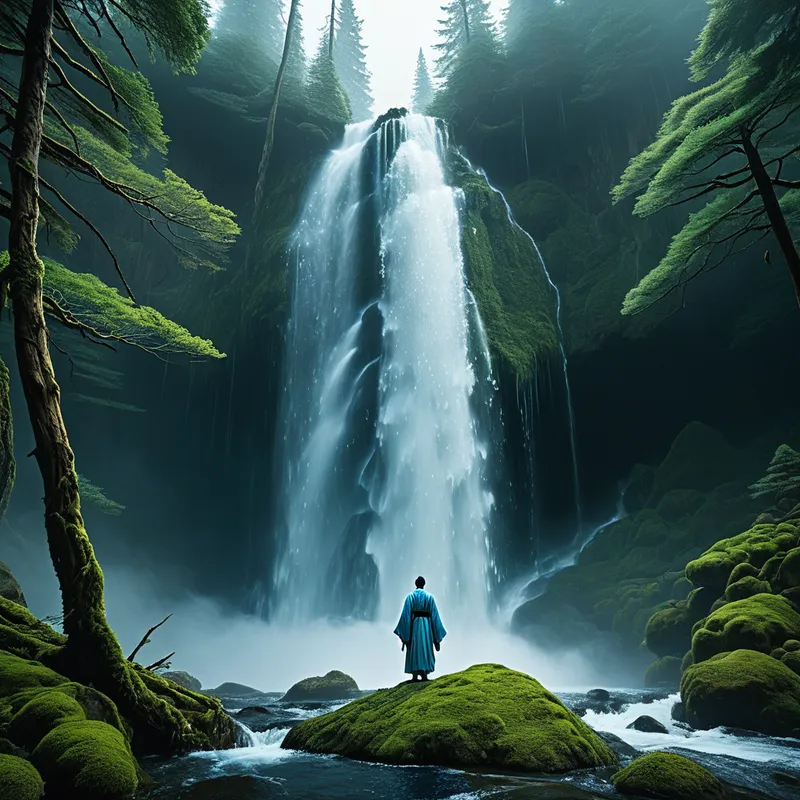
Kami of mountain streams Myth Meaning & Symbolism
A myth of the liminal water spirit, the Mizu no Kami, embodying the journey from raw, chaotic potential to integrated, life-giving consciousness.
The Tale of Kami of mountain streams
Listen. Not to my voice, but to the sound behind it. The sound that was here before words. It begins in the high, secret places, where the rock weeps and [the earth](/myths/the-earth “Myth from Hindu culture.”/) sighs. Where the silence is so deep it becomes a roar. This is the birthplace of the kami.
It was not born, but became. A gathering of cold seeps from forgotten stone, a conspiring of melting snows, a whisper of underground veins finding a crack in [the world](/myths/the-world “Myth from Tarot culture.”/). At first, it was only a sound—a thin, silver complaint against the granite. Then, a trickle, feeling its way like a blind root. Then, a voice.
This was the Mizu no Kami in its first raw thought. It knew nothing but its own falling. It was chaos given melody; a wild, purposeless energy carving its path in tantrums and caresses. It shattered rocks in its youth and lulled pebbles to sleep in its quieter moments. It was alone, but its loneliness was a song that filled the entire mountain gorge.
It did not see the fisherfolk who sometimes startled at its cold touch, or the woodcutter who cupped its [water](/myths/water “Myth from Chinese culture.”/) to his brow. It only felt their brief disturbance, a warmth that was quickly swallowed by its own relentless coolness. It was a spirit of pure process, a journey with no destination, singing a song it could not understand.
But the mountain is a wise parent. The stream’s constant flow began to wear not just the stone, but its own wild nature. As it descended, it learned the weight of the earth, the patience of the channel, the companionship of the air that cooled its surface. It met the roots of ancient pines that drank deeply and gave back the sigh of green life. It learned the touch of [the moon](/myths/the-moon “Myth from Tarot culture.”/), which pulled at its very soul, teaching it rhythm.
The transformation was not a single event, but a slow sedimentation of being. The chaotic voice began to articulate. The splash against a boulder became a deliberate word. The gurgle in a deep pool became a contemplative hum. It began to recognize. It felt the gratitude of the deer at its bank, not as a disturbance, but as a connection. It felt the prayers of the village downstream, where its waters were called “life-giver” and “purifier.” These thoughts, soft as silt, settled into its current.
One evening, under a full moon that painted its surface in quicksilver, the stream paused in a wide, deep basin. For the first time, it saw its own reflection—not as a mere surface, but as a face formed from swirling eddies and captured starlight. It saw the ancient cedars mirrored in its depths, the history of the mountain held in its gaze. In that moment of stillness, the raw, orphaned spirit of the waterfall completed its journey. It was no longer just a force of nature. It had become a kami—a conscious, sacred presence within the landscape. Its song remained, but now it was a song that listened, that nurtured, that remembered. It had found its place in the great, breathing web of kami.
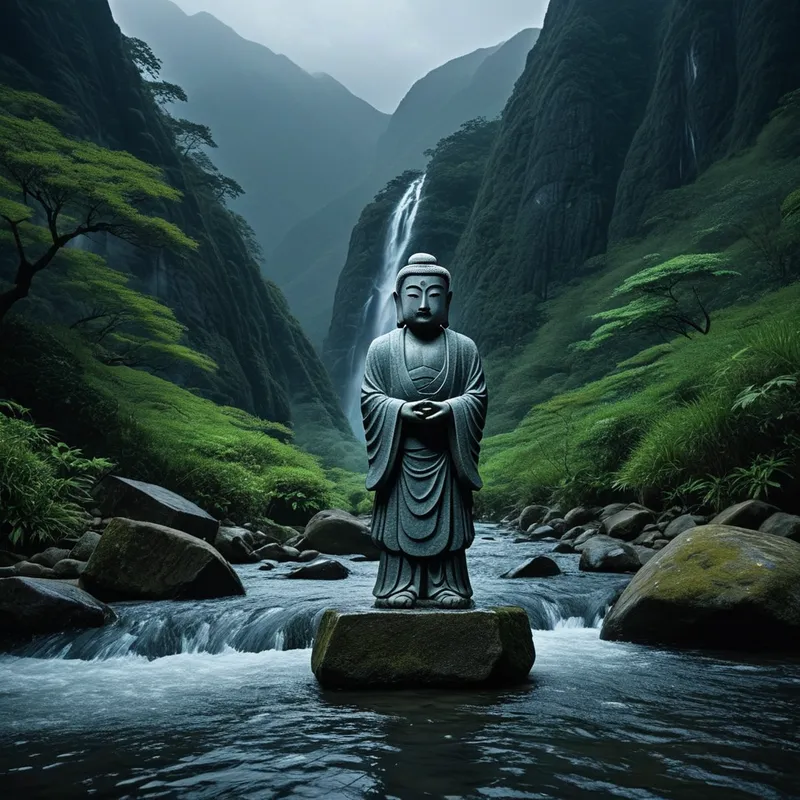
Cultural Origins & Context
This narrative of the water kami is not from a single, codified text like the Kojiki or Nihon Shoki, which chronicle the deeds of the celestial kami. It emerges from the bedrock of Shinto</ab title>, an animistic tradition that perceives sacred spirit (kami) in the phenomenal world itself. The myth is a composite, drawn from countless local folk beliefs (mukashibanashi) and the observed life of mountain streams.
It was passed down not by priests in grand shrines, but by villagers, farmers, and travelers. A woodcutter might speak of the strange feeling of being watched by a particular cascade. A grandmother would tell children not to shout near the headwaters, lest they anger the stream’s spirit. These stories served a profound societal function: they encoded ecological wisdom and fostered a relational ethics with nature. To recognize a stream as a kami was to engage with it as a living neighbor, one to be respected, thanked, and not polluted. This myth was the psychological and spiritual infrastructure for sustainable living, teaching that the source of life is not a mere resource, but a conscious, responsive entity on a journey of its own.
Symbolic Architecture
Psychologically, the stream’s [journey](/symbols/journey “Symbol: A journey in dreams typically signifies adventure, growth, or a significant life transition.”/) is the archetypal [path](/symbols/path “Symbol: The ‘path’ symbolizes a journey, choices, and the direction one’s life is taking, often representing individual growth and exploration.”/) of unconscious content toward [consciousness](/symbols/consciousness “Symbol: Consciousness represents the state of awareness and perception, encompassing thoughts, feelings, and experiences.”/). The raw, chaotic [waterfall](/symbols/waterfall “Symbol: Waterfalls in dreams often signify a release of emotions or a transformation, symbolizing the flow of life and the transition of feelings.”/) at the [source](/symbols/source “Symbol: The origin point of something, often representing beginnings, nourishment, or the fundamental cause behind phenomena.”/) represents the primal, undifferentiated [energy](/symbols/energy “Symbol: Energy symbolizes vitality, motivation, and the drive that fuels actions and ambitions.”/) of the [psyche](/myths/psyche “Myth from Greek culture.”/)—pure potential, powerful, but directionless and self-absorbed. It is the “[orphan](/symbols/orphan “Symbol: Represents spiritual abandonment, primal vulnerability, and the quest for belonging beyond biological ties. Often signifies a soul’s journey toward self-reliance.”/)” [archetype](/symbols/archetype “Symbol: A universal, primordial pattern or prototype in the collective unconscious that shapes human experience, behavior, and creative expression.”/) in its purest form: a force that exists but has not yet found its belonging in the greater [system](/symbols/system “Symbol: A system represents structure, organization, and interrelated components functioning together, often reflecting personal or social order.”/) of [the Self](/myths/the-self “Myth from Jungian culture.”/).
The stream does not create its path; it discovers it through the resistance of the world. The psyche individuates not in a vacuum, but through engagement with the hard, defining realities of life.
The descent is the process of [life](/symbols/life “Symbol: The symbol of ‘Life’ represents a journey of growth, interconnectedness, and existential meaning, encompassing both the joys and challenges that define human experience.”/) experience—the encounters with obstacles (rocks), the periods of [depth](/symbols/depth “Symbol: Represents profound layers of consciousness, hidden truths, or the unknown aspects of existence, often symbolizing introspection and existential exploration.”/) and [reflection](/symbols/reflection “Symbol: Reflection signifies self-examination, awareness, and the search for truth within oneself.”/) (pools), the nourishment from other parts of the psyche ([tree](/symbols/tree “Symbol: In dreams, the tree often symbolizes growth, stability, and the interconnectedness of life.”/) roots). The [moon](/symbols/moon “Symbol: The Moon symbolizes intuition, emotional depth, and the cyclical nature of life, often reflecting the inner self and subconscious desires.”/) represents the pull of cyclical, unconscious rhythms that guide the process. The final [moment](/symbols/moment “Symbol: The symbol of a ‘moment’ embodies the significance of transient experiences that encapsulate emotional depth or pivotal transformations in life.”/) of self-reflection in the pool is the critical threshold of [integration](/symbols/integration “Symbol: The process of unifying disparate parts of the self or experience into a cohesive whole, often representing psychological wholeness or resolution of internal conflict.”/). The kami sees itself not in [isolation](/symbols/isolation “Symbol: A state of physical or emotional separation from others, often representing a need for introspection or signaling distress.”/), but as a mirror holding the entire world. It realizes its [purpose](/symbols/purpose “Symbol: Purpose signifies direction, meaning, and intention in life, often reflecting personal ambitions and core values.”/) is not in its isolated power, but in its relatedness—as purifier, [life](/symbols/life “Symbol: The symbol of ‘Life’ represents a journey of growth, interconnectedness, and existential meaning, encompassing both the joys and challenges that define human experience.”/)-giver, and connective flow. The orphan finds its home by becoming a vital [organ](/symbols/organ “Symbol: An organ symbolizes vital aspects of life and health, often representing one’s emotional or physical state.”/) in the [body](/symbols/body “Symbol: The body in dreams often symbolizes the dreamer’s self-identity, personal health, and the relationship they have with their physical existence.”/) of the world.
The Dreamer’s Resonance
When this myth pattern stirs in the modern dreamer, it often signals a process of emotional or psychic integration. To dream of a chaotic, loud, frightening mountain stream may point to raw, unprocessed emotional energy—a “flood” of feeling that feels overwhelming and directionless. The dream ego might be the stream itself, feeling out of control, or a figure trying to cross it, representing a life challenge.
Conversely, dreaming of a clear, gentle, singing stream in a forest often accompanies a period of psychological flow, healing, and intuitive clarity. The somatic sense is one of coolness, cleansing, and movement. A pivotal dream image is the source: finding the hidden spring from which the stream emerges. This can symbolize connecting to the primal, authentic origin of one’s energy or creativity, before it was shaped by external forces. The dream asks: Where does your essential energy come from, and what is it trying to become as it flows through the landscape of your life?

Alchemical Translation
The alchemical work modeled here is the transmutation of [prima materia](/myths/prima-materia “Myth from Alchemical culture.”/)—the chaotic, base substance of the soul—into the aqua vitae, the water of life. We all begin as that orphaned waterfall: a bundle of innate potential, drives, and talents that are powerful yet unrefined, often experienced as anxiety, restless energy, or a sense of being fundamentally separate.
The alchemy occurs in the descent, in the willing engagement with the world’s resistance. Each rock that shapes the current is a limit, a failure, a responsibility—the very things that give our chaotic energy form and direction.
The modern individual’s journey involves allowing this raw self to flow into life. We must let our energy be channeled by commitments (the riverbanks), deepened by reflection (the pools), and purified by time and experience (the constant flow). The goal is not to stop the flow, but to become conscious of it—to become the kami of our own stream. This means moving from identifying with the chaos of our origins (“I am a mess of emotions”) to embodying the integrated, purposeful flow (“I am a process that cleanses, nourishes, and connects”). We cease to be orphans of our own psyche when we recognize that our individual journey is what sustains the entire ecosystem of our relationships, work, and inner world. We find our belonging by becoming essential.
Associated Symbols
Explore related symbols from the CaleaDream lexicon: